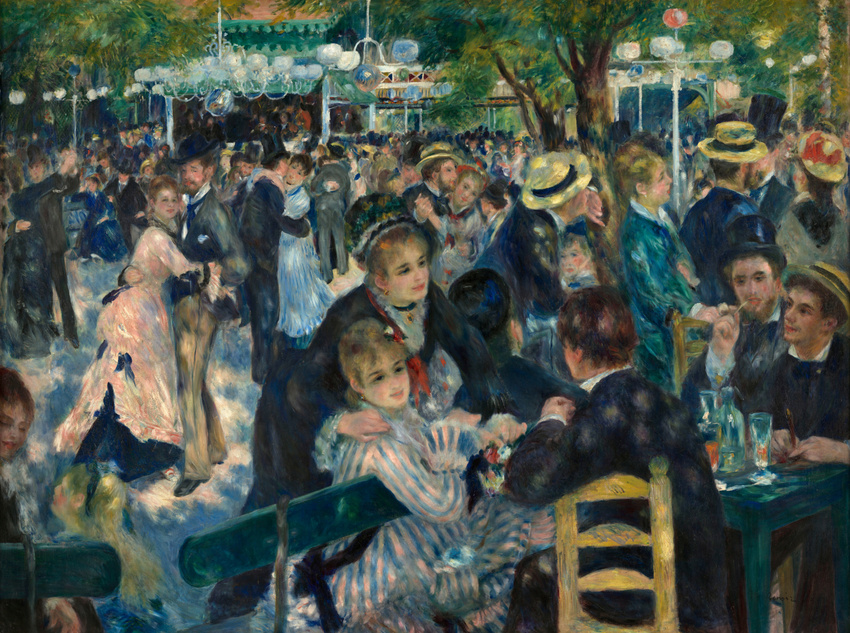
There is a moment in Pierre-Auguste Renoir’s Bal du moulin de la Galette — painted in 1876 and among the greatest works of early Impressionism — when you stop looking at the painting and start feeling it. The crowd moves, the light dapples, the conversations overlap. You are not standing in front of a canvas. You are standing at the edge of a Sunday afternoon in Montmartre, and everyone around you is alive.
That capacity to make joy feel like a place you can enter is what distinguishes Renoir from nearly every other painter of his generation. Manet, Degas, and Caillebotte were equally committed to painting modern life — the cafés, the boulevards, the parks and pleasure gardens of a rapidly changing Paris. But where they often brought a cool, observational distance to their subjects, Renoir brought warmth. His vision was, as he put it himself, simple and unambiguous: “A picture should be a pleasant thing, joyful and pretty.”
That sounds almost naive until you stand in front of the work and realize how difficult joy actually is to paint — how easily it tips into sentimentality, how rarely it arrives without sacrifice of seriousness. Renoir managed both. His joyful paintings are also, on close inspection, radical ones.
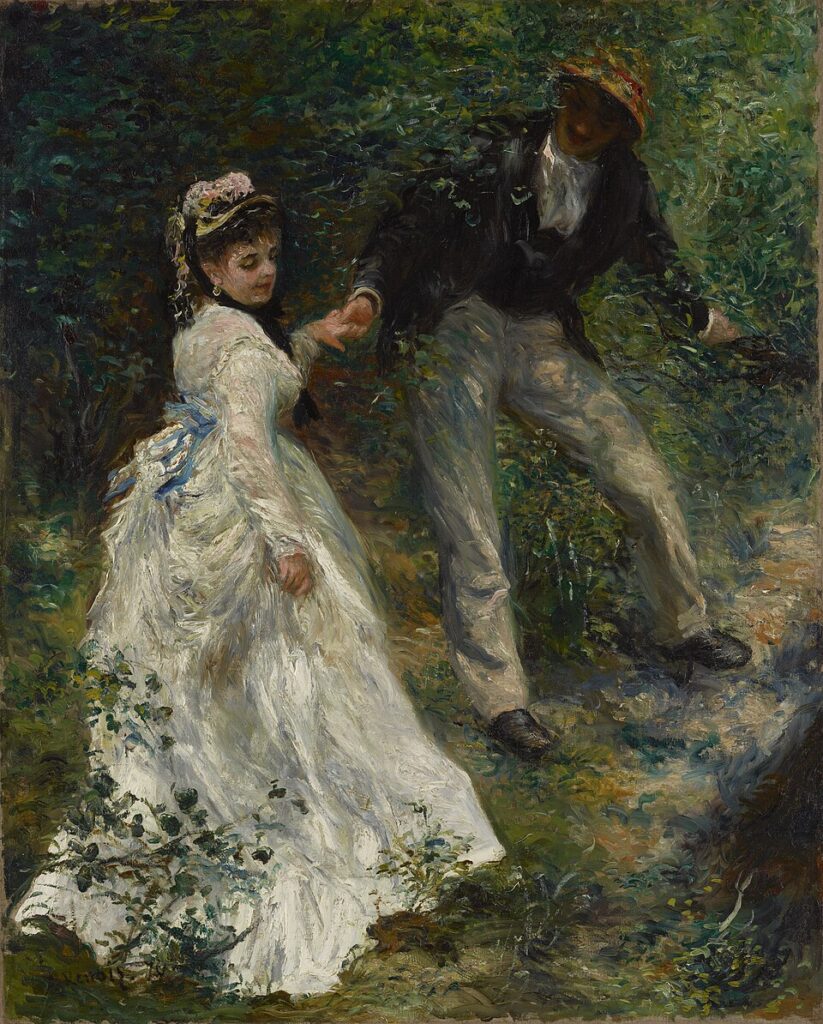
Pierre-Auguste Renoir (French, 1841 – 1919), “La Promenade,” 1870, oil on canvas, 32 × 25 1/2 in., The J. Paul Getty Museum, Los Angeles
La Promenade, painted in 1870 and now in the collection of the J. Paul Getty Museum, shows a middle-class couple caught in a fleeting moment in a sun-dappled park — not posed before a studio backdrop but immersed in nature, in light, in each other. Renoir had spent the previous summer painting outdoors with Claude Monet, who pushed him toward a lighter, more luminous palette, and the influence shows: the dappled light filtering through the foliage would become one of the defining signatures of his mature Impressionist work. It is a painting built from observation and feeling in equal measure, the glazes floating into each other, the scene hovering between documentation and dream.
By 1880, Renoir’s ambitions had grown to match his vision. Luncheon of the Boating Party — now one of the most beloved paintings in the collection of The Phillips Collection in Washington — gathers his friends around a table at a riverside restaurant outside Paris, freezing an afternoon of laughter, wine, and easy companionship into something monumental. Duncan Phillips, who acquired the painting in the 1920s, called it one of the greatest paintings in the world. Marjorie Phillips put it more simply: “They are every man, all people.” That universality — the sense that Renoir was not painting a specific afternoon but the idea of an afternoon, the feeling of belonging somewhere among people you love — is what keeps the painting alive nearly 150 years later.
What Renoir understood, and what his finest paintings still demonstrate, is that joy is not the absence of complexity. It is a choice made in full awareness of everything that joy leaves out — and a declaration, made in paint, that beauty and human connection are worth celebrating anyway.
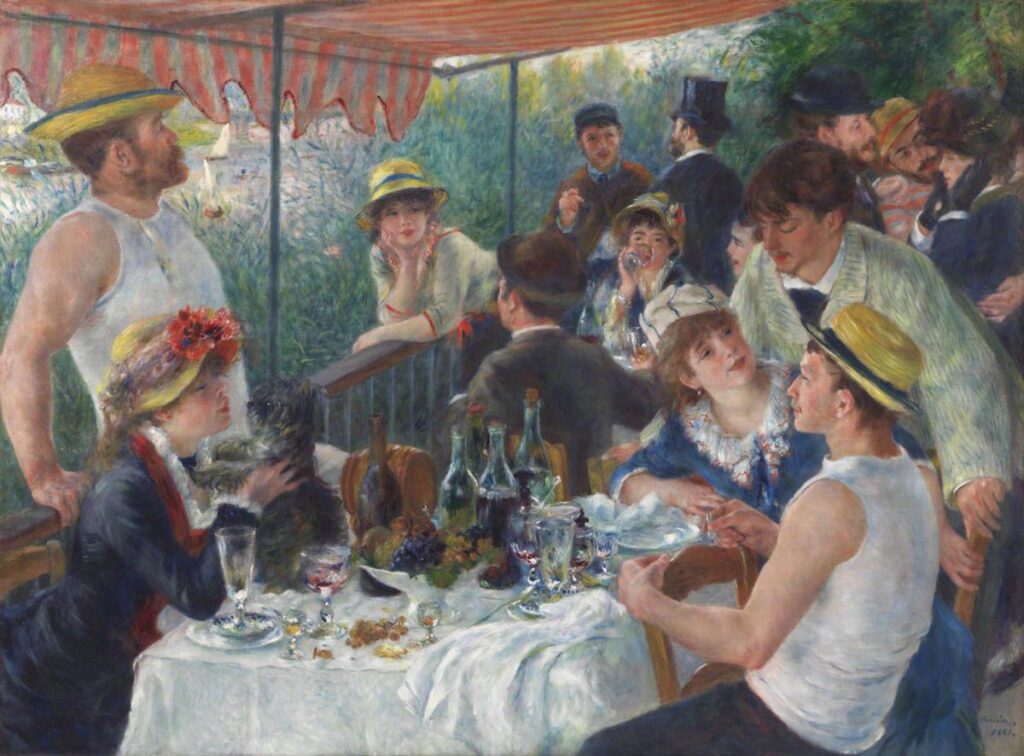
Pierre-Auguste Renoir (French, 1841 – 1919), “Luncheon of the Boating Party, (between 1880 and 1881), oil on canvas, 51 1/4 x 69 1/8 in., The Phillips Collection
Renoir began as a porcelain painter, taught himself oil painting through relentless practice, and spent years studying the masters before he found his own voice — proof that the path to joyful, confident painting is built one lesson at a time. If you’re ready to start that journey yourself, the brand new Oil Painting Boot Camp is designed to take you from the very beginning — what to buy, how to start, and how to build a painting step by step — with the same fundamental approach that has underpinned great painting since Renoir’s day.
A major exhibition of Renoir’s work — Renoir and Love: A Joyful Modernity — is on view at the Musée d’Orsay in Paris through July 19, 2026.