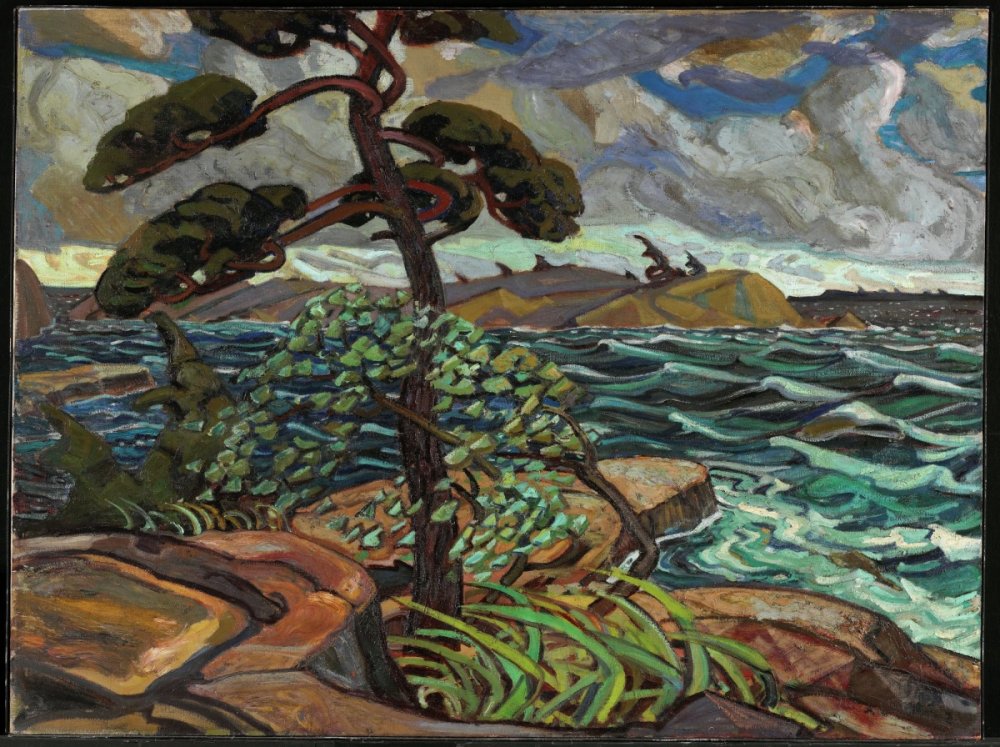
In 1921, Arthur Lismer stood on the rocky shore of Georgian Bay and watched a storm bend a lone pine nearly sideways against the wind. The result, A September Gale, Georgian Bay, is one of Canadian art’s most recognizable images: a wind-thrashed tree clinging to windswept rock, set against churning water and scudding clouds. Lismer called it a “nature symphony,” and the painting’s heavy, sculptural brushwork — in the waves, the clouds, the twisted trunk — reads almost like a physical record of the storm’s force. The composition is also a deliberate nod to fellow painter Tom Thomson’s The West Wind, linking Lismer’s work to a shared visual language his circle was actively building.
That circle was the Group of Seven, a collective of Canadian landscape painters — including Lismer, Varley, A.Y. Jackson, Lawren Harris, and others — who formally organized in 1920, though their roots trace back further through work and friendships with Thomson, who died in 1917. United by a desire to capture the Canadian wilderness in a bold, distinctly national style rather than imitating European traditions, the group became central to how Canada pictured itself as a country — vast, rugged, and untamed.
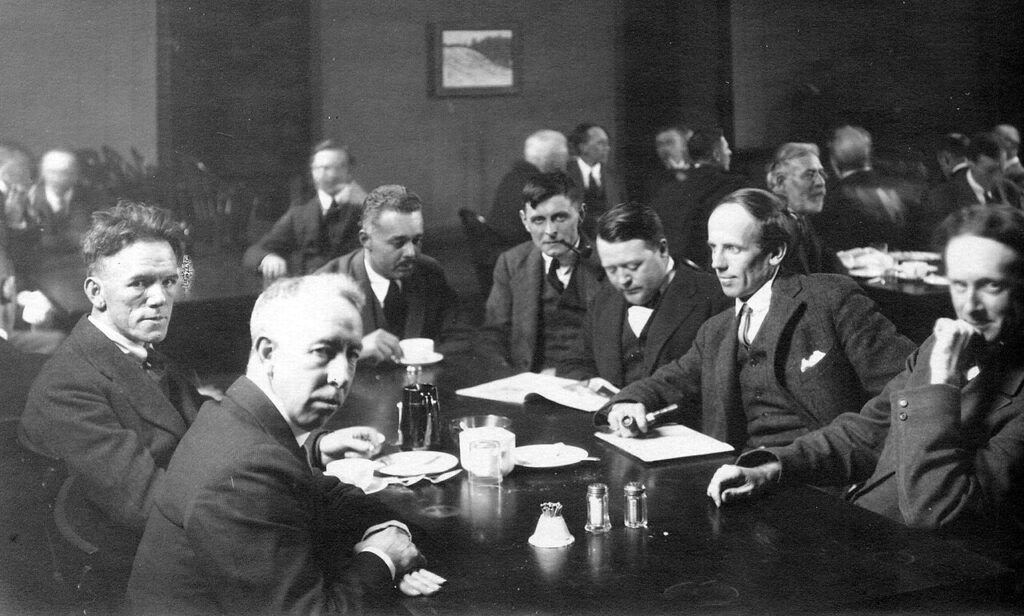
(l-r) Frederick Varley, A. Y. Jackson, Lawren Harris, Barker Fairley (not a member), Frank Johnston, Arthur Lismer, and J. E. H. MacDonald. Image ca. 1920
That framing, though, carries a well-documented problem. Scholars and Indigenous artists have long noted that the Group of Seven’s vision of “empty,” uninhabited wilderness erased the presence, history, and ongoing relationship of Indigenous peoples with those very lands — land that was, in reality, neither empty nor unclaimed. In recent years, scholars and institutions have begun re-examining and recontextualizing this legacy, acknowledging that the group’s nationalist landscape imagery contributed to a settler narrative that sidelined Indigenous sovereignty and presence.