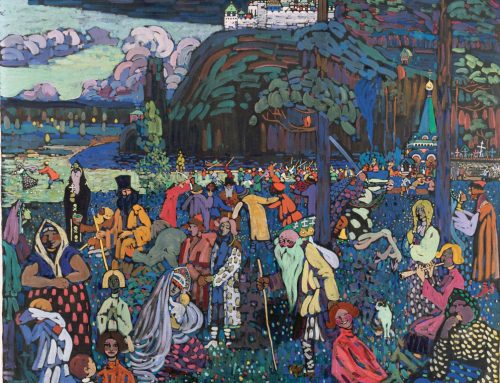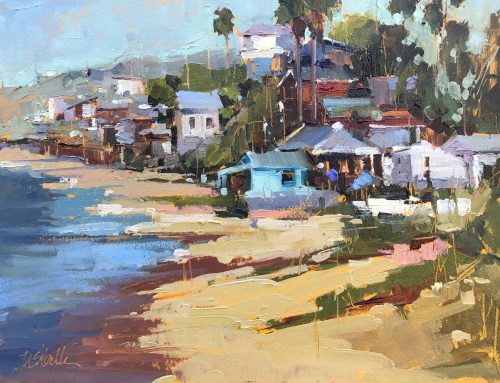
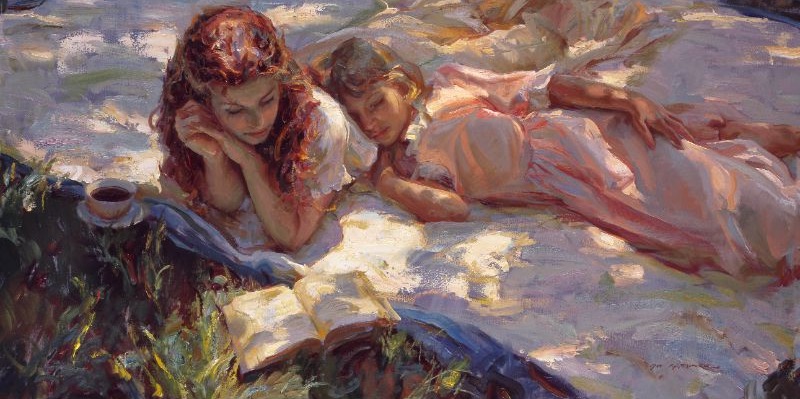
A Wisconsin native, Daniel Gerhartz often returns to the same local landscapes. “I’ve got a couple of brothers who are really big outdoorsmen, and they often tip me off to some pretty nice spots,” he says. “But I can just as easily pull an Andrew Wyeth, who painted endless compositions from one farmstead, and stay within a quarter mile of my front door.”
Once he chooses a location, Gerhartz plans carefully. “I used to do thumbnails with a big, fat, thick pencil and make a 2 x 3-inch sketch before every painting,” he says, acknowledging that “there’s a beauty to putting marks on paper.” Still, these days he’s more likely to take a picture of the scene with his phone, de-saturate it, and shrink it down to get a good look at the light and graphic set-up. “Whichever kind of study I do, I have to feel confident in the composition, in the light and dark balance, and in the sense there’s a significant structure underneath what I’m about to paint,” he explains. “I don’t want to waste my time with something that’s not powerful and effective.”
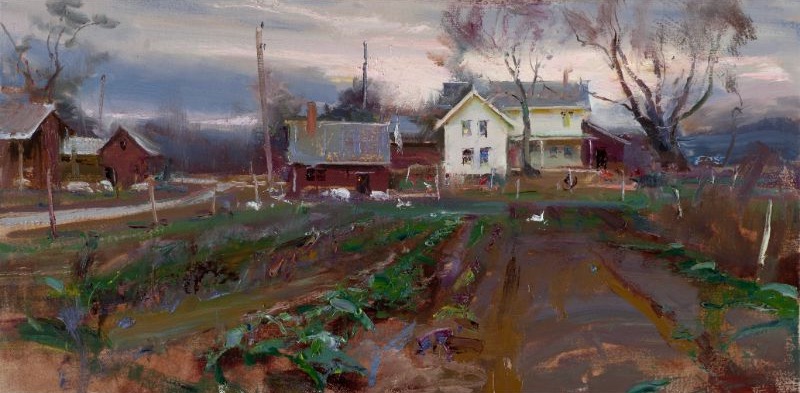
Maid Marion’s Organics (oil, 12 x 24 in., plein air)
ESTABLISHING A STRONG FOUNDATION
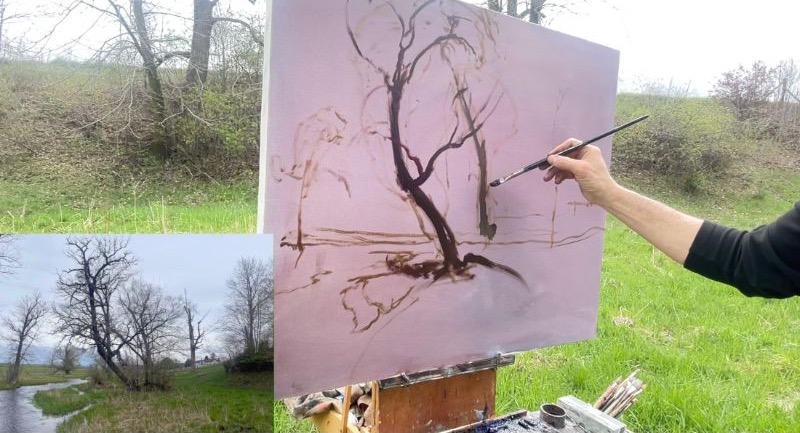
Gerhartz begins by staining his canvas with a thin wash of color — for the demonstration painting in this article, he chose a soft pink. “I decide on the underpainting color when I’m in the field,” he says. “It has to complement the scene in front of me.” In this case, the pink served as a counterpoint to the dominant greens, both activating and balancing the composition.
Next, he sketches in the principal elements of the scene with a rich red-brown. “I like to start with a deep, dark, warm color,” he says. “It gives the work a classic look when I begin adding opaque, cooler tones on top. It’s beautiful, but it also reflects how things actually appear.”
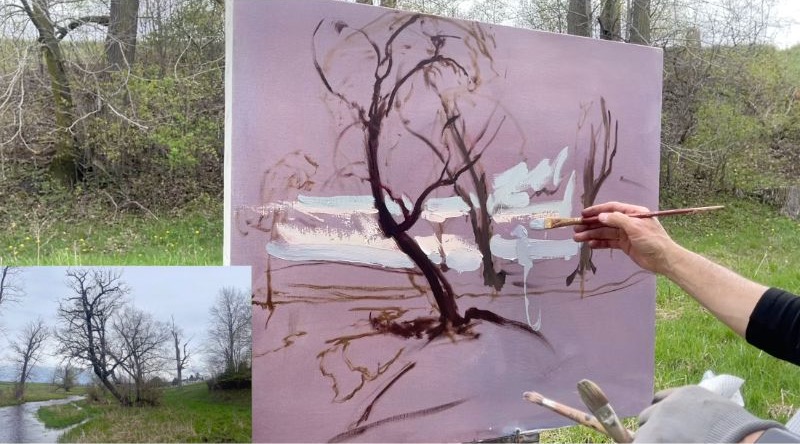
Making bold, confident marks, he indicates the extremes of the tonal range and secures the light envelope across the canvas. “It’s hugely important to get your lightest lights and darkest darks in right from the start,” he says. “Why? Because then you’ve got something to compare against as you work on the rest of the painting. Otherwise you’ll get lost, just floating around the middle.”
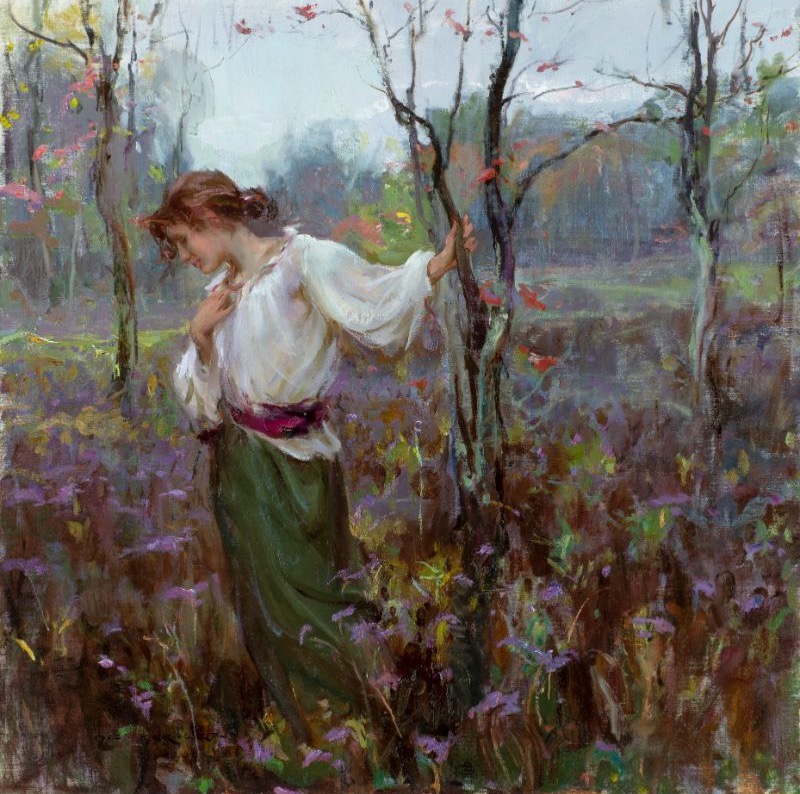
Michaelmas (oil, 30 x 30 in., plein air)
BALANCING BOLDNESS WITH RESTRAINT
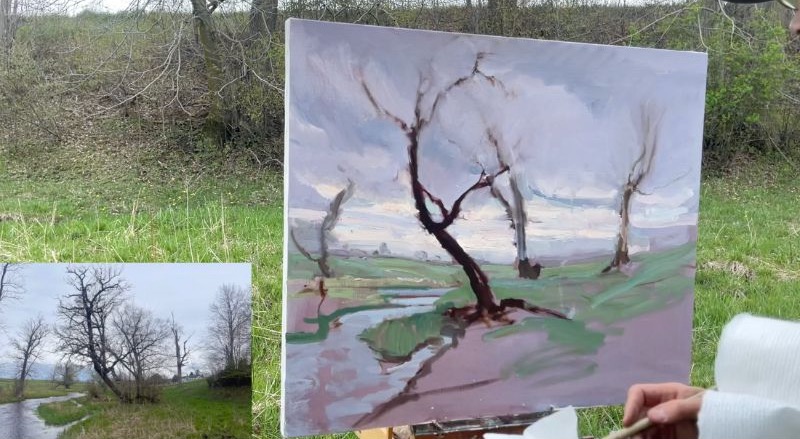
With the key elements and value range established, Gerhartz lays in broad passages of sky and land using a mix of warm and cool colors. By quickly covering the canvas with bold, energetic brushstrokes, he gives the painting its structure early on.
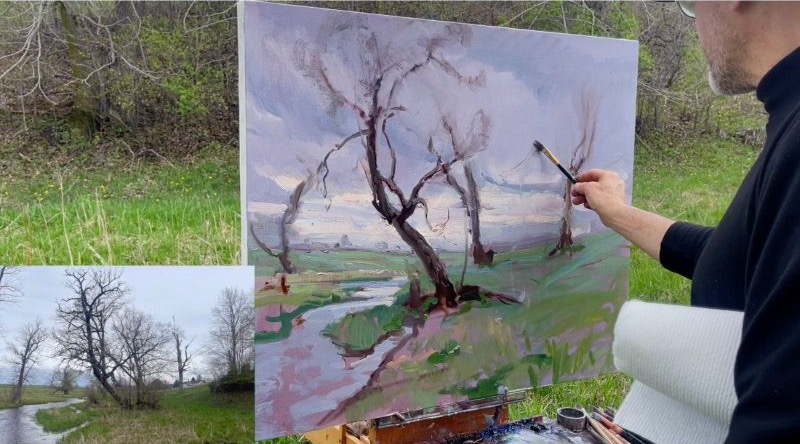
From there, he works back into these initial statements, enriching the color and suggesting texture and detail without losing the immediacy of his first marks. Sometimes this process continues on site; other times, he refines a painting back in the studio with the help of photographic reference.
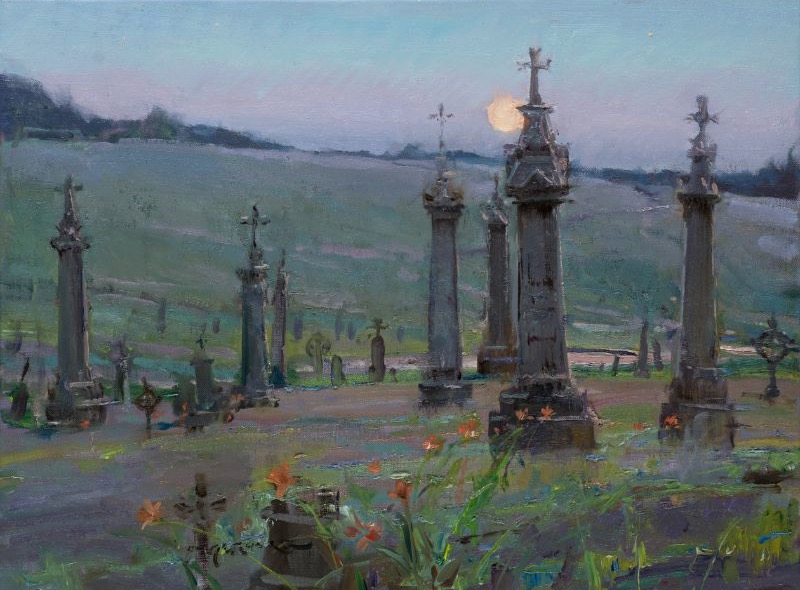
As Summer Fades (oil, 18 x 24 in., plein air)
“Often, I’ll go back out the next day if I need to finish a plein air work, especially when the location’s not far from my home,” says Gerhartz. Occasionally, however, life gets in the way, as was the case for this demo painting. “When I started the piece, the first greens were just beginning to pop up, but my daughter had a busy soccer schedule that week, so I couldn’t get back out there for a few days. By the time I did, the leaves had all come in and the grass was full and thick — it was a completely different scene. I had no choice but to finish it from photos.”
Regardless of whether this late-stage work takes place outdoors or in the studio, the artist’s brushwork retains a sense of vitality, giving his finished paintings the freshness and energy of an alla prima approach. This balance of boldness and refinement serves him well when tackling more challenging plein air subjects — scenes where direct observation alone may not be enough.
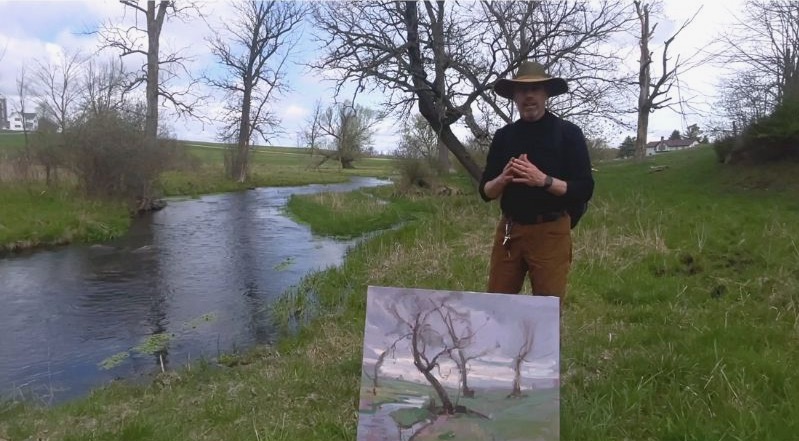
STEP-BY-STEP PAINTING DEMONSTRATION:
Capturing Light and Atmosphere
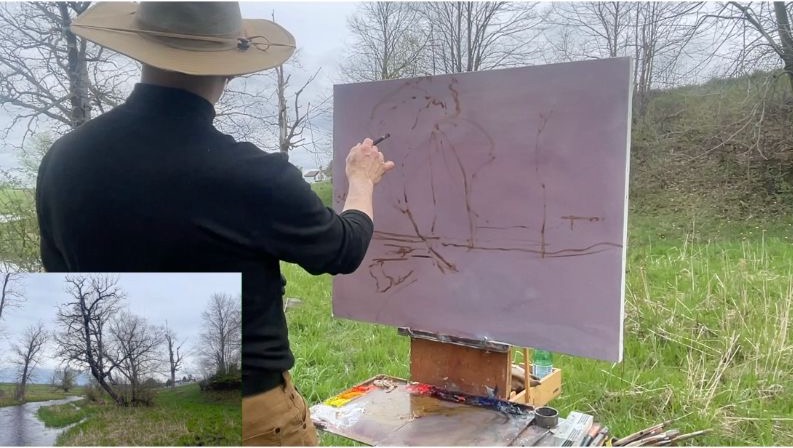
Step 1
Painting not far from his home in early spring, Gerhartz tones his canvas — alkyd-primed linen — with a wash of warm pink before sketching in the major elements using a warm red-brown.
Step 2
As he develops the drawing, the artist modulates the dark brown, making it gradually lighter and cooler as the image recedes. He is already establishing the overall value range at this stage.
Step 3
Using Rembrandt oils and a variety of hog-hair bristle brushes, he begins to define the sky, including areas of pure white. His brushwork is swift and direct.
Step 4
A combination of blues and violet-grays fill much of the sky, while the grassy areas are painted with a wide range of warm and cool greens. The tone and color gradient of the creek are also established so that nearly the entire painting is up and running at this point and the light envelope is locked in cross the canvas.
 Step 5
The artist then begins to work back into his initial statements, augmenting the color and suggesting greater texture and detail, all while keeping the brushwork energetic and fresh.
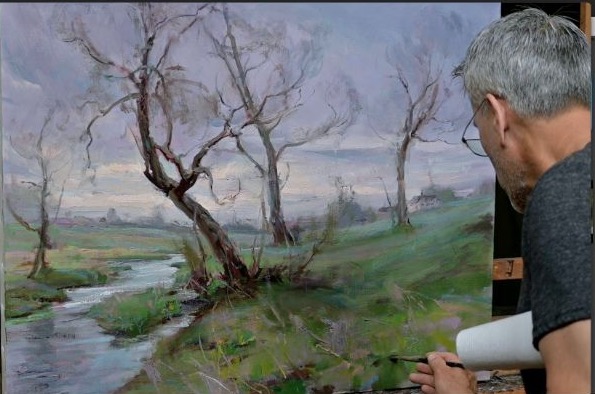
Step 6
Back in the studio, Gerhartz continues to refine the painting, adding a building in the background and layering into every element to enrich color and reinforce the variety of detail. He applies cooler values to the distant greens, indicating the reflection of the cool blues and grays of the sky, while in the foreground, the grasses become more lush and vibrant.