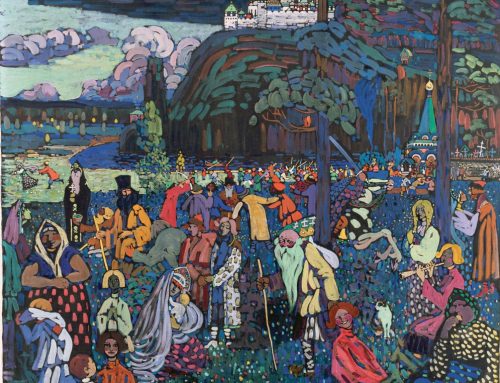
From moonlit rivers to fireworks to polar auroras, these four paintings show how artists make darkness glow.
Halloween is the season for lingering after dark, and painters were drawn to the night long before the holiday existed.
MOONLIGHT, DUTCH STYLE
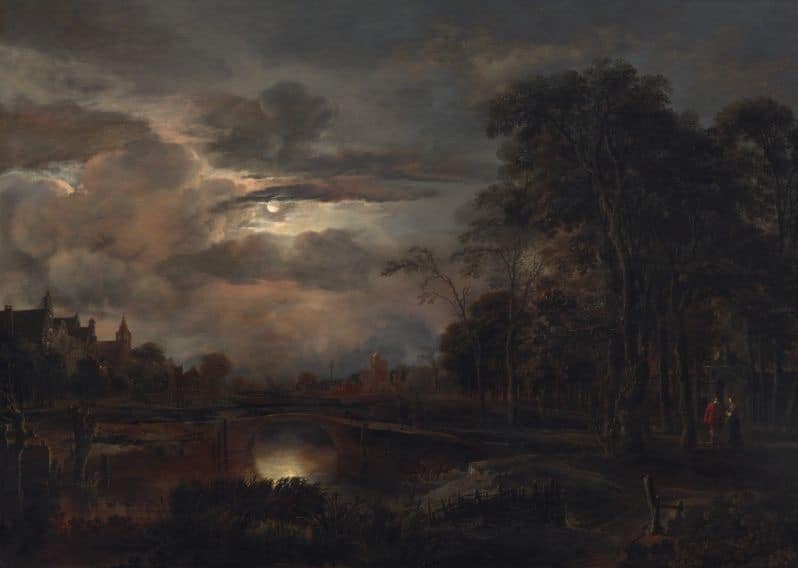
Aert van der Neer, Moonlit Landscape with Bridge. probably 1648/1650, oil on panel, 30 7/8 x 43 3/8 in., National Gallery of Art, Patrons’ Permanent Fund
“Aert van der Neer initially painted realistic tonal landscapes and winter scenes, but by the late 1640s, he developed his own specialty of nocturnes, or night scenes. These mysteriously dark, moonlit pictures established him as an innovative and important landscape painter. Nevertheless, from about 1659 he took on a second, rather short-lived career as a tavern keeper in Amsterdam. He went bankrupt in 1662 and at the time of his death in 1677 was quite heavily in debt.
“Van der Neer used his consummate technical skills to create this nocturne’s radiance by applying multiple layers of translucent and opaque paint. Here, the luminous clouds have parted to reveal a full moon over a tranquil stream. The moonlight reflects off the water that separates the town at left from the village and the country estate with its ornate gate at right. The light glints off window panes, shines upon a fashionable couple in conversation by the gate, and provides safe passage for the people crossing the stone bridge.” [National Gallery of Art]
RYDER’S GLOWING SEA
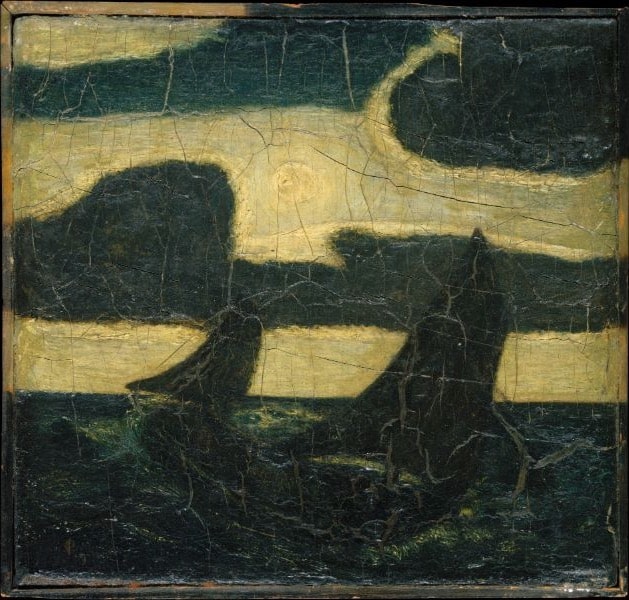
Albert Pinkham Ryder, Moonlight Marine, 1870–90, oil and possibly wax on wood panel. The Metropolitan Museum of Art, Samuel D. Lee Fund, 1934.
“Raised in the whaling port of New Bedford, Massachusetts, Ryder continued to seek contact with the ocean after he moved to New York in 1870. A sea captain recalled his friend Ryder’s visits to his ship when it was in port: ‘On moonlight nights he would go on to the bridge and watch the numerous craft passing up and down the Hudson, getting ‘moonlight effects.’ I have known him to walk down to the Battery at midnight, and just sit there studying the effect of clouds passing over the moon.’ Ryder’s habit of applying pigment in many thick layers has caused changes in the contours of certain forms — clouds, sails, and the boat’s hull — since this painting was completed.” [The Metropolitan Museum of Art]
WHISTLER’S FIREWORKS
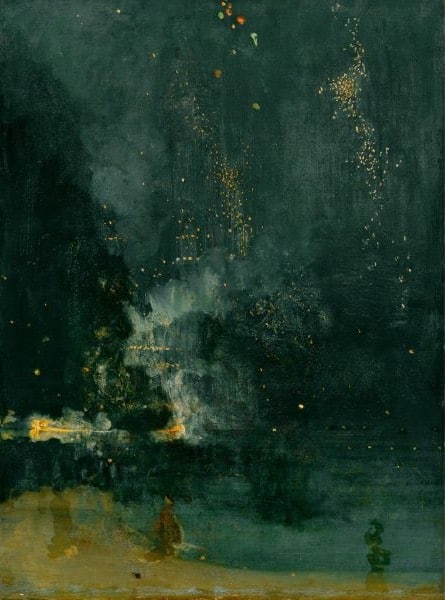
James Abbott McNeill Whistler, Nocturne in Black and Gold, the Falling Rocket, 1875, oil on panel. Detroit Institute of Arts, Gift of Dexter M. Ferry, Jr.
“This work, which is a depiction of a fireworks display in London’s Cremorne Gardens, is probably Whistler’s most infamous painting. It was the central issue of a libel suit that involved the art critic John Ruskin and the artist. Ruskin had publicly slandered the work by making the statement, ‘I have seen, and heard, much of cockney impudence before now; but never expected to hear a coxcomb ask two hundred guineas for flinging a pot of paint in the public’s face.’ Whistler won the libel suit; however, he was awarded only the token damages of one farthing. This is one of Whistler’s many ‘Nocturnes, which are characterized by a moody atmosphere, a subtle palette, and overall tonalist qualities.” [Detroit Institute of Arts]
Get InsideART in your inbox.
Artist features, painting tips, and event news, delivered free. SIGN ME UP →
A SKY THAT MEANS SOMETHING
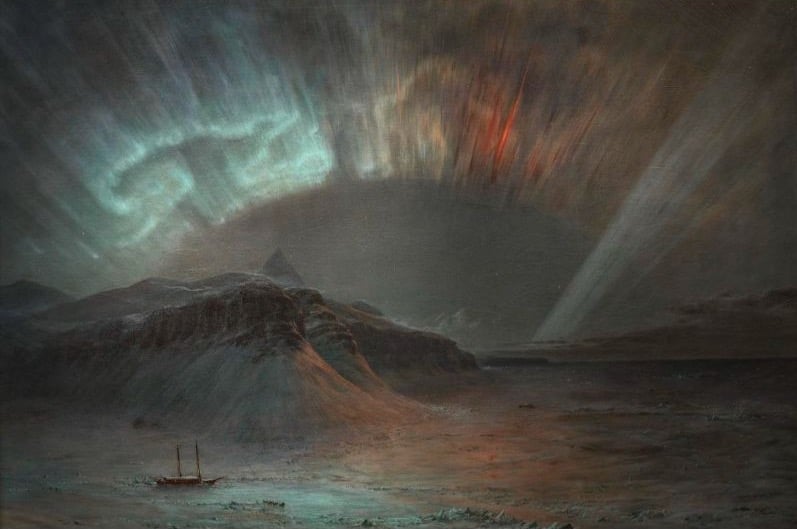
Frederic Edwin Church’s Aurora Borealis (at top) puts the spooky sky center stage. Explorer Isaac Israel Hayes’s ship sits frozen in pack ice under a dark Arctic sky, with auroras overhead and a dogsled suggesting hope of rescue. The canvas is nearly seven feet wide. Viewers at the time read the auroras as a divine omen tied to the Union cause and the moral stakes of the war.
If you’d like to try a night scene of your own this Halloween, these painters offer a few cues. Keep the palette restrained, as Whistler did. Build your darks in layers, as Ryder did. And let one bright source, whether a moon, a rocket, or an aurora, command the sky.