A remarkable body of never-exhibited abstract watercolors by Andrew Wyeth has revealed that the methods of 1950s abstract expressionism lay at the heart of Andrew Wyeth’s meticulous realism all along. The revelation has surprised painters and curators alike who thought they knew the full story of this iconic American artist’s creative life.
In the strange twists and turns of art appreciation and criticism, Wyeth’s paintings have been alternately celebrated and condemned for decades. Wyeth embraced classical realism despite his age’s celebration of experimentation and abstraction. Now, the new scholarship is sweeping all that aside.
out of the corner of your eye,” Wyeth said. On numerous occasions he actually called himself an abstract artist and was known to praise Jackson Pollock, Willem de Kooning, Hans Hoffman, and especially Franz Kline,” said a reviewer on Forbes.com, “a book of whose Wyeth kept in his studio until his death. But the art world didn’t want to hear it. In the 20th century, institutions, scholars, and collectors demanded categorization and labeled Wyeth a realist.”
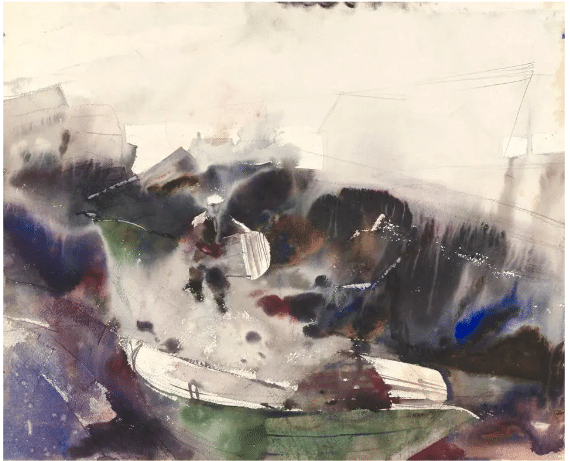
More than 60 abstract watercolors comprised the first exhibition to focus on Wyeth’s interest in the abstract art of his contemporaries and the roots of his own practice in gestural, abstract methods.
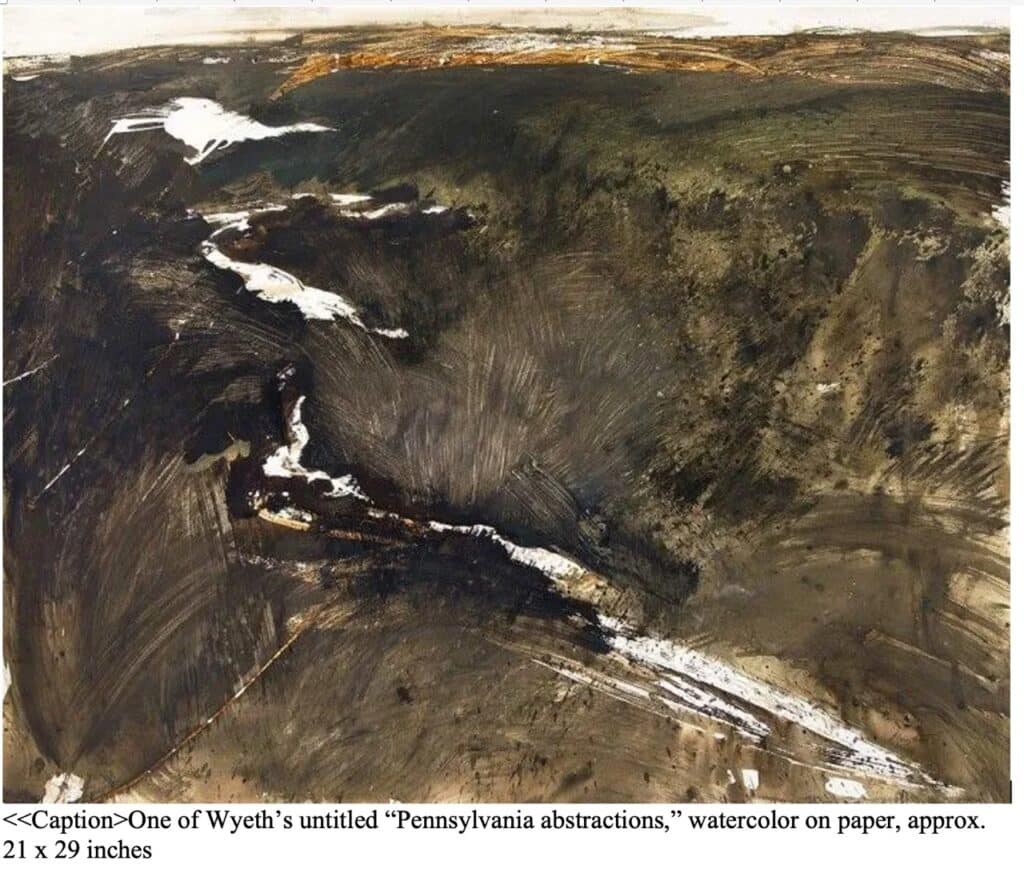
Wyeth’s “abstract flash” recalls Henri Matisse’s famous “bolt of lightning.” Matisse said that, for the artist, “the essential thing is to spring forth, to express the bolt of lightning once senses upon contact with a thing. The function of the artist is not to translate an observation but to express the shock of the object on his nature,” he said, “the shock, with the original reaction.”
The abstract watercolors demonstrate that Wyeth both felt and acted directly from that “shock” of contact. “From this material,” William L. Coleman, Wyeth Foundation Curator and Director of the Andrew & Betsy Wyeth Study Center at the Brandywine Museum of Art, told Forbes.com, “a new understanding of an iconic artist emerges: an American original who was actively engaged with new currents in the art world, used a startlingly free and fierce method when it suited his goals, and for whom a visionary transformation of an observed subject into pure form and gesture was a fundamental aspect of his practice.”
It’s more than just “Wyeth used underlying abstraction” as a technique (as did John Singer Sargent and every other successful realist of the 20th century). That much artists have long agreed upon. It’s how completely Wyeth embraced the methods of abstract expressionism not as a structural or compositional tool but as a means of directly transmitting/channeling the raw essence of felt, poetic vision through the material.
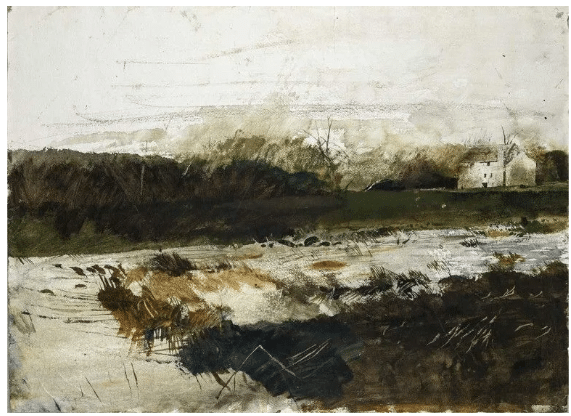
Another of Wyeth’s untitled “Pennsylvania abstractions,” watercolor on paper, approx. 21 x 29 inches
There’s also an echo of Robert Henri’s conviction that “the most vital things in the look of a face or of a landscape endure for only a moment.” (The Art Spirit, p. 27) Wyeth appears to have used the unobstructed conduit of abstract expressionism to visualize his apprehension of his subject in all its immediacy. Later he would compose larger paintings resonant with original impulse, thereby expressing what Henri called, “the most important things in life” via the look and mood of a young or a weathered face, a shuttered barn, an abandoned dory, or a windswept fallow field.
To serious admirers, it’s always been clear that Wyeth created from deeply felt flashes of insight into nature and humanity at the margins of life, death, and time. We now know he purposely combined gestural abstraction and realism to create work that transcended technique or style altogether – though few if any of the exhibitions’ prominent reviewers, still thinking in terms of this or that style or art-world categorization, have explicitly said so.
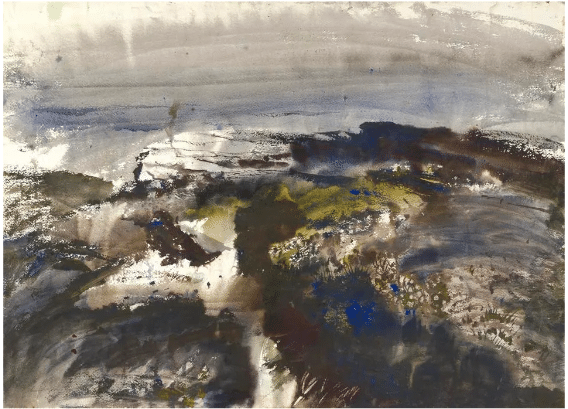
Andrew Wyeth, ‘Untitled,’ (rocky coast) 1947. Watercolor on paper, 21 3/8 x 29 1/2 in. © 2024 Wyeth Foundation for American, Art/Artists Rights Society (ARS), NY
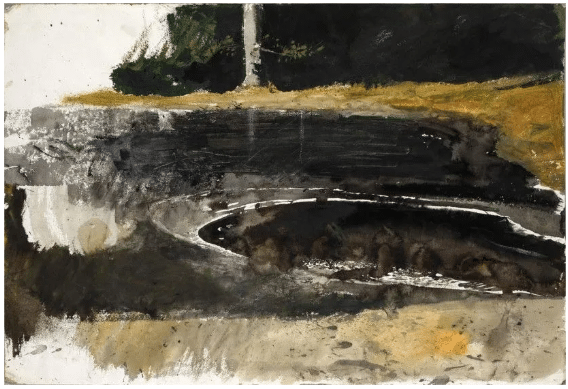
Another of Wyeth’s untitled “Pennsylvania abstractions,” watercolor on paper, approx. 18 x 28 inches
“This body of work presents a collective portrait of an artist who was open to new ideas others found challenging and for whom abstraction was a legitimate and vital direction alongside the realism for which he is better known,” the curators say.
Recently wrapped up at the Farnsworth Museum in Maine, “Abstract Flash – Unseen Wyeth” was the second half of a two-part exhibition based on Wyeth’s “equally divided career” between summers on the coast of Maine and the rest of the year living in Chadds Ford, Pennsylvania. Part one of “Abstract Flash,” centering on Wyeth’s Pennsylvania abstractions, ran in the spring of 2024, while the selection of Maine paintings closed in September. The exhibitions at each location included highlights of Wyeth’s realist work in egg tempera to show the results of the abstract beginnings.

Andrew Wyeth, ‘Untitled,’ (Maine coast) 1950. Watercolor on paper, 21 ½ x 29 3/8 in. © 2024 Wyeth Foundation for American, Art/Artists Rights Society (ARS), NY