
Five words: Keep looking, thinking, and painting.
Like a handful of magic beans, that simple sentence contains the entire history, philosophy, and technique of artmaking in embryo.
Looking (and really seeing), thinking (about painting, yes, but also about life, the universe and everything!), and painting – learning by doing, making paintings in classes, workshops, and outside of them on your own, hundreds of them, until miles of canvas stretch behind you. That’s what artists are doing nearly all the time, whether they have a day job or a full-time studio practice, whether physically making art or only in stolen moments of the eye, heart, and mind.
An artist friend, something of a mentor, said it – probably as a way of wiggling out of having to deliver some well-deserved negative criticism – but the words ring true, and they’ve kept ringing in my ears for many years now.
Some 60 years earlier still, the great seascape painter, Frederick Judd Waugh (1861-1940), said essentially the same exact thing in his analysis of his process of painting. It comes down, he said, to three things: “observation, concentration, then application.”
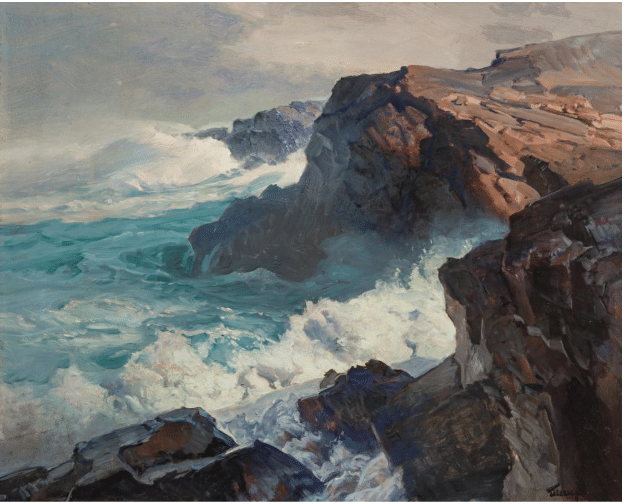
Frederick Judd Waugh (1861-1940), Seascape, oil on Masonite, 24 x 30 inches
Education aside (formal learning is built into all three concepts, if you think about it), what else is there? There are many meanings for these three words, so here are just a few:
- Looking can mean seeing like a painter – seeing what’s really there in the motif or the model, not what you think is there. It can also mean seeing big, with an eye not just for simple shapes but for meaning and beauty as well. But it also means looking at paintings both contemporary and historical, bad, good, and especially great, all the time. And it means:
- Thinking (about what you’re seeing and thinking about painting in general – what it is, why we do it, what it’s meant to civilization since the beginning, and how doing it, you might in your own small way help make the world a slightly better place. But it also means thinking about your subject and your painting, before, during, and after, and, of course,
- Painting, because moving that brush around is the only way you’ll synthesize what you’ve learned, seen, and discovered.
Charles Herbert Woodbury (1864-1940) was Waugh’s contemporary and (aside from Winslow Homer) his rival for “best painter of the ocean” of the day. Woodbury chimed in with, “a picture is a thought or feeling expressed in terms of Nature. The method is a matter of the moment …. Clear sight, clear thought, clear expression; the thought should depend on the sight, and the expression on the thought.”
Sight, thought, and expression = looking, thinking, and painting.
An aside: Look, I know I used a “clickbait” headline designed to get attention, but it was half in jest, and it really is the truth. Take those five words to heart and “do these three simple things” and honestly you can’t fail. However, the irony is that those “three simple things” are far from simple and becoming an artist is a lifetime’s calling. It’s nowhere near the” quick fix” such flashy headlines promise.
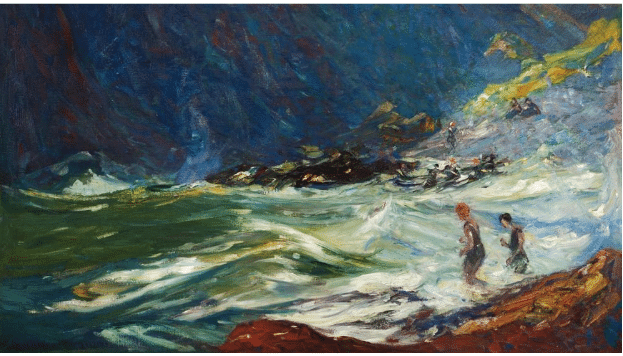
Charles Herbert Woodbury, The Blue Cliff, oil on canvas, approx. 14 x 30 in.
‘Paint It the Way it Seems’
If there’s one “most important thing” that Woodbury said, it’s the following. Charlie W. ran a super-popular outdoor painting school in Ogunquit, Maine for the first 40 years of the twentieth century. He taught literally thousands of painters what was then a radical idea: don’t paint it the way it looks, paint it the way it seems.
His simple advice packs a punch. It’s not just how does it look? – it’s how does it look to you. Woodbury’s hitting the ball into the artist’s court. He’s implying that good artists access feeling, not just seeing, in their process. He’s daring his students to trust themselves, to get to know who they are, to know what they see and like, what they don’t, and to try to get some of themselves into their paintings. He was perhaps the first teacher to formalize a practical method of emphasizing feeling as well as teaching academic skills in plain-air painting.
Speaking of plein-air painting, the Big Plein Air Convention is coming up fast. It’s not too late to snag tickets for the 12th annual Plein Air Convention & Expo in beautiful Lake Tahoe May 19-22, but there are under 150 tickets left and they’re going fast. If you want jump in, register here!
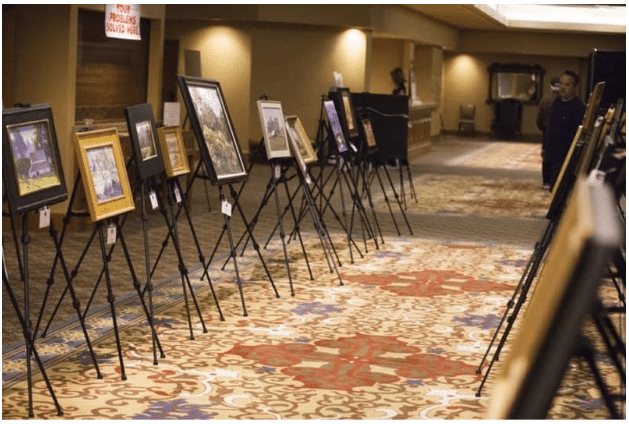
Participants’ plein air paintings are sold right off their easels at last year’s PACE.
If you’d rather stay home and learn, there are several very thorough instructional videos out there on painting the ocean. Painting is a wild and surprising adventure. Whatever, you do, keep looking, thinking, and painting.
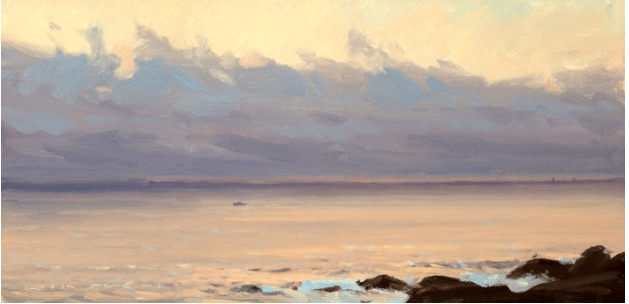
Lisa Egeli, Opportunity, oil, 8 x 16 in.
Lisa Egeli is a painter who clearly knows how to bring the viewer into her work. She also know how to bring the outside into her studio so she has a nearly endless amount of time to work on a painting until she gets it just right. For her, getting it right means also managing to let the heart and soul shine through to deeply connect with viewers.
Lisa Egeli’s teaching video, Painting the Sea, is her “full disclosure” how-to workshop-on-demand. Check it out here.
All On a Summer’s Day
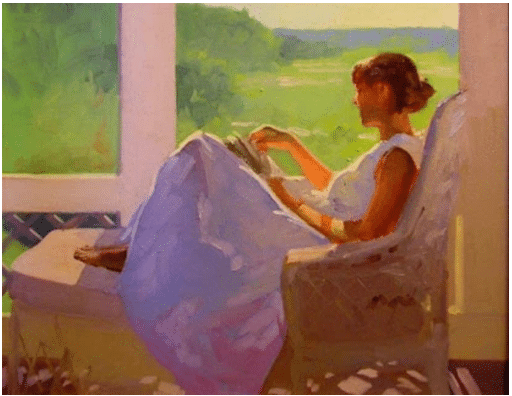
As spring flips hot one day and cold the next, feel the warmth of the sun on the porch on a summer day in Maine, an oil that radiates warmth and feeling, by Dennis Perrin, Master Painter (1950 – 2021)

Dennis Perrin, Deep Blue, oil on canvas, 12 x 16 in
Perrin’s painting, “Deep Blue,” (above) is available at Todd Bonita Gallery.