
On August 25, 1758, a Prussian soldier, a young officer who’d grown up a nobleman yet proudly chose the life of patriotism and battle, squinted through the dusty, late August sun beating down on his uniform’s greatcoat.
The Russian army he faced outmanned his own by more than 1,000 infantrymen and had twice the number of armed men on horseback. Yet, history records that on that day King Frederick’s Prussians narrowly defeated the Russian forces at Zorndorf (now Sarbinowo, Poland), leaving 21,000 Russians dead. Though almost too close to call, it was another victory for Prussia’s class of military noblemen who notched numerous unlikely wins against Europe’s encroaching great powers, successfully fighting to establish a united Germany, despite having drastically fewer resources and manpower.
The unique color of that young man’s uniform that day at Zorndorf came from a newly created pigment, accidentally discovered in 1705, that would come to be known as Prussian Blue. It owes its existence to chance and a down-and-out alchemist who parlayed an error into a fortune.
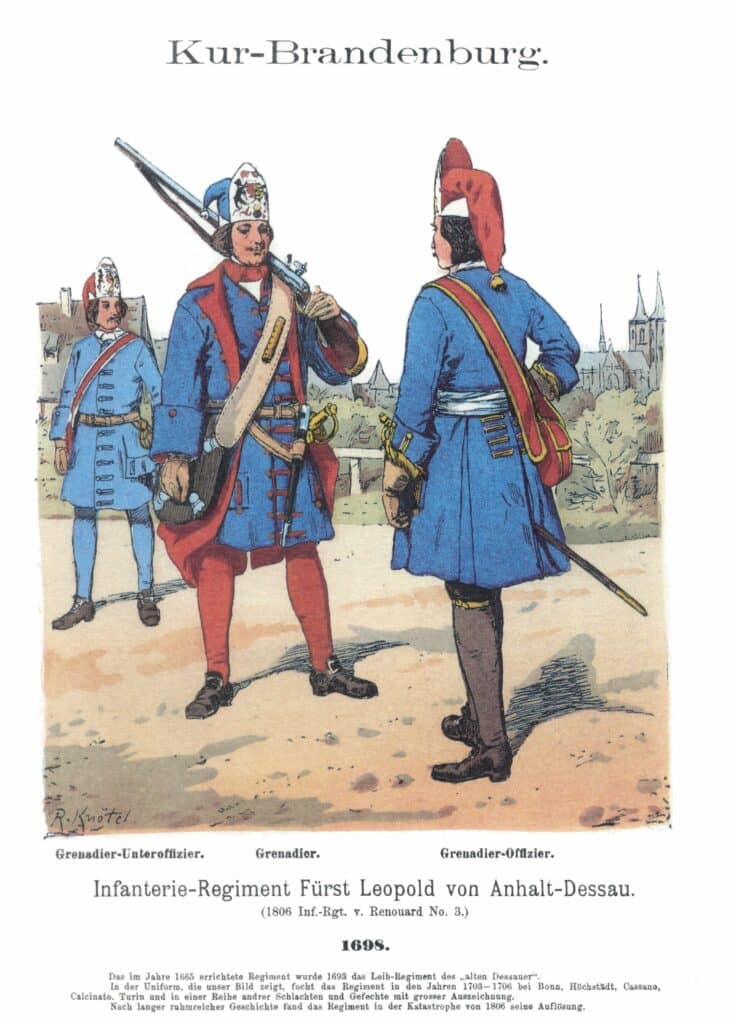
“I say, Sir, that jacket of yours is rather a lovely shade of blue….” “Thank you, Sir. And may I return the compliment to you, Sir!”
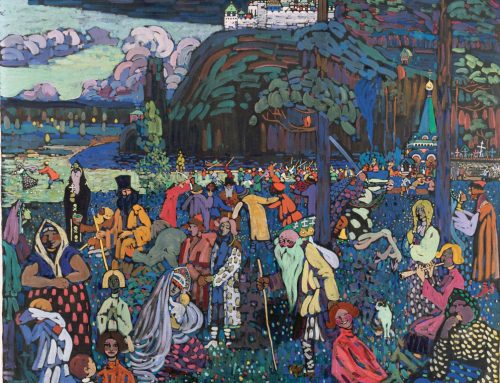
It was the first artificial blue pigment, and over the years it acquired several other “blue” names, including Berlin, Parisian, and Turnbull’s blue. Before the 18th century, blue was a rarity in painting. Only a single mine in Afghanistan produced lapis lazuli, the semi-precious mineral ground to make the Ultramarine blue (so named because it literally came, via trade ships, from beyond the sea). Because Ultramarine was so expensive to make and in such short supply, until Prussian came along, blue was almost exclusively reserved for religious paintings, such as Michelangelo’s ceiling frescoes at the Vatican. There were other blues, including indigo and azurite, but they were all greenish, weak, or tended to fade.

Jean_Auguste_Dominique_Ingres,_La_Grande_Odalisque,_1814
It was discovered sometime between 1704 and 1706 in a dimly lit paint-grinder’s workshop in Berlin. Jacob Diesbach was mixing up some cochineal red (created from crushed beetles) with iron sulfate when he realized he’d run out of a crucial ingredient – potash. He dashed out to the nearest supplier, a disreputable alchemist named Johann Konrad Dippel, who sold him a batch that turned his mixture first pink, then purple, and finally a deep blue. Diesbach went back to the man and demanded to know what was going on. They realized that the potash he’d supplied had reacted with impurities in the iron sulfate and somehow produced the compound ferrocyanide, which is still the main chemical component in the paint.

Japanese woodblock printing artists such as Hokusai fell in love with it at once.
Despite the “cyanide” part of the name, Prussian blue is not toxic. (By the way, phthalocyanine blue, or “phthalo blue” for short, is very similar but made a bit differently, using copper instead of iron sulfate and happens to be a bit more transparent too). A few decades later, a photographer-chemist figured out how to use “cyan” in combination with the new invention of photo-sensitive paper and the first blueprints were born. Both Prussian and phthalocyanine are considered “transparent” pigments because their crystalline nature allows light to bounce through instead of off the pigment’s surface – unlike the solids in a tube of the more opaque Ultramarine.
Prussian blue plays very well with white, and it’s got tremendous tinting strength – as well as an annoying ability to somehow get itself everywhere and anywhere (think cheeks, sleeves, tabletops, ears….), which is unfortunate – because its “staining” quality makes it one of the harder pigments to clean up.

Lorette with Coffee, by Henri Matisse
Have you had your Sunday Coffee with Eric Rhoads? Check out his inspiring weekly blog, where he talks about art and life, at CoffeeWithEric.com.