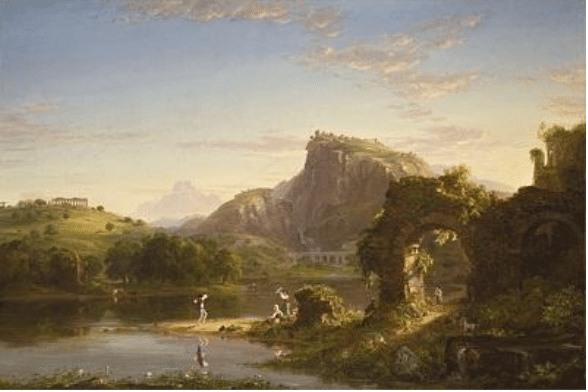
When America’s first great landscape painter, Thomas Cole, began painting the trees, rivers and mountains of the northeastern U.S. in the 1830s, he was aiming for a union of the sublime and the beautiful (or “picturesque” in the parlance of his times). The latter, purely “beautiful” genre, is often referred to as the “Pastoral” mode.
The word “pastoral” is related to “pasture.” The prototype was a classical ideal where in some vanished (imaginary) Golden Age, celebratory dancers, and carefree shepherds revel, wander, and lounge in a harmony of nature and humanity.
The Pastoral mode’s primary originators were two French painters living in Rome in the 17th century. Claude Lorrain (1604/5?–1682, generally referred to as “Claude”) painted the prototypical Pastoral landscape, while his contemporary Nicolas Poussin (1594-1665), gave more importance to the figures within it.
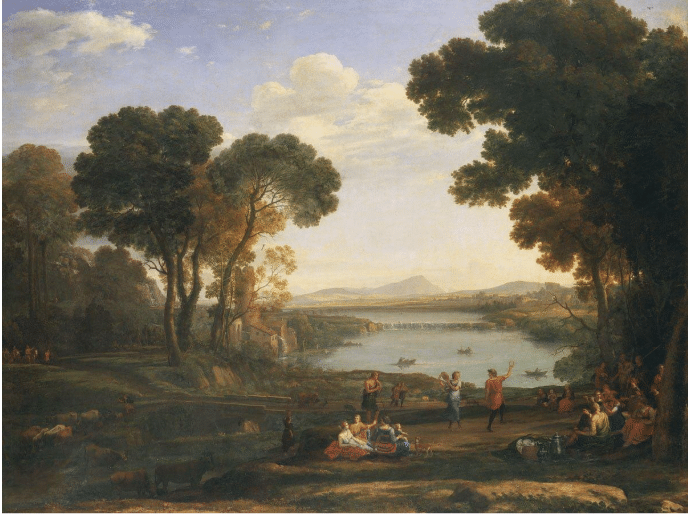
Claude Lorrain, Landscape with dancing figures
(the Marriage of Isaac and Rebecca), 1647
Many Hudson River School artists who followed Cole leaned into the Pastoral mode that Claude exemplified. In their paintings, created 200 years later (during the mid to late 1800s), calm and beauty reign over softly lit, atmospheric, and at times “enhanced,” if not half-imaginary, landscapes.
These paintings picture the young American nation as a place of Eden-like peace and prosperity, where, To borrow a phrase from Wordsworth, “God’s in His Heaven and all’s right with the world.” (From the settlers’ point of view anyway).
The result is a world in which nature, animals, men, and women exist together with a dreamy, timeless harmony, all aglow with universal blessing.
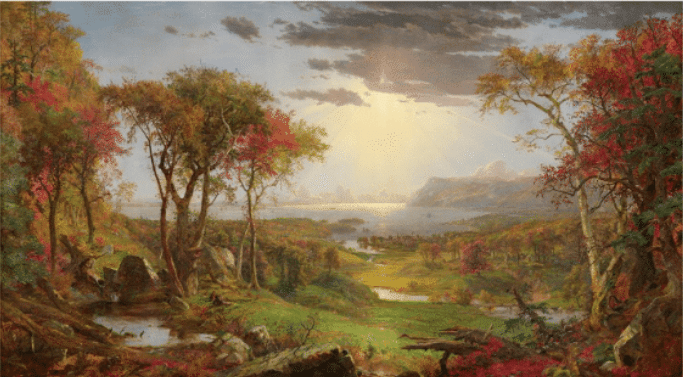
Jasper F. Cropsey, “Autumn on the Hudson River – 1860.” Oil on canvas,
59 3/4 x 108 1/4 in. National Gallery, Washington D.C. (painted from memory in his London studio)
The Pastoral landscape followed the Claudian formula for 200 years, right up to the end of the Hudson River School. From an “art history for artists” perspective, the blueprint went like this, from front to back:
- foreground in focus, framed by lush, oversized trees and detailed perhaps with passive figures and tame or domestic animals in imaginary scenes worthy of classical literature, often including Romanticized “pagan” (Greek and Roman) ruins,
- middle ground in soft focus, with a tranquil body of water with pristine banks,
- background with very distant mountains dissolving in the haze of atmospheric perspective,
- all set beneath a sky luminous with honeyed light, or clearing up, freshly washed by a receding storm.
Although many think of the Hudson River School as America’s first truly original art movement, its practioners owed more to the history of European landscape painting than most people think. Thomas Cole was a visionary. But many of the landscape painters who followed, such as Cropsey (above) and Asher B. Durand (below) more or less applied North American scenery to the European formula. Compare the similarities of composition, lighting, color, space, perspective and content in the pairing below of Claude’s 1650 painting and Durand’s of 1840.
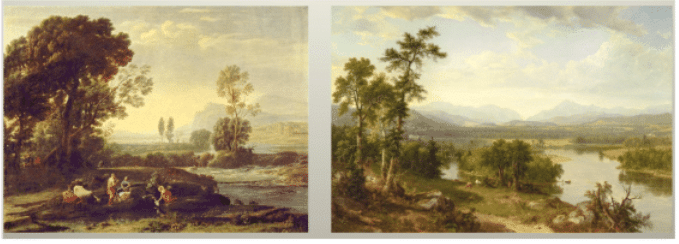
Typical pastoral painting (left) by Claude, c. 1650, typical Hudson River School landscape (right) by Asher B. Durand, c. 1840. What’s old is stolen new again.
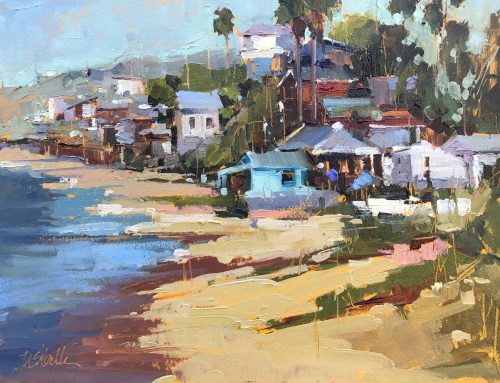
The Pastoral mode is still in play today in a wide variety of forms. Today’s leading practitioner of the Hudson River School manner is Erik Koeppel, who teaches the historical technique in two detailed videos.
And if you’re eager to get out and swing a brush amid the trees and mountains yourself, you might want to look into the annual mountain painting trip that Streamline holds in New York’s Adirondack Mountains in mid June. It is open to anyone who wants to attend and is designed for painters who usually attend events but don’t have a chance to paint with friends. This is all play – no work, no show, no sale, no workshop. Just friends and new friends painting together. Learn more here.
Stolen Rembrandt Given New Life as “Multimedia Experience”

Frameless, London’s largest permanent multi-sensory art experience located at Marble Arch, has brought Rembrandt’s stolen masterpiece “The Storm on the Sea of Galilee” back to life through groundbreaking immersive technology. This biblical scene, depicting Jesus calming a violent storm as terrified disciples struggle to control their ship, transforms from static painting to dynamic experience as visitors feel the crashing waves, hear the thunderous storm, and witness the dramatic lighting that Rembrandt masterfully captured in his only known seascape.

Originally painted in 1633 and stolen from Boston’s Isabella Stewart Gardner Museum in 1990 during history’s largest art heist, this masterpiece has remained missing for over three decades, with only an empty frame marking its absence. Frameless allows visitors to step inside this lost treasure, experiencing the physical terror of the storm.
The exhibition, housed in a former Odeon cinema, features four distinct immersive galleries where projection mapping and sophisticated sound design transform classical masterpieces into living, breathing environments. Visitors have described the experience as “mesmerizing,” “extraordinary,” and “blown away” by the innovative approach to experiencing art beyond traditional gallery constraints. Learn how they did it here.