George Caleb Bingham (March 20, 1811 – July 7, 1879) was an American artist, soldier and politician known in his lifetime as “the Missouri Artist.” He went to Virginia to fight in the Civil War because he opposed the extension of slavery westward.
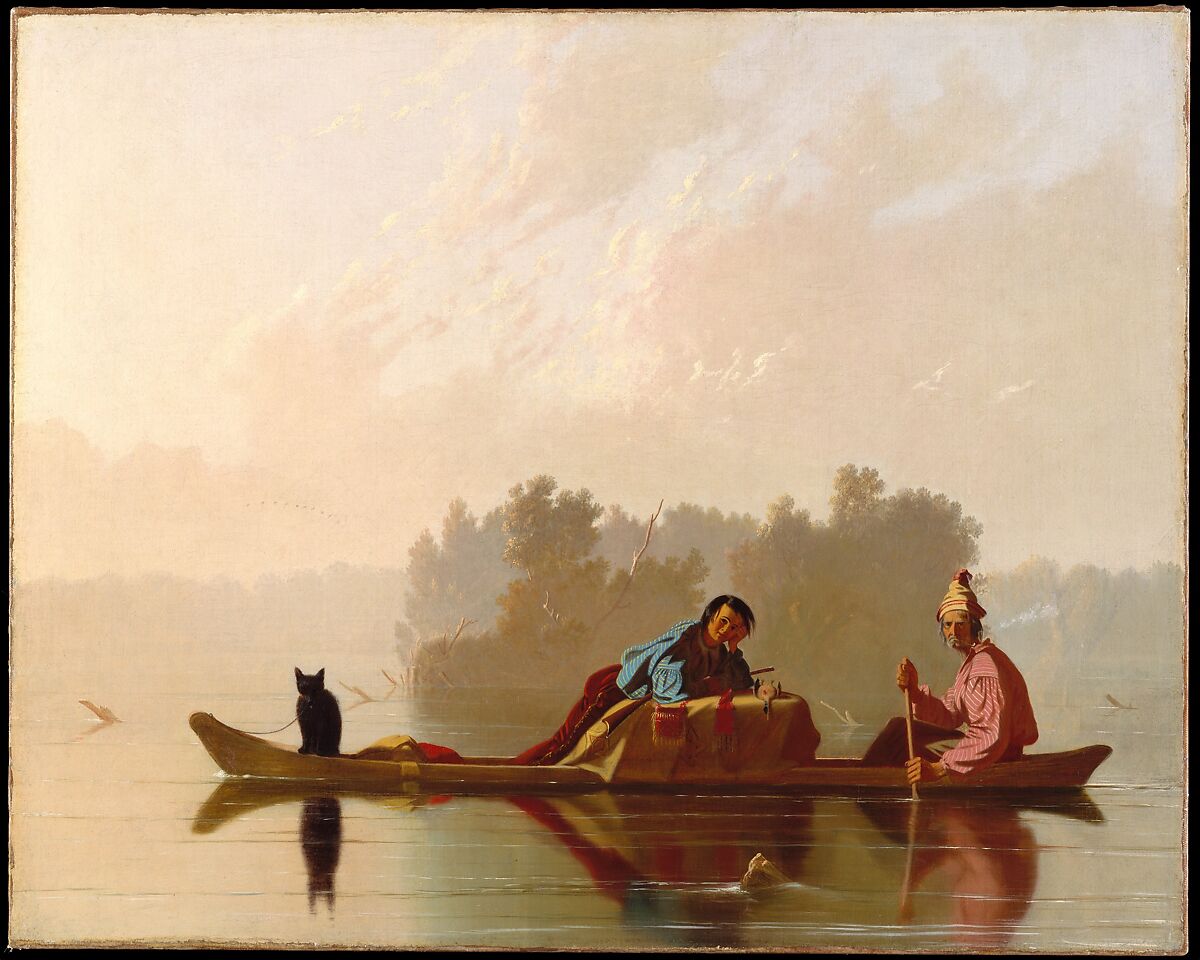
Not coincidentally, Bingham’s most famous painting is also his most haunting and mysterious. It’s also mis-titled; when the American Art Union exhibited it, they renamed it to avoid any controversy. Painted around 1845, Fur Traders on the Missouri River was originally titled French Trader, Half-breed Son.
Look closely and you’ll see the latter is exactly what Bingham painted; his subject reflects the reality of fur trappers and traders frequently “marrying” Native American women in their territories. The painting depicts a dugout canoe, in the center which sits the younger man, whose clothing and beaded medicine pouch indicate his Native American origins.
The two characters have wildly clashing vibes. The older man, the boy’s father, is remarkably dour-looking; he’s frowning, with a furrowed brow and a disgruntled look that’s anything but happily patriotic. He is, incidentally, wearing a Phrygian cap, a French symbol of liberty; this places the curious image within an earlier historical period, when this part of the country was a French territory dominated by French fur traders.

Detail: George Caleb Bingham, Fur Traders Descending the Mississippi. 1845
The scene is so still, it’s as if nature itself holds its breath, clashing with both the man’s bad mood and the boy’s odd expression, which in contrast reads like a dreamy merriment. Yet, what’s really odd about this painting is how the two figures stare straight out at us, caught in motion. The only way we’d see them like this is if we’re floating past them in another boat – which makes their expressions even weirder.
The diffuse, hazy light that glows from the entire painting exemplifies what scholars call the Luminist style, a variant of the prevailing Hudson River School mode. Shimmering horizontal lines indicate the hidden currents that break around a submerged rock in the foreground.
Scholars disagree about the seated animal chained to the front ofd the boat; it’s either called a black fox, a black bear cub, or a cat. It’s another part of this paintings weirdness; it’s backlit, so we can’t really see details, yet it demands our attention because its silhouette gets so much contrast (while the “main” characters have an island right in back of them, and therefore they don’t stand out nearly as much).
There’s a funny meme that plays up the weirdness hidden in this painting.

Not to make too much out of it, but on some level this meme could be said to speak to precisely why this painting haunts some viewers – if you care to look beneath the surface, there is a deeper archetype: that of a wild, uncertain land with a shadowy, shape-shifting force of nature at the prow.
If you’re interested in how landscape paintings can tell a story, have a look at Nicholas Coleman’s video Storypainting: Creating Emotion with your Brush.
Carl Bretzke on Painting with Friends
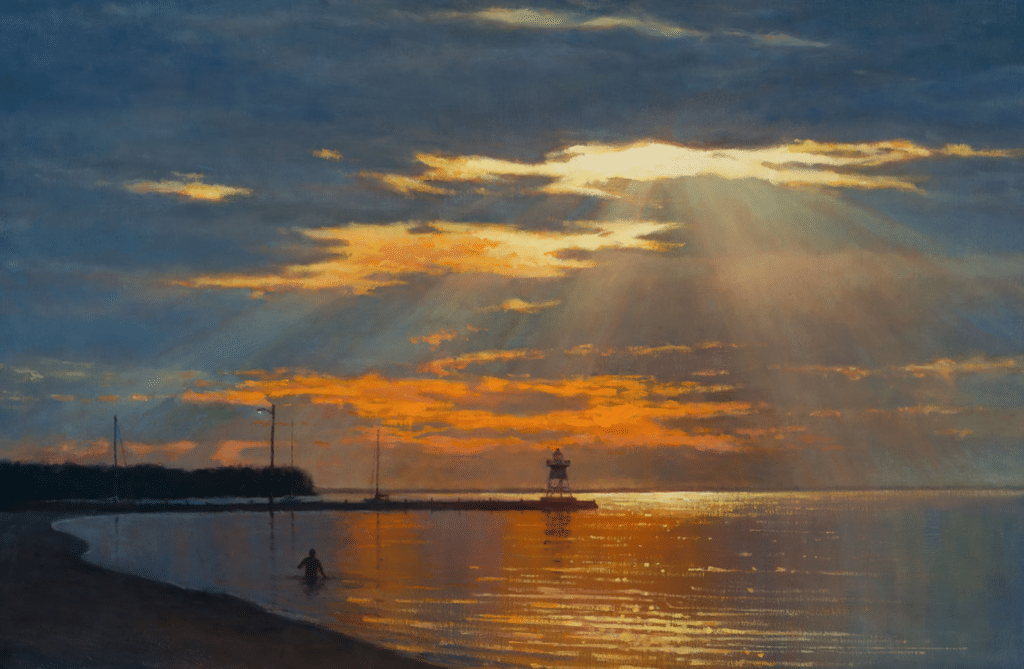
Carl Bretzke, Great Lakes Grandeur, oil, 24 x 36 inches
Artist Carl Bretzke joined Eric Rhoads on last week’s Plein Air Podcast week. During the interview, Carl mentioned he had attended nine of 10 Plein Air Conventions and was eager to attend the one coming up in May in Denver. Surprised he had attended that many times, Eric asked him why he keeps coming back.
“I come back primarily to see my friends, most of whom I met at the convention originally,” said the artist. “But I attend every demonstration, because I always learn new things about painting from every one of them.”
As Eric said, “Having a curious mind serves him well. The best never rest; they always strive to learn more.” Who knows, maybe we’ll see you there. (www.pleinairconvention,com)
And if pastel is your thing, Pastel Live is coming up this summer in August. www.pastellive.com.