Claude Monet loved to paint the sea, and a quick study of some his best as well as some lesser-known paintings of the ocean can teach practicing artists sound fundamental skills when diving into a seascape. We’re looking at:
- Horizon lines
- Color
- Composition
Horizon lines – hard-edged or blended – can make or break a seascape. There are two main dials to turn here, 1. blending the edge between sky and sea on the canvas (if you’re using oils) and 2. mixing closer or more contrasting values and testing them on your palette.
However you choose to do it, softening the line between the sky and the ocean creates the illusion of depth by opening up the space in your painting’s background (which corresponds to what we see as we peer across the ocean into the distance). In the painting below, Monet has not blended the horizon’s edge (except for contrast when it goes behind the rockface); instead he has adjusted the values of the water and the sky to be close enough to each other to push the line between them into the distance.
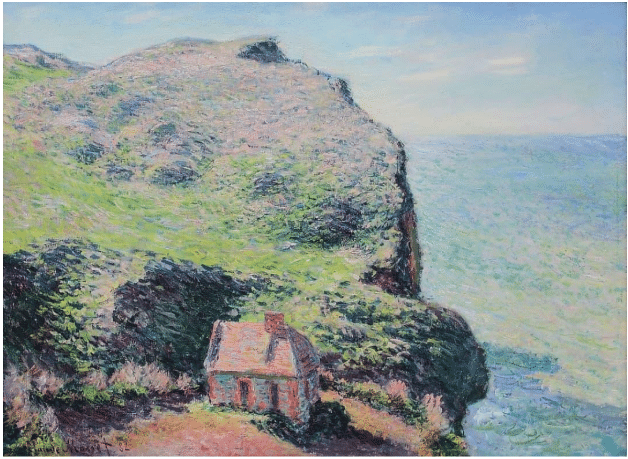
Claude Monet, The Customs House, Varengville, 1882
On a subtler note, the transition between ocean and sky also helps set or support the mood of piece, as in the sun-washed and wistful “Customs House” above. Here the artist has softened the horizon, creating the illusion of receding space.
In contrast, the harder the horizon line the more attention it calls to itself, flattening the feeling of depth. In his famous Jardin a Sainte-Adresse, below, Monet deliberately flattens the picture plane and uses a hard-edged horizon line (reflecting the strong influence Manet had on him at the time).
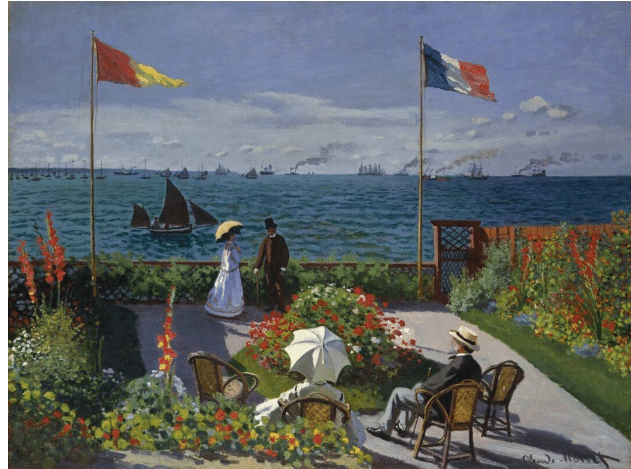
Claude Monet, Jardin a Sainte-Adresse, oil, 1867
He had a good reason; because he wasn’t really “painting the sea” so much as going for a startlingly modern and edgy (at the time) painting of a non-traditional motif: contemporary French bourgeois life. It’s meant to look harsh and geometric instead of “beautiful” or plein-air perfect. The horizon line’s true role is to be in relation to the other broad flat geometric shapes in the manner of (in 1867) still undreamt-of abstract art.
Color Is the ocean blue? Is the sky? They really don’t have to be, but assuming they are, what kind of blue(s) are we talking about? Is it a hot Mediterranean blue? A briny blue green? A northern Atlantic gray-green-purple blue? And how dark or light will it be (how much visual weight will you give it)? Here’s where knowledge and practice of color-mixing and values comes into play.
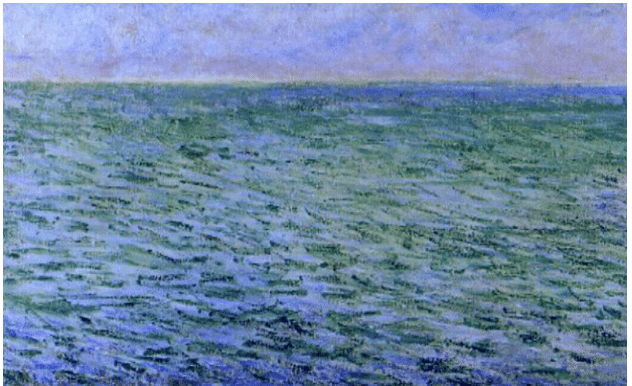
The Impressionists painted the ocean by weaving together many small wavy horizontal brushstrokes, sometimes using different colors, and sometimes just using different values. Of the same color All you have to do to make your Impressionistic sea believable is not overdo the contrast and paint the waves larger, darker, and further apart in the foreground, fading back all three of those dials (less contrast between wave and sea, smaller waves, and fewer of them) the further you go back. For a little dimensionality, place the dark shadow line right next to a lighter line in the foreground.
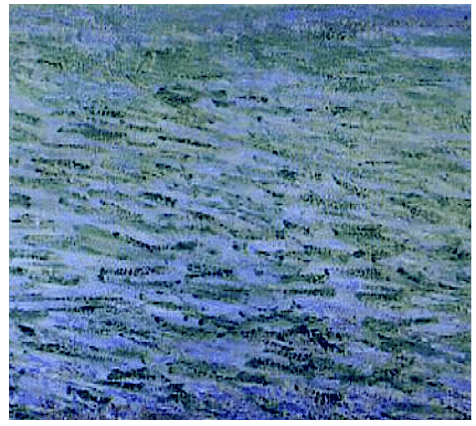
Now, does the color of the sea have to match the sky? You would think they would, as the water is merely getting its color by reflecting that of the sky’s, but in practice often they don’t, and on paintings that’s usually best if just for the sake of variety.
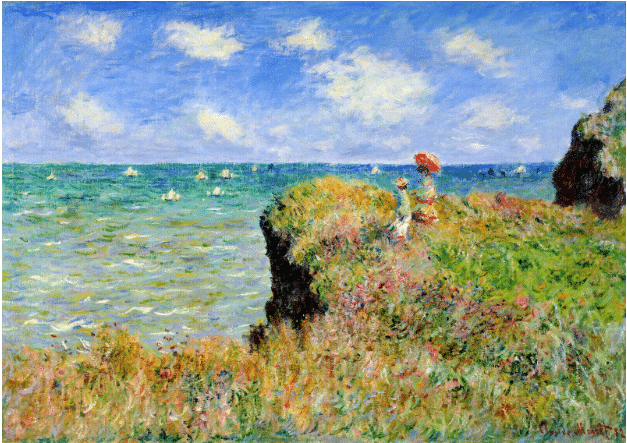
Claude Monet, The Cliff Walk at Pourville, 1882
So the short answer is no (look no further than any of the Monets in this article), BUT: unless you’re deliberately being dramatic or “modern” like Monet in his Degas phase, sky and sea should probably more or less relate in a kind of harmony (call it a “sympathy”) with each other. This you achieve by including some of the same colors in both of them.
Composition – While it may seem just a matter of big shapes and parallel lines, you do have three fundamental choices here: are you going to put the emphasis on the sky, the sea, or the shore? This choice can make or break your painting; neglect to make it and you risk losing dynamism, focus and impact. So at the outset you should ask yourself what you want this painting to be “about” – do you want to “tell a story” (i.e. depict something interesting) about the sky, at sea, or the shore?
Consider adjusting the height of your horizon line accordingly. Is the focus up front or further out? If the goods are mostly in the foreground: soften and raise the horizon way up top to keep distraction to a minimum, as here:
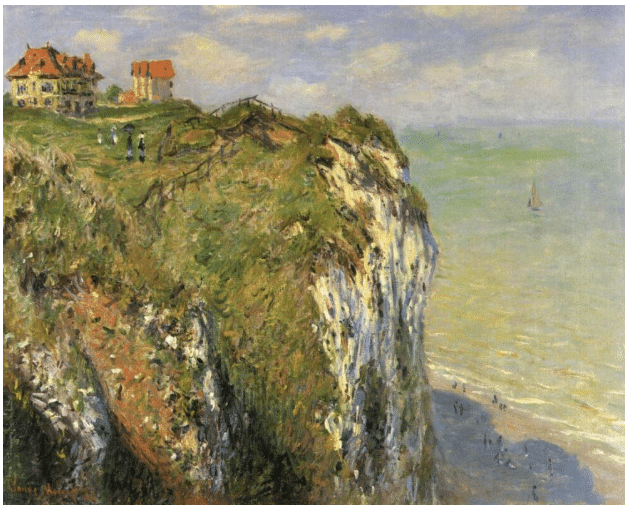
Claude Monet: “Cliffs near Dieppe” (1882) Note the minimalizing value-matching and edge-blending at the horizon line.
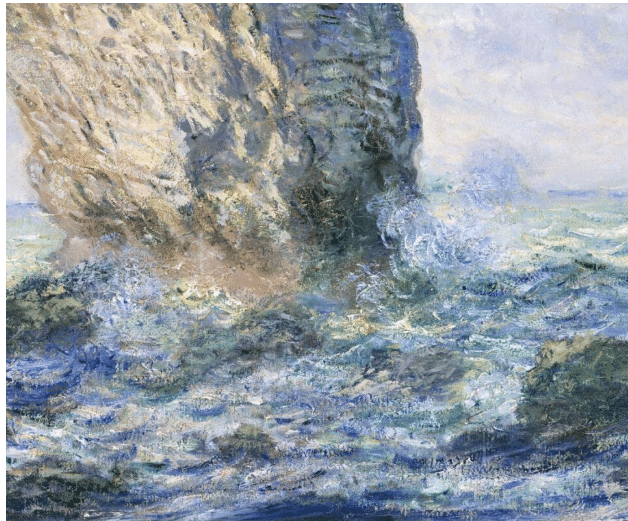
Or lower it if the focus is going to be on the foreground and you want us standing there looking up at very tall, close objects such as cliffs or large rock formation, as Monet does here:
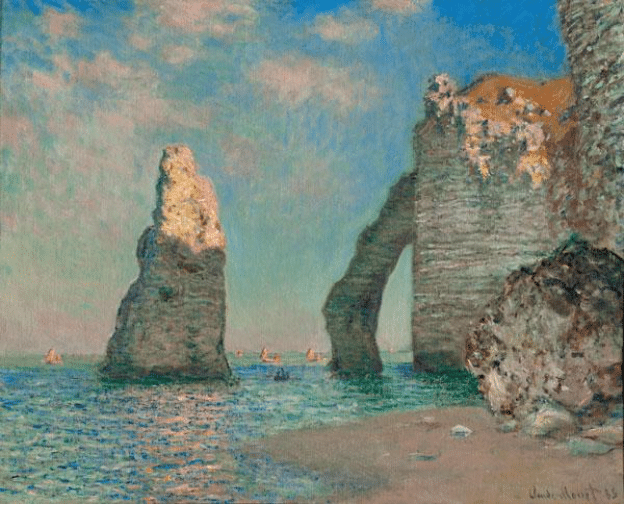
Claude Monet, The Cliffs at Etretat, 1885
If you’re wanting to emphasize the sense of distance and open space, as most plein air painters do, whether you place the horizon line in the lower third or the upper, getting a soft transition between them, using wither value or blending, is key (see “Horizon Lines” above).
Go ahead and near-center the horizon line if you think you can guarantee enough interest in the color, texture, design, movement, and variety between two large swaths of stacked-up rectangles to keep the interest of the viewer. Seriously, Monet and I give you permission. Because Monet certainly manages it; in the one below, it’s his magic with color (and the wonderfully subtle “V” shaped perspective lines of the boat’s wake receding toward the horizon) that win the day.
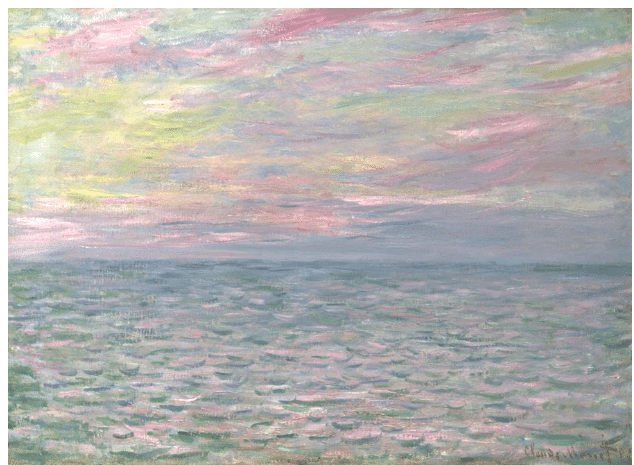
Claude Monet, Sunset at Pourville, Open Sea, 1882
Happy beach days, everyone.
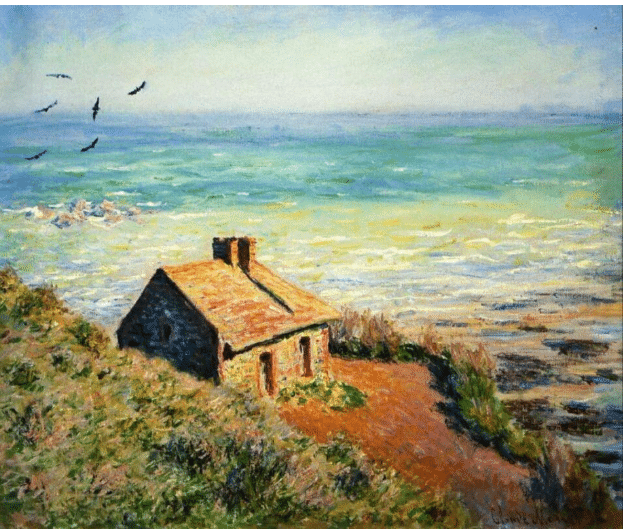
Claude Monet, Fisherman’s Cottage on the Cliffs at Varengville, 1882
Mastering the Sea
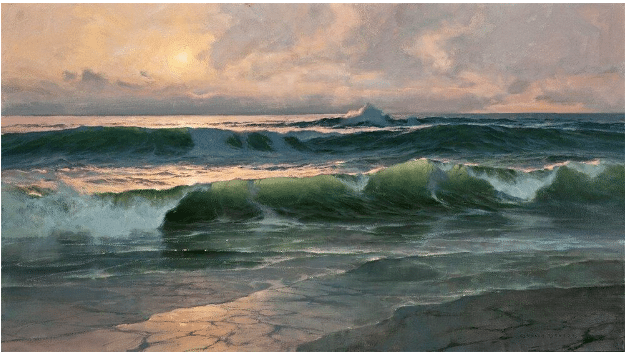
Donald Demers, Waves at Sunset, oil
Donald Demers is an internationally renowned artist and a master at painting the elusive characteristics of the sea. His video, titled Mastering the Sea, details a reliable method that allows you to consistently paint the sea with accuracy and emotion. In this video, he walks you through a complete demonstration that includes not just technique but key facts about how the sea moves and the water’s relationships with light, clouds, rocks and sand, wet or dry. Check it out here.
There’s also a bundle of two on sale that together constitute a real masterclass for painting the ocean with accuracy, passion, and life. Check that out here.