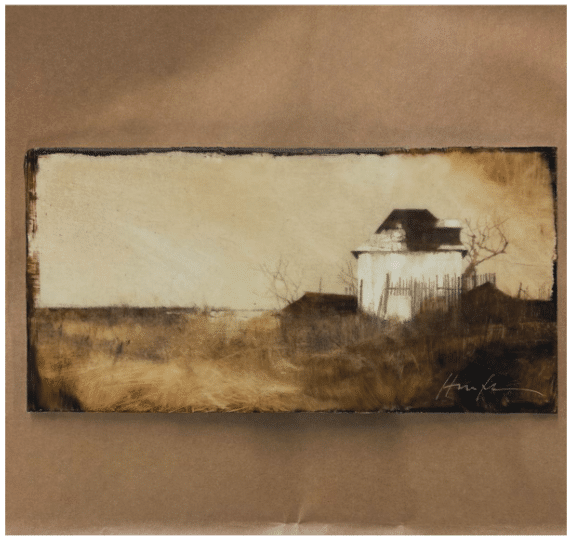
There is a beauty in abandoned places: boarded houses dismantled by wind and rain, rusted millwheels, collapsing barns and sealed grain silos the color of dust. These are lonely places, sure, but oddly fascinating and almost, in a way, comforting… silent companions of the land, they can seem almost ready to whisper of the lives that passed through but dwell there no more. Charlie Hunter (Rule Breaking Landscapes<<https://painttube.tv/products/charlie-hunter-rule-breaking-landscapes is one artist who celebrates such places. Jason Kowalski, though in quite a different way, is another. Writer Alison Malfronte introduces us to the latter.
Jason Kowalski (b. 1986) pays tribute to the past by painting time-worn places as they appear today. “There is a unique beauty in the undone, in the abandoned, and in the shadows of greatness that once was,” says the Colorado-based artist. “My subject matter highlights generational memories from a bygone era that was defined by hard work, happiness, and hope.”

Jason Kowalski, Café, oil
Some of Kowalski’s strongest childhood memories involve riding in the back of his mother’s Saturn and admiring the landmarks he saw out the window.
Kowalski first fell in love with history through the antiques that filled his grandparents’ home. “Grandpa Howard had a special story for each item, and I enjoyed asking him about the historical significance behind his collections,” the artist recalls. “Antiques are more than possessions — they are cherished memories.”
“I remember driving by abandoned billboards with layers peeling away and thinking how wonderful the collage of time-worn text was,” he says. “I was compelled by those layers of history.”
Today, Kowalski incorporates this layering effect in his contemporary realism paintings by concealing vintage ephemera such as heirloom postcards, black-and-white photos, and old newspaper clippings. These carefully placed elements create both physical texture and a sense of historical context for the buildings and objects he depicts.

Jason Kowalski, gas pumps, oil
the Laguna College of Art + Design in California that he discovered his current subject matter while on a road trip with his artist wife, Maria. Today, they journey cross-country with their three children in a restored aluminum trailer, searching for inspiration.
“Our Avion has a working 8-track player, the original 1970s cabinetry, and quilts that were hand-sewn by my wife’s grandmother,” Kowalski notes. “We cherish our time together, and my wife and kids are helpful in spotting things to paint.”
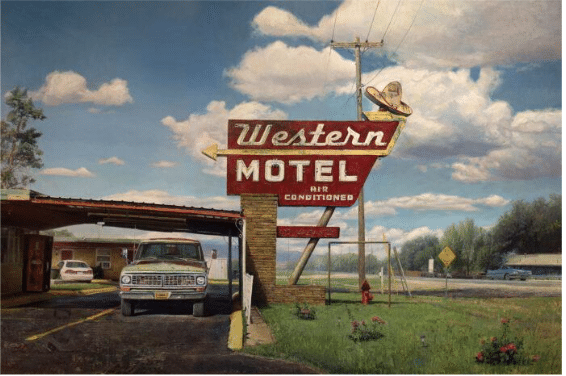
Jason Kowalski, “Western Motel,” 2023, oil on wood panel, 48 x 72 in., J. Willott Gallery (Palm Desert, California)
One landmark spotted on a recent trip along Route 66 is shown in “Western Motel,” (above). In this carefully rendered piece, an angular sign boldly calls travelers to stone lodgings that appear to date from the 1950s. Although the aging vehicles in the lot suggest the motel has seen better days, the building’s solid construction and saturated colors remind us of the strength of spirit that built a nation.
“I often marvel at the time, dedication to craftsmanship, and community cooperation that it took to build things before an automated era,” says Kowalski. “In a painting, my subject matter finds honor and is preserved for the next generation.”
This article was originally published in Fine Art Connoisseur magazine (subscribe here).
Video Demo: How to Paint Greens with Pastels

Greens are often a source of trepidation for many artists, especially when painting a verdant landscape. All that green can be overwhelming!
In this demo, Xenia Sease explains her approach for tackling a predominantly green landscape, from honing in on her focal area to creating convincing atmosphere. Many artists experience trepidation when faced with the challenge of painting greens. The visual overload that comes from a lush landscape can be daunting. Xenia acknowledges this struggle and emphasizes the importance of finding ways to keep the painting interesting without falling into monotony.