By Douglas Fryer
Part II (Go here to read Part I)
One longstanding motivation for landscape painting has been to represent nature as a manifestation and revelation of the divine or supernatural.
These are pictorial forms meant to contemplate powers and influences that are beyond ordinary senses. The concept of Providence, or the protective care of God or Nature as a spiritual power, has long been an inspiration to many landscape artists.
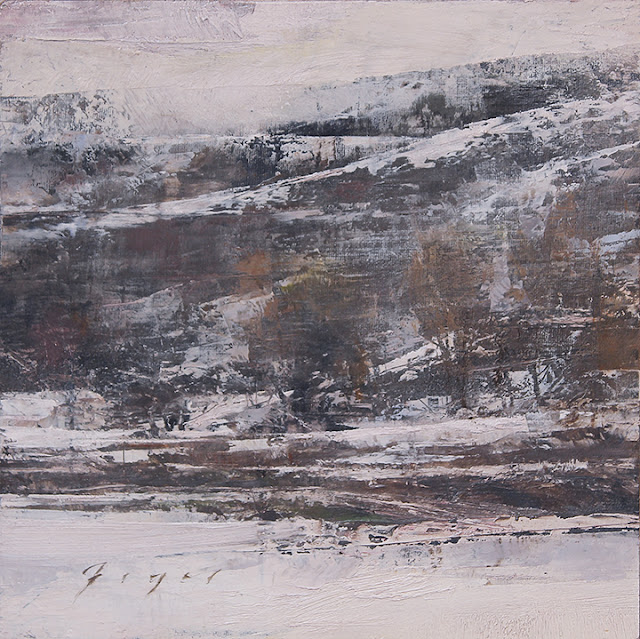
Douglas Fryer, Hillside and Fields, Midwinter, oil, 5″ x 5″
Another artist may be interested not only in nature, but in the relationship that man has with his environment. He contemplates the interconnectedness we have with the world: humanity as a part of nature. The traces we leave on the land have long been subjects in landscape painting, whether in an agrarian or an urban setting.
The value of a work of art is dependent upon the intent and beliefs of the creator, combined with methods of execution appropriately fitted or contrived for the purpose of full expression of that objective. Can the artist separate his belief from the execution of his work? Fortunately—or unfortunately, as the case may be—art is brutally honest, and unmercifully reveals the artist to the discerning viewer. The longer I paint the more I realize that art is a record of a state of mind.
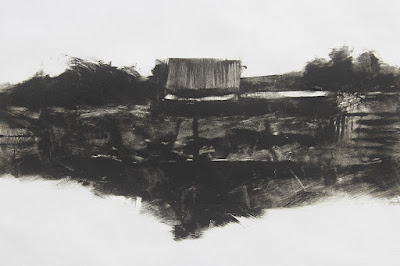
Douglas Fryer, Spring City Barnyard in Twilight, 8 x 12, monotype
If I am in an ordinary state of mind my paintings are commonplace. If my thoughts and emotions are at a high point of sensitivity and activity, my paintings tend to convey extraordinary thoughts and emotions. The difficulty is in retaining those high points as long as possible, increasing the heights on future works, and finding the most appropriate form for the expression of that state.
The greatness of a work of art is not in the display of knowledge or information, details and facts, the skillful adherence to style or formula, or in “photographic” accuracy of its rendering. Rather it is in the preciseness with which it communicates personal impressions and sentiments, and the emotions it provokes in the heart of the viewer. What better test of a work of art than to judge it by the inspiration one gains by viewing it, listening to it, reading it, or having it played out before us? Beauty is dependent upon arrangement, upon the unseen, indefinable and ineffable poetic moods.
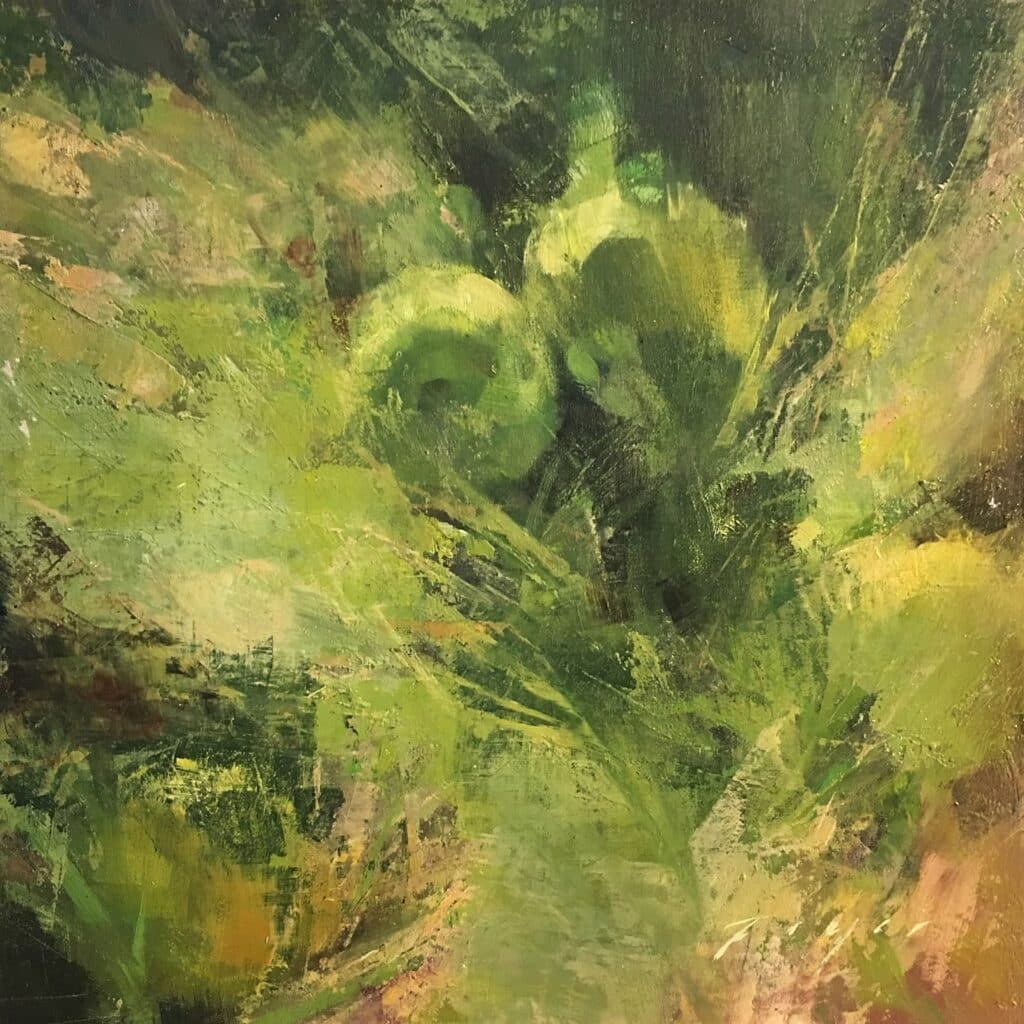
Douglas Fryer, Fallen Apples, oil, 5″ x 5″
Moments of illumination or inspiration are truths that are confirmed to us even if they are fleeting. In observational drawing and painting a primary task is to combine seeing with knowing. Often, we think we have been accurate, but when using rules of measuring, perspective, or tone, we find that our “seeing” was actually inaccurate.
On the other hand if we resort only to rules, methods and rigid measuring techniques, we tend to forget that the human eyes, combined with the translation and interpretation of the brain and in combination with deliberately imagined or invented elements, cannot always be reduced to the same conventions and rules.
“One of the great difficulties of an art student is to decide between his own natural impressions and what he thinks should be his impressions,” Robert Henri said in The Art Spirit. “The demand we so often hear for finish is not for finish, but for the expected.”
Knowledge of systems and observation are incomplete and possibly entirely inadequate without acknowledging the equally important metaphysical aspects that are so vital in any expressive endeavor.
If you’d like to dive deeper into Douglas Fryer’s philosophy of art and technique, you may want to check out his video Painting with Intuition.
PleinAir Salon: Hinterland Hive is the Bee’s Knees
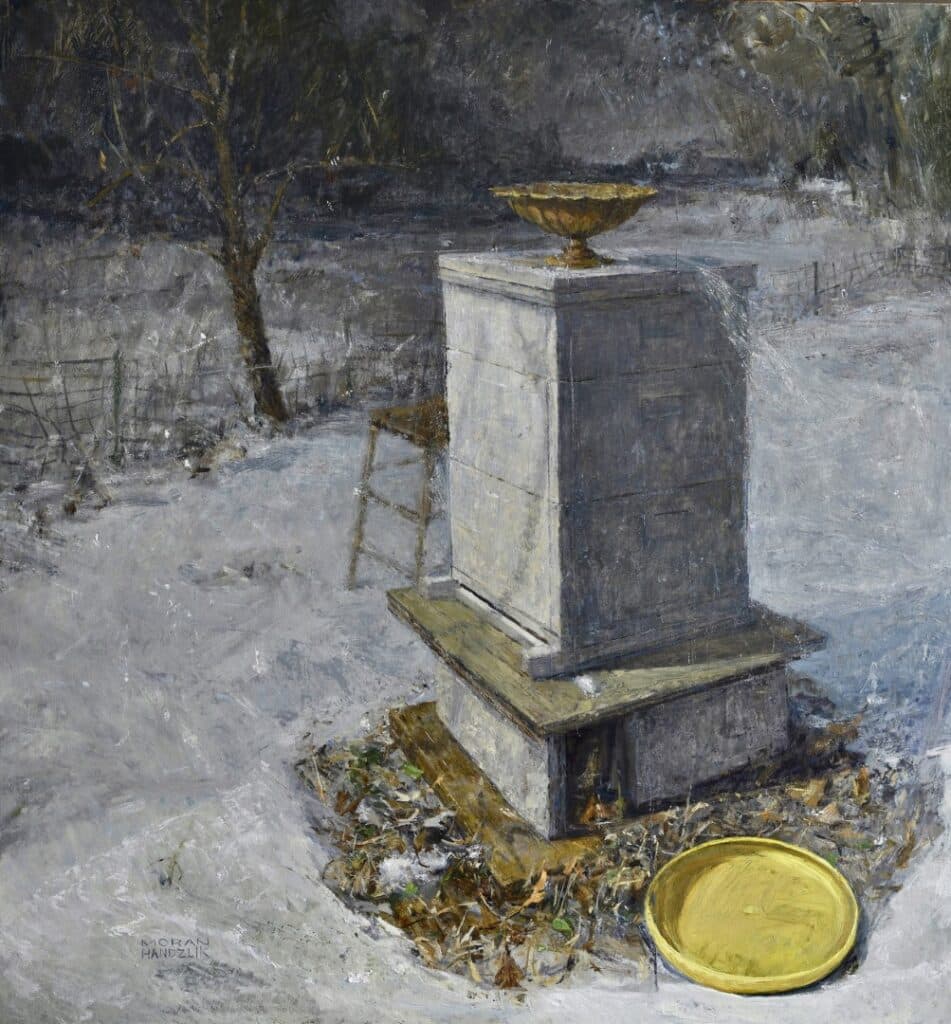
Bethann Moran-Handzlik, A Mind of Winter, oil on panel, 32″ x 30″
Oil painter Bethann Moran-Handzlik has won First Place in the March PleinAir Salon for her oil A Mind of Winter.
In a recent article on her work, art writer Chris Gargan pointed to this painting in particular: “Hers is a contemplative engagement, sometimes taking weeks to complete even in the bitter cold and stinging winds of Wisconsin winter. (Works such as ) her painting of a bee box in the snow, done in her backyard with her brushes taped to her gloves because her fingers became too numb to grip … are the product of hours and days of careful, reimagined, and reexamined attention to all aspects of the visual sensation.”
“The dense tapestry of marks, blended, scraped, flickered, dragged, stippled, and thickly impastoed upon the surface, cannot be simply unwoven. The Gordian knot of marks and brushwork adds to the visual and poetic mystery and intention of her painting.”
Enter the monthly PleinAir Salon
Enter your best work today in the ongoing PleinAir Salon with over $33,000 in cash prizes and exposure of your work. The winning paintings are showcased in Inside Art and the Grand Prize gets featured on the cover of PleinAir® Magazine. Visit PleinAirSalon.com now to learn more!