Happy National Cat Day! Nobel prize-winning author, philosopher and physician held that there are but “two means of refuge from the misery of life – music and cats.” Perhaps we could agree to add a third, that of “art” to the list.
Most artists I know would probably agree, along with French philosopher Hippolyte Taine, who said that he had “studied many philosophers and many cats” and come to the conclusion that “The wisdom of cats is infinitely superior.” In the study of cats, artists have the advantage of a sharp eye for character and the imagination to plumb their mysteries, their quirks, and their charms.
John Leith Craxton RA (1922-2009) was an English painter with a storied fondness for cats. He was sometimes called a neo-Romantic artist but he preferred to be known as a “kind of Arcadian.” His whimsical depictions of cats, created over the course of a long career, have been collected in Craxton’s Cats (2024), written by Andrew Lambirth.

John Craxton, “Cat” (1958), woodcut
Craxton’s depictions disarm us with their illustration-like quality, yet his cats are strangely self-contained (like real ones) and each has a distinct personality. Leave it to an artist to realize that no two cats, however similar in species, are truly alike. Perhaps the secret of painting them well has to do with the infinite play between playfulness, almost-human qualities like curiosity, excitement, and uncertainty – next to the almost unassailable subtleties such animals hold so guardedly to their chests.

John Craxton, “Cats and chair” (1997)
Surely one of the fancier cats in art history is surely the white angora chasing a butterly in the 1761 painting of the same name. Bachelier was an inventor and master ceramicist at the Sèvres porcelain works as well as a painter of pets and still lifes. Surely this fluffy White Angora wouldn’t look out of place next to fine bone china tea setting, around which, one has every confidence, this graceful feline would step without spilling a drop.

Jean-Jacques Bachelier, White Angora Cat, 1761
One of the most remarkable lessons on drawing anywhere comes from Manet’s 1861 “Cat Sleeping.” With just a few pencil marks, the artist conveys the ring of truth, as anyone knows who’s ever observed a cast sleeping.
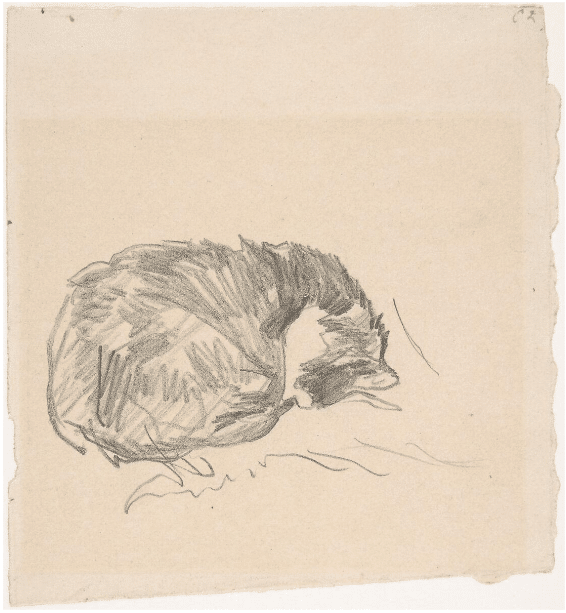
Eduard Manet, “A Cat Curled Up, Sleeping.” 1861
Manet shows a cat at rest, supremely unconcerned with any human presence. (“Cats just want to be cats,” said the cat-approving Chilean poet Pablo Neruda.) Says the Met in NYC, where it’s housed: “A masterly pencil line of varying thickness catches the distinctive feline profile of curled neck, ears and brows. Patches of hatching suggest tousled fur, and a few light strokes anchor the form in space.” Fantastic! As brilliant for what it leaves out as for what the artist puts in.
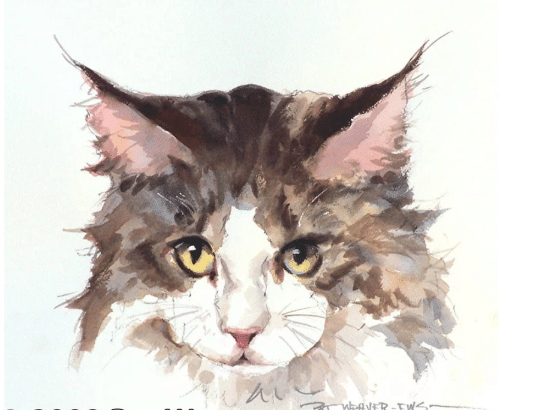
Watercolorist Shelley Prior uses watercolors to enter the secret lives of her subjects, including quite masterfully, cats.

Shelley Prior – the cat, captured! in watercolor.
Prior is a realist in Canada working exclusively in water media. Her still lifes and wildlife paintings are as photorealistic as her pet portraits are charming and compelling. She teaches how she does it in her video, “Pet Portraits in Watercolor.” You can check out an hour-long preview of the video on YouTube for free right here.