Inspiration comes in many forms, and creativity is its currency. But where does creativity come from, and what even is it?
It’s thought that childhood play and adult creativity originate in similar processes in the brain. But even today there’s little consensus about just how or why humans evolved creativity, let alone the tendency to theorize about it.
The idea of human creativity is only a few hundred years old. Not saying people had no concept of creation or weren’t creative before. They did and were. But even our predecessors (e.g. the ancient Greeks and Romans) conceived of creativity not as a human act but as a manifestation of spirit (“inspiration,” which chares a connection to the word “spirit, “comes from inspirare, meaning “to breathe in” from outside.)
Even during the Renaissance (15th century), the very idea of human creativity met with resistance. At that time, the term “creation” was still reserved for creation “from nothing,” something presumably only God could do.
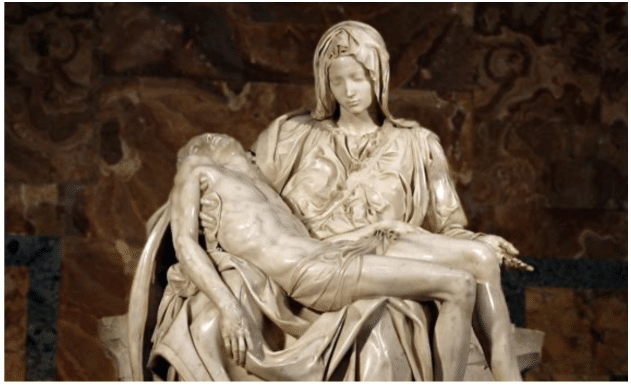
Detail, Michelangelo’s Pieta, Vatican Museum.
The word “create” (from the Latin term creare) only appears in English for the first time Geoffrey Chaucer’s “The Parson’s Tale” – but only to indicate divine creation. Even Michelangelo, so celebrated for his contribution to humanism, believed in essence that true art is but a shadow of divine perfection, that only God creates while all the great artists can hope to do is copy. Anything else was crazy talk.
Imagination is the Key to Progress
It’s only been a mere two hundred years or less that we’ve recognized that the capacity of imagination enables us to learn and to grow, to envision and invent things that might be, and to picture – and make real – things that aren’t yet but could be.
Creative expression gives a voice. It generates ideas, thoughts, and visions about the world as it is and as it might be.
“Creativity is the language we use to communicate the urgency of our dreams for a better future.”
— Audre Lorde
Artist and poet William Blake was one of the first to start us thinking about creativity the way we do. For Blake the imagination was the great secret of human existence. Blake introduced the concept of the human imagination as a divine faculty that can connect us to the infinite and to the sacred, and thereby transform the world through creative energy.
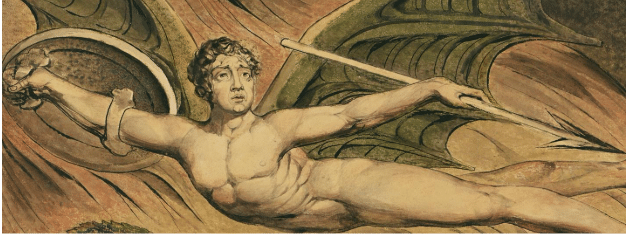
Detail of an illustration by William Blake
To do that requires an artist like Blake to break with the received ideas that most people think of as normal and sane. Only then does one see, create, and enable viewers to see beauty and potential where others ordinarily do not.
For many artists, art is an exhilarating way to shake off the numbing stupor of daily routines and wake up to a wider world than the “sensible” (and predictable) one we’ve learned to accept as the only (sane) reality.
Viewing an exciting painting can be like seeing a sunlit morning through a freshly washed pane of glass. It reminds us how vivid the world around us can be if we’re willing to show up for it. For that we have to throw off the shackles of accepted daily sanity and see with newly opened eyes, like a madman – or a child.
What a delightful way to lose your mind.
My soul can find no staircase to Heaven unless it be through Earth’s loveliness. ” – Michelangelo
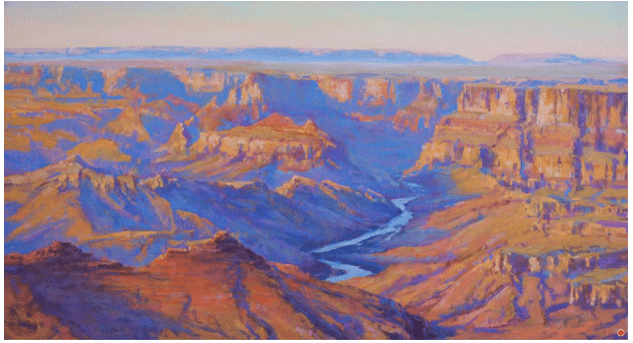
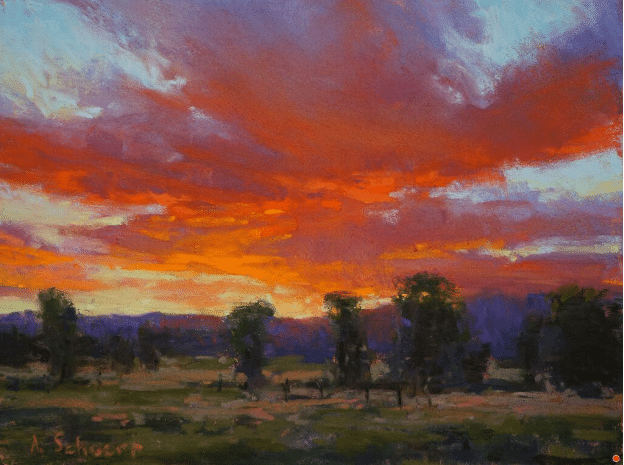
Aaron Schuerr, “Evening Color at Navajo Point,” Pastel, 14 x 19 in.
Pastelist Aaron Schuerr’s vivid landscapes make viewers stop and open their eyes just a little wider to take in their energy and beauty. He teaches his technique in two separate videos, one of which is titled “Storytelling in the Landscape,” which available here.