“Paint the flying spirit of the bird rather than its feathers.”
-Robert Henri
It’s the bane of many a beginner and something even pros have to stay on their guard for: Overworking refers to paintings that suggest too much work has gone into them. Often it’s what beginners mean when they feel the painting’s gone stiff and lifeless, perhaps because it’s painted too tightly. It can also mean a painting is verbose (too much detail throughout that adds nothing to the overall statement) or fatally flawed (showing evidence of failed attempts to solve underlying structural problems).
There’s nothing wrong with good tight, realistic painting. But overworking is different. Overworking is one of the top problems developing painters face. It’s caused by two related things:
1. not having enough confidence – that is, meticulously going over a single portion of the painting, adding more and more detail or desperately trying to get it to “look right.” The antidote: scrape or paint it out and work on another part of the painting and then come back to it later. Or
2. not seeing the big picture clearly enough to begin with – meaning, not just the composition but the overall impression your viewer will get from the work. This is something too rarely considered. Painting is easier when you’re working toward expressing a strong feeling or statement rather than, again, trying to get it to “look right.” Antidote: Work in dialogue with your canvas, searching for overall feeling and accentuating that while diminishing non-essential details.
Throughout the many twists, turns, exultations and pitfalls of simply making a painting – any painting! – it’s difficult to keep in front of your mind the spirit of the thing, the initial idea, the life of it, the overall feeling or “vibe” you want the work to transmit to the viewer. But without feeling and artistic vision, even technically perfect work falls flat.
“Don’t just paint it, paint it doing something.” – Charles Hawthorne
Birds furnish a good example, because in life they’re almost never at a stone standstill, so painting how they live or what they’re doing can often help loosen your eye and brush. “There is a vast difference between a drawing aimed at recording an instant in the life of an alert organism and one aimed at showing how light falls on a stuffed specimen,” so says George Kirsch Sutton of the Wilson Ornithological Society. “A Bruno Liljefors would fully understand what I have just tried to say; so would a Jan Vermeer.”
Bruno Liljefors was Sweden’s most influential wildlife painter during both the 1800s and 1900s. His depiction of animals, particularly his famous bird paintings, remain timeless and influential to this day. He’s great because his details are just enough to convey specificity, color, and form, as well as action and movement, the latter of which were missing from wildlife painting at the time.
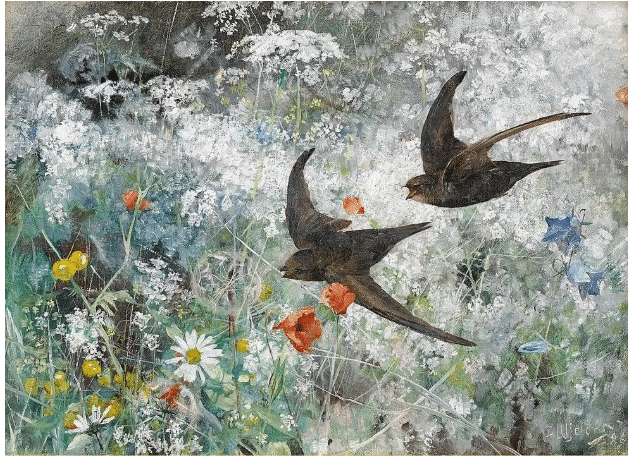
Bruno Liljefors, Common Swifts, 1886
In anyone else’s hands, the painting above could easily fall into overworked – too much detail, trying to get too much into the picture. In Common Swifts (1886), Liljefors gives us “accurate” representations of the birds and the wildflowers (it would be possible to identify each species he paints), and yet in each case the details are “just enough.”
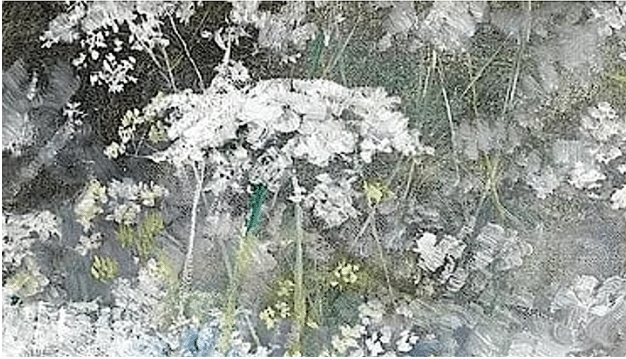
Detail of the Queen Anne’s Lace in Common Swifts: not one single flower or floweret is rendered. They’re all just dabs of paint.
The overall painting is wild, dense, and arresting, and the details are all minimally rendered. We don’t actually see any feathers on the birds or petals on the flowers – for example, see the closeup of all that foamy Queen Anne’s Lace above. And yet this artist became famous for bringing accurate wildlife painting beyond the domain of science and into an art in its own right. How? He kept the big picture in mind.
He didn’t just “faithfully” paint birds, animals and flowers, he painted them doing something. He brought them to life by investing them with motion and a feeling for their life and growth in the wild.
The two pitfalls mentioned above – forgetting the big picture, and getting distracted and lost in detail – come down to confidence.
So how do you fight overworking?
- Practical answer: let go of “perfect” and trust that less is more. Evoke more and describe less. When you’re painting details, ask will these details I’m adding make this a better painting? You generally want to add detail only where it’s needed, that is, where your main subject resides. The rest (everything that is not the main point of interest) can, and 90 percent of the time should, be less detailed. Trust that your viewer will engage emotionally and imaginatively as they “complete” your forms in their mind.
- Unwelcome answer: paint a lot of paintings. Attend classes and workshops and challenge yourself by entering competitions, online and off. Paint, paint, paint. This is the only way to build the confidence you need to “put it on and leave it on.”
- Tricky/controversial answer: force yourself to pay more attention to the overall feeling or idea your painting will convey than you do to any one part of it.
In the end, it’s not about detail vs. suggestion, tight vs. loose, or even abstraction vs. realism. It’s about what the artist gets into the work. Technique is just technique. You can have loose, abstract paintings that convey tons of feeling, just as you can have tight, minutely detailed ones that do the same, and you can have meaningless abstraction, and you can have empty realism. Let’s take a look at an example of meaningful abstraction.

The Flying Spirit of the Bird”: two sculptures by Brancusi with increasing abstraction, from “Golden Bird” on the left to “Bird in Space” on the right. Both express soaring up into the sky.
Speaking of birds, take the Romanian sculptor Constantin Brancusi who spent some 20 years on a series celebrating the theme of a bird in flight – and yet never sculpted the bird. Brancusi was after the essence of a bird in flight. He concentrated on the animal’s movement (he scultpted it “doing something”) rather than its physical attributes.
Though considered by some an abstract artist, Brancusi didn’t intend to make challenging or puzzling art. He abstracted (simplified) the figure (the bird in flight) with one purpose: to express it poetically, in essence, in a three-dimensional work offering a relatable experience.
The key is recognizing and prioritizing the work’s overall concept or feeling-idea, doing what it takes to bring it out, and adding details only until they start to detract from the overall feeling.
You may or may not know the “feeling-idea” of a painting when you begin it. Often you find it halfway through – a sudden idea for what you might be able to do for the viewer. For many paintings, the more training and practice you get, the better your chances of catching inspiration.
It all comes down to the balance of form and feeling.
“You have to know the rules in order to break them,” they say. I think you have to internalize the rules you need in order to most simply and powerfully express what your heart and soul wants you to say. Either way, the only way is to expose yourself to those rules.
If your painting could benefit from immersion in the time-tested principles of design and composition, check out some of these professional high-quality tutorial videos.