By Dina Brodsky
As a contemporary miniature artist, I spent the first 15 years of my career struggling to find my place in the traditional gallery system. When Instagram became the go-to platform for the art world, I dreaded having to adapt, as well as the distraction it was bound to bring.
While I still dislike social media and do not relish the necessity of spending time online rather than in the real world, I have come to view Instagram as the single most powerful tool that has ever been given to artists. It has allowed me to find an audience specific to my niche, stop being reliant on galleries and other gatekeepers to make a living, and fully take control of my own art career. Instagram allowed me to slowly drop my multiple part-time jobs and concentrate on what I loved – making art.
Important Instagram Do’s and Don’ts
(What’s worth spending your time on, what isn’t, and what will actually hurt the growth of your account)

Artist, designer, and mother, Kristin Nohe Juchs gives her 100K followers numerous short video clips of how she creates her intricate drawings in colored ink.
DO NOT Use your Instagram Account like it’s your artist website.
Your instagram account is generally the first impression that galleries, collectors and the general public will have of you online – ever since instagram became the preferred platform of the art world, most people will check out your IG account before looking at your website, reading your CV, or looking up any articles about you. It should showcase your art to its best advantage, and concentrate on your professional achievements and creative process rather than your personal life. That being said – it shouldn’t look like your artist website (clean, minimalistic, and meant to replicate a gallery wall). Your instagram account should present your work in a manner that is as engaging and organic as possible, giving viewers a glimpse into your studio practice.
DO THIS instead:
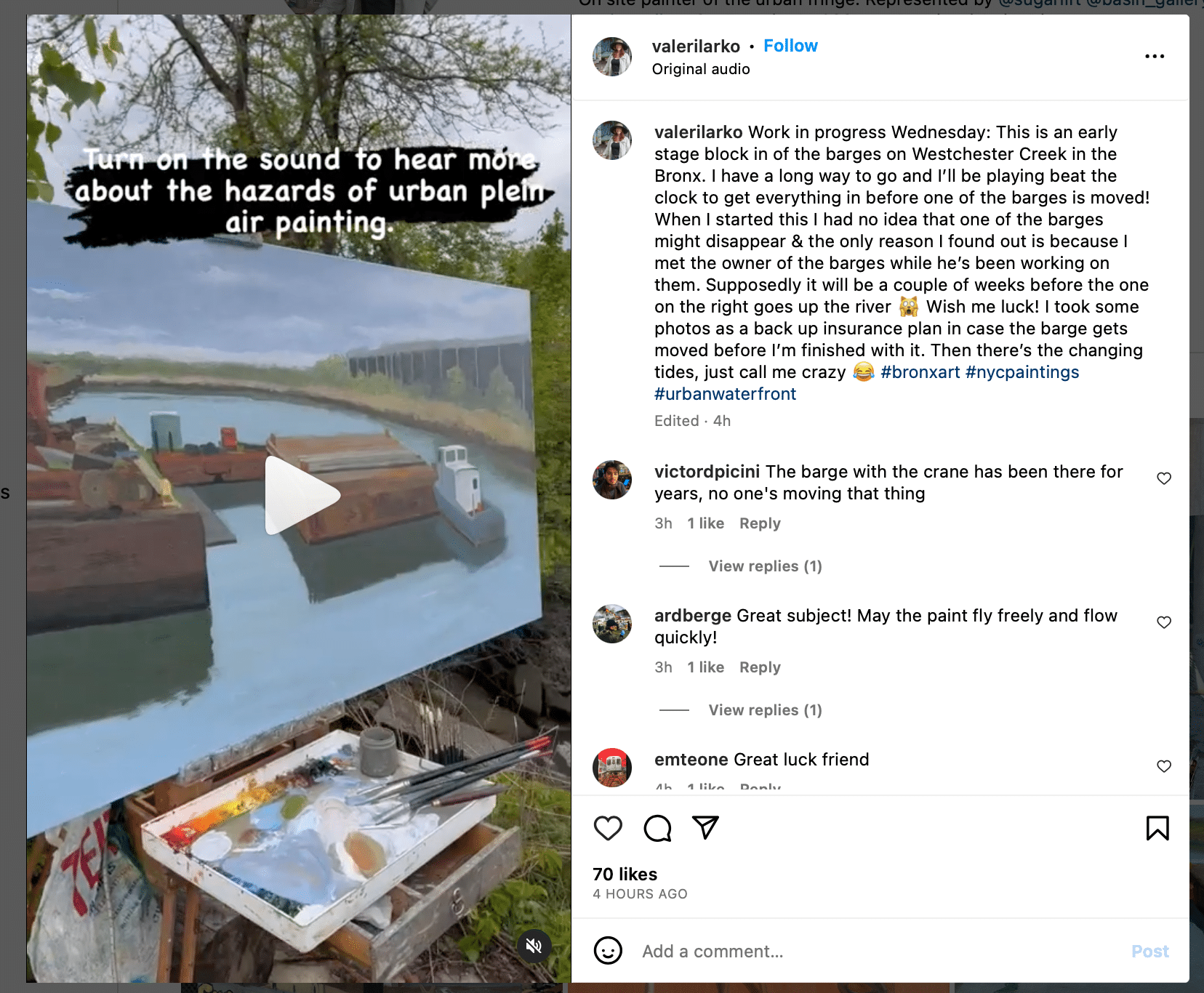
Show context. Pretend you are inviting someone into your studio for the day to watch you paint (sculpt, weave, etc). Your posts and videos should look like the viewer is standing over your shoulder and observing your creative practice up close. Show them your studio, mixing paint on a palette – the myriad of beautiful, messy moments that lead to a finished work of art.
Instagram’s format gives your followers a chance to get to know you – let them inside your world, show them what goes into your process, let them hear your voice, and you will wind up with a stronger connection than you could ever have with a visitor to your website (or a visitor to a gallery which is displaying your work).
Showing your work in context will also visually tell the viewer a lot of information – the size of the painting, the texture of the paint, the physicality of the artwork as an object rather than just a 2d image on a screen.
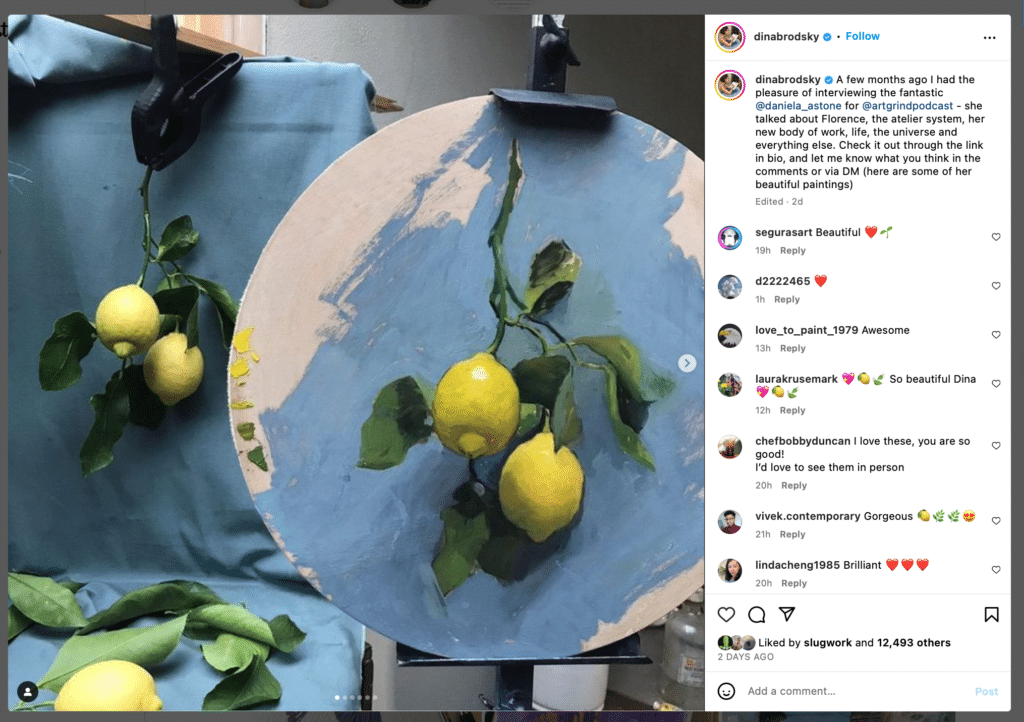
Dina Brodsky’s Instagram account is all about context and dynamic content.
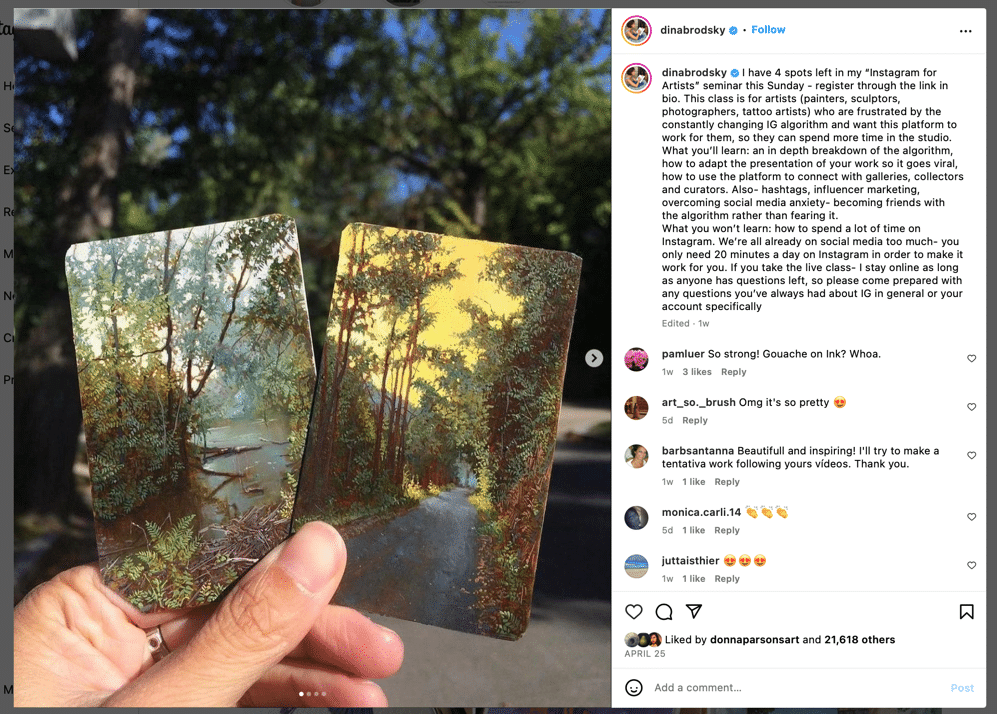
DO NOT Make your posts in horizontal/landscape format.
This is an incredibly common mistake a lot of artists make because, well – some of our work (sometimes all of it!) is in landscape format. The reason this hurts engagement is because most people are looking at instagram on their mobile device, which is in portrait/vertical mode. This allows the image to take up the entire screen, so viewers can see more detail, texture and everything else your work of art consists of. A landscape format image takes up less of the screen, so viewers see less of the painting, and more of the text, hashtags, and other posts surrounding it.
DO THIS instead:
Make your posts in vertical/square format. This is one of the easiest tweaks to make to boost your engagement – if you are painting in landscape format, put the painting up on an easel or your studio wall and photograph it in square or portrait mode, showing a bit of context around it. This will also show your audience how big the painting is.
* * *
Dina Brodsky is a full-time artist and social media influencer. She offers Instagram for Artists, an online course that helps artists “win Instagram” at their own pace. In Part 2 of her two-part series for Inside Art, Dina covers the specifics of selling your work on Instagram and how (and how not) to promote a studio sale, workshop, or gallery exhibition on Instagram. Dina also offers a free guide for artists to troubleshoot their lnstagram account that breaks down some common problems and offers solutions. Download it here.
Give Yourself the Business
Get your art business in shape with Inside Art publisher and dynamic entrepreneur Eric Rhoads’ YouTube channel, Art School Live.