
By Contributing Writer Rick Delanty
Rick Delanty will be demonstrating his technique for achieving a lush and loose look to his acrylic paintings at the inaugural Acrylic Live online event. Three days of professional-level instruction in acrylic painting, Acrylic Live is the only place you’ll find more than two dozen masters of the medium teach their admired styles and essential techniques. It runs THIS WEEK, March 25-28, 2025. Check out the premium faculty here.
Acrylics have been the target of some complaint and criticism. They’ve been around awhile, since being introduced into the States in the 50’s, with Permanent Pigments’ innovation called Liquitex. They were popular as a medium for outdoor sign-makers, because they are pigments suspended in a polymer emulsion and therefore dry as tough as plastic as well as incredibly resistant to fading from ultraviolet light.
But they quickly found their way into the fine arts too. Artists admired them for their versatility and flexibility on a variety of surfaces. Robert Motherwell, Helen Frankenthaler, Barnett Newman, Thomas Hart Benton, and David Hockney all created sizable works in acrylics.
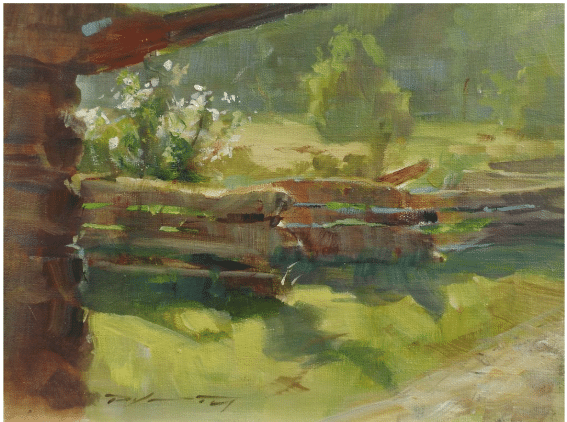
Rick Delanty, “Split Rail,” 9 x 12 in.
I came upon acrylics “through the back door,” I would say, having exhibited large-scale watercolors first at the Laguna Festival of Arts in the 80’s, where I glazed each with Plexiglas. It was there that I received a comment from a collector that he “liked the painting just fine” but was “getting tired of seeing the reflection of the backyard in the glass.”
Museum glass at that size, for its weight and expense, was not an alternative for me at that time, and I wanted to stay with a water-based medium. I was also looking for a medium that would not put glass between the collectors and their art. Acrylics seemed the next logical choice, so I tried it.
Eureka! I had the best time layering colors, not being concerned about different levels of transparency, being able to work thinly or opaquely, cleaning my brushes with soap and water, and having my painting dry in a reasonable (for me) time frame. And when I travelled by air, I was no longer concerned about where I might find solvent when I arrived. (Years later, I started using acrylics as underpaintings for my oils).
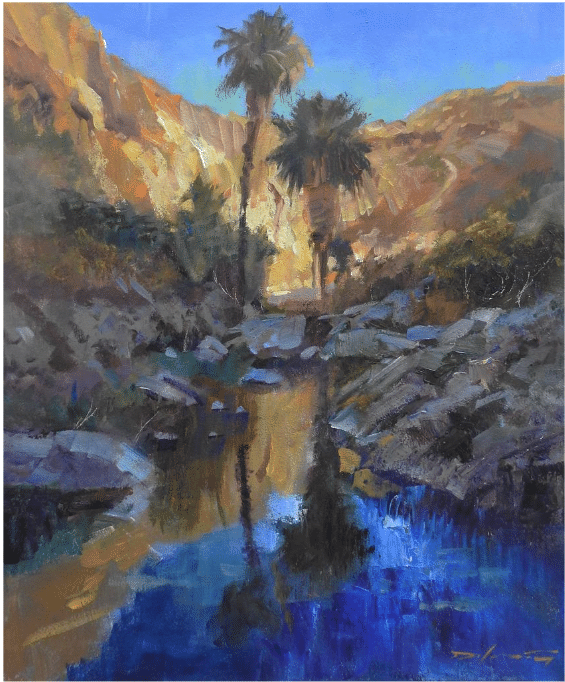
Rick Delanty, “Golden Sundown, Palm Canyon,” acrylic on canvas, 24 x 20 in.
The speedy drying time, vivid color, and forgiving nature of the painting process were so attractive that I still paint in acrylics today, as well as oil and watercolor.
The painting pictured, “Trestles Trail,” (at the top of the page) is a 24” x 36” painted on stretched canvas on location. The vividness of acrylic paints proved perfect to simulate the clarity of that perfect day at the beach. I started with a large stick of willow charcoal to knock in the largest shapes.
Using a 2” brush and burnt sienna (Golden Open Acrylics), I blocked in most of the painting in an hour, knowing that I would be able to correct color passages both large and small during the same session. Blues and greens were swept in over the top of this warm under-layer, and details of branches, grasses and waves were tipped in with a palette knife at the end of the session. I believe the forgiving nature of the medium helped to evoke the fresh uncluttered spirit of that breezy, clear day.
For my Acrylic Live demonstration on March 28, I will use acrylics to create an underpainting for a Yosemite snow scene, then a block-in, and then work through a variety of textures using a variety of brushwork and tools. My emphasis will be on anxiety-free painting and listening to one’s intuition to respond to the painting as it develops.
I hope you will be able to join us for Acrylic Live this month, as an excellent faculty has been lined up to demonstrate the many advantages of acrylic painting.
Keep Painting!
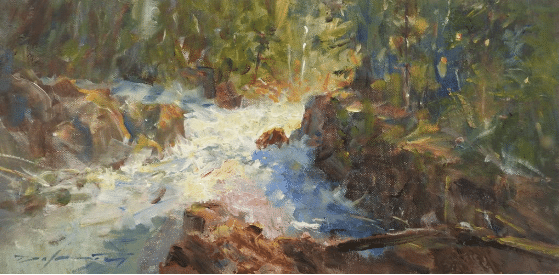
Rick Delanty, “River Bend, the Animas,” acrylic, 8 x 16 in.