“Light is the fundamental building block of observational art, as well as the key to controlling composition and storytelling. It is one of the most important aspects of visual art.”
— Richard Yot
Light has to be the single-most basic aspect of realist art (it’s what enables us to see at all), as well as one of its most refined and sophisticated technical elements. Light as it plays with shadow allows painters to create the illusion of volume, and light affects every other aesthetic value involved: color, texture. volume, even mood and emotion. But it’s not easy.
“Painting light that feels natural is without doubt one of the biggest challenges for artists that pursue painting realism,” says Matt Ryder, an award-winning British artist living and working in Dubai, UAE. He is a lifelong painter inspired by the natural world and the beauty of nature and an artist firmly committed to realism.
“To create the illusion that there is a sense of space and air using just pigment, canvas, and brush, an artist must truly understand how light affects everything that it touches and even the areas that it doesn’t,” he says.

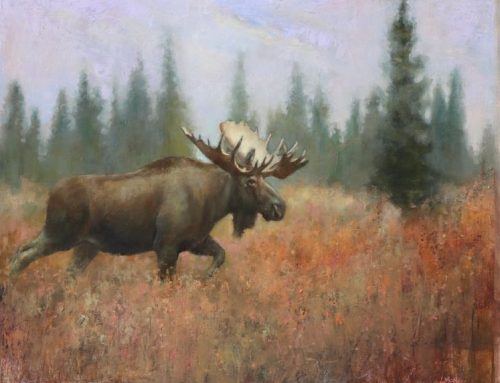
Matt Ryder, November Light, Oil on Linen, 12″ x 16”
In addition to plein air and studio landscapes, Matt Ryder is known for his own take on floral still life painting, especially roses. He has exhibited and taught in the UAE, USA and Ireland.
No matter what he’s painting, he starts outside in “real” light, even if only in memory. It’s what sets his still life paintings apart.
“When I start a new flower painting, I will always look to my experience painting out in the open air, whether I’m painting a still life set up or using a photo reference,” he says. “This experience of plein air painting, be it a landscape or a flower garden, is absolutely essential to my studio practice. The aim for me is to have every painting feel natural and filled with light, allowing the painting to become a window into a very real feeling place.”
Ryder’s sense of light – and dark – directs everything he does, right from the start. “When creating my compositions, I always look for strong contrasting areas of light and shadow,” Ryder says. “I want to get as bright and light as I can and as dark as I can, ensuring that I don’t over complicate things. Flower painting is complicated enough without further over complicating a composition by not knowing what shapes and what colors go where!”
Light also plays into his varied treatment of edges, crucial for any realist. “I use hard and soft edges to allow the flowers to feel more natural in their environment,” he says, “often fully abstracting background elements that will create a vignette of sorts, that lead the eye to what’s important in each painting.” From there, he’s free to compose at will, but his sense of light is never far from the initial observational foundation.
But there are limitations to what we can do in nature, with the light constantly in flux, and artists are lucky to be living in a time when cameras are so powerful, ubiquitous, and easy to use. However, Ryder is quick to acknowledge there are limitations to what painters can do with a photograph. Navigating between the best and worst of those worlds is something just about every realist painter does at some point.

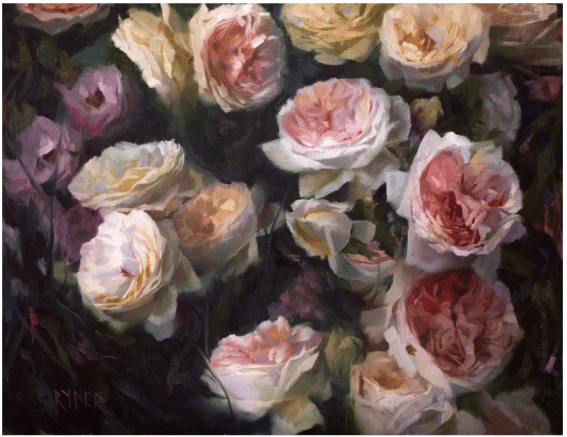
Matt Ryder, Pink Red and Green, Oil on linen – 12″ x 16”
“When using photos, I will usually manipulate the images in Photoshop to better replicate what I observed when I took the photo,” Ryder says. “Almost always that will involve lightening the shadows and adjusting the color. Without the experience of painting from life, this part of the process would be fruitless. I believe one must fully observe nature before embarking on the tricky task of painting it.”
A photograph, Ryder says, “will never pick up a subtle violet or a hint of orange, a pure cobalt or cool viridian, but when you paint so much outside of the studio an artist can begin to bring those nuances of color into the work, even exaggerating nature but still ensuring the image feels true to life and working from a monitor no longer becomes a hindrance; it just becomes another part of the process.”
Ryder is inspired and deeply influenced by the master realists of the past, including Sorolla, Sargent, Monet, Renoir, and Isaac Levitan. “These are artists who truly understood the importance of light and how much it can affect the mood of the painting,” he says. “By bringing these ideas into contemporary painting, we can get the best of both worlds, combining traditional methods and technology to create our work today.”

Matt Ryder, Blue sky roses, 11″ x 14″ – Oil on linen
“The more that I paint, regardless of subject, the more I understand I am on a lifetime pursuit to paint light,” Ryder says. “And it is taking me on a joyous journey of observation and study of our beautiful world.”
Learn the ins and outs of how to paint ROSES like a master in the video Matt Ryder: Painting Roses Simplified