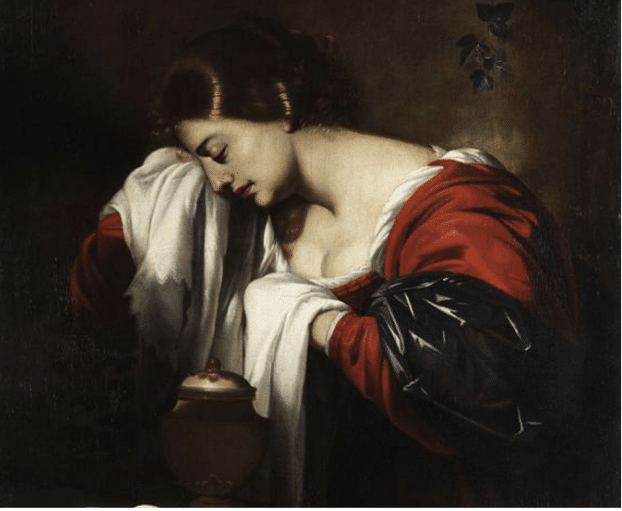
Mary Magdalene in art constitutes a fascinating and revealing subject of study as the iconography and the meaning of her image revolve and change over time.
A new exhibition on Mary Magdalene in art is showing at the Diocesan Museum of Agrigento in Sicily this summer. The show includes loans from major museums across Italy, including a large Guercino from the Vatican Museums, and features artists including Cecco del Caravaggio, Nicolas Regnier, Mattia Preti, Andrea Vaccaro and Francesco Hayez. The show will run until 30th October 2025.
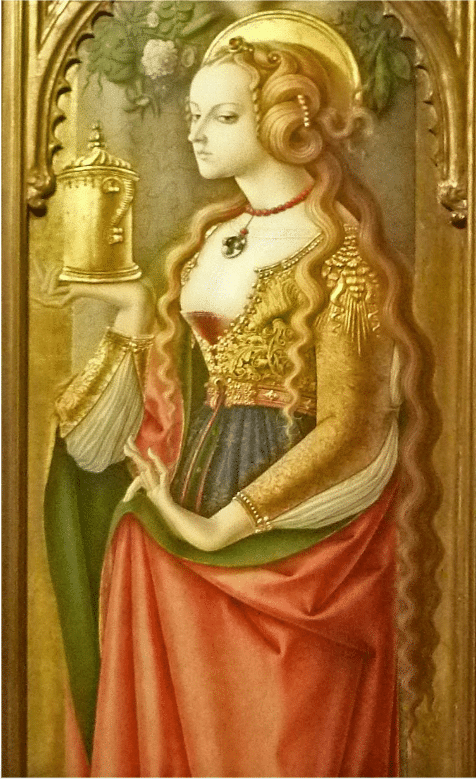
The Medieval look: This is a cropped image of an altarpiece of Mary Magdalene by Carl Crivelli, dated to circa 1480-1487. altarpiece in International Gothic style by Carlo Crivelli showing her with her characteristic long hair (in one Biblical story, she washes Jesus’ feet with her hair).
Mary Magdalene is an important motif in the history of painting. Artistic portrayals of the figure have swung pendulum-like along the same lines that the church has treated her image at various periods of history, on a spectrum between devoted follower, quiet contemplative, sensual “scarlet woman,” and penitent sinner.
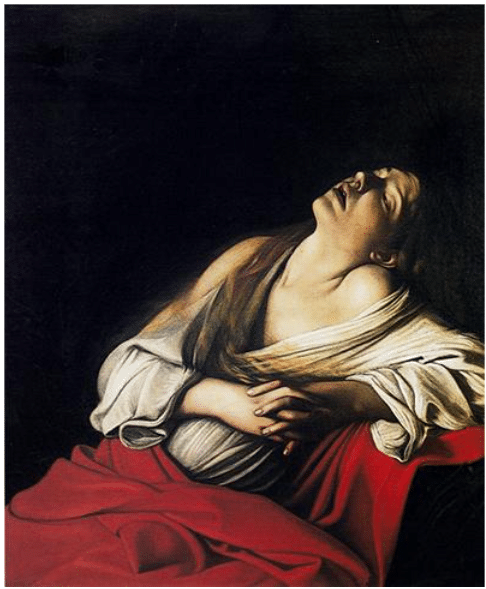
Caravaggio, The Magdalene in Ecstasy, oil, 1606, 103.5 cm × 91.5 cm (40.75 in × 36 in)
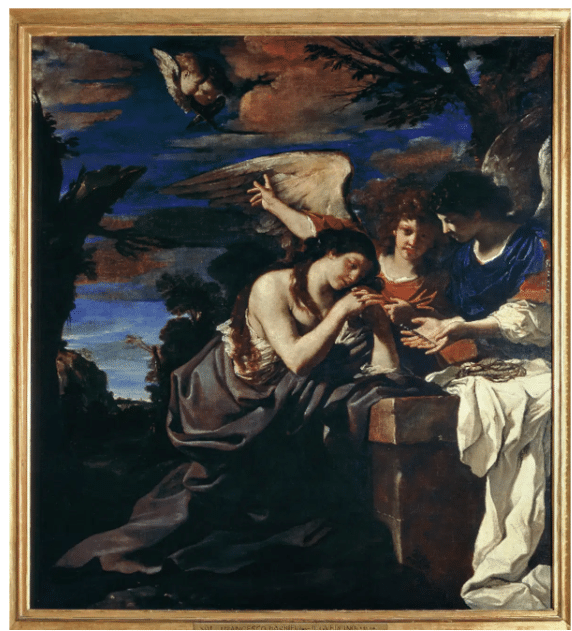
An Italian Renaissance portrayal of Mary Magdalene from the exhibition.
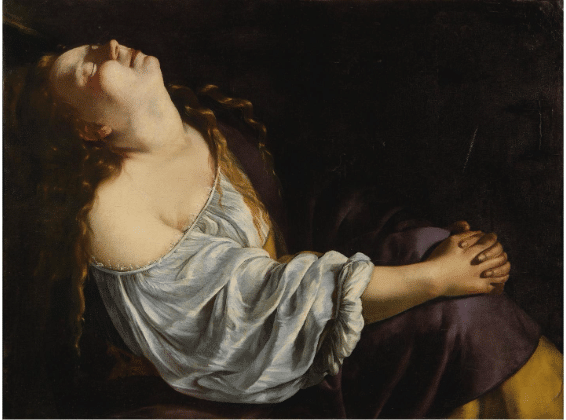
Mary Magdalene by Artemisia Gentileschi, oil, 1613-1620
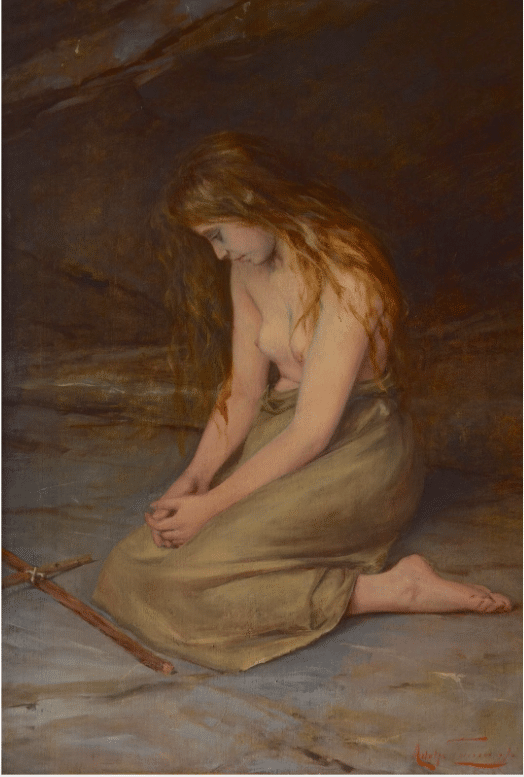
Penitent Magdalene (1893) by Adolfo Tommasi
We know that Mary Magdalene was a historical figure who hailed from the Jewish fishing port of Magdala on the banks of the Sea of Galilee. She was a prominent follower of Jesus and was believed to have been healed by him. She supported his ministry financially and was present at his crucifixion and burial. She played a major role among Jesus’s (historically neglected) female disciples.
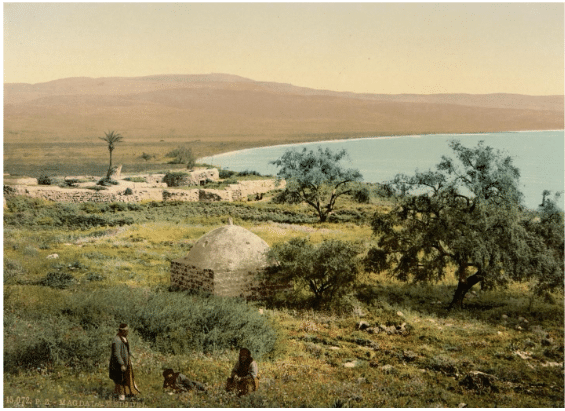
Photograph taken c. 1900 of al-Majdal, a village standing among the ruins of Magdala, Mary Magdalene’s hometown
Early Christian writings often portray Mary Magdalene as a prominent, spiritually insightful figure favored by Jesus, challenging traditional patriarchal norms. Some early texts even describer her as Jesus’s closest and most important disciple, the only one who truly understood his teachings to the extent that it caused tension with Peter. She is honored as the “apostle to the apostles” because by the early account it was she, and not Peter, who was first to witness Jesus’ resurrection.
Because Mary is listed as one of the women who supported Jesus’ ministry financially, she must have been relatively wealthy. The places where she and the other women are mentioned throughout the gospels indicate strongly that they were vital to Jesus’ ministry and that Mary Magdalene always appears first, whenever she is listed in the Synoptic Gospels as a member of a group of female disciples, indicates that she was seen as the most important. Carla Ricci notes that, in lists of the disciples, Mary Magdalene occupies a similar position among Jesus’ female followers as Simon Peter does among the male apostles.
That women played such an active and important role in Jesus’ ministry was not entirely radical or even unique; inscriptions from a synagogue in Aphrodisias in Asia Minor from around the same time period reveal that many of the major donors to the synagogue were women. Jesus’ ministry actually brought women greater liberation than they would typically have held in mainstream Jewish society. It was the later powerful “church fathers,” such as Pope Gregory mentioned above, who practically erased from history the role women played in Jesus’s following.
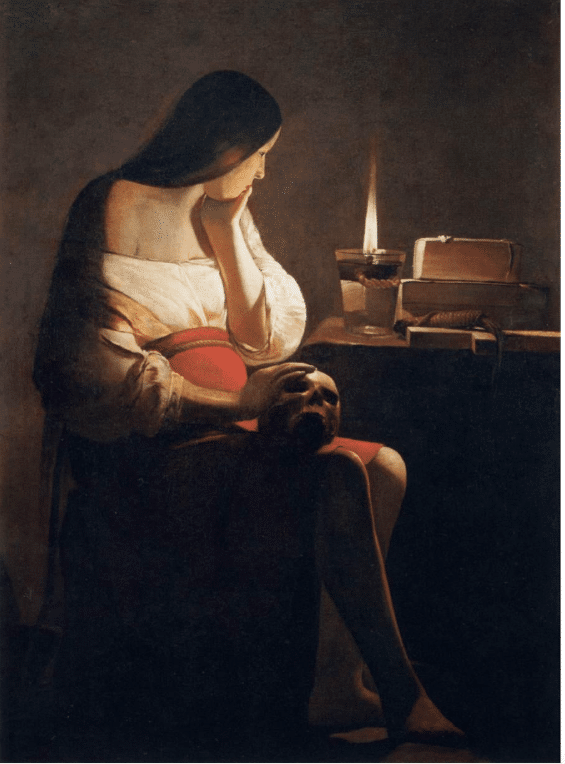
Magdalene with the Smoking Flame (c. 1640) by Georges de La Tour
Following the lead of Georges de La Tour’s marvelous “Magdalene with the Smoking Flame,” the image at times has acted as an evocation of introspection and contemplation of a deeply receptive, inward-seeking sort. The addition of a skull or an hourglass to the iconic barren landscape connects the subject to Northern European “vanitas” painting, shifting the image from a specific religious context to become about time, mortality, and mourning in general.
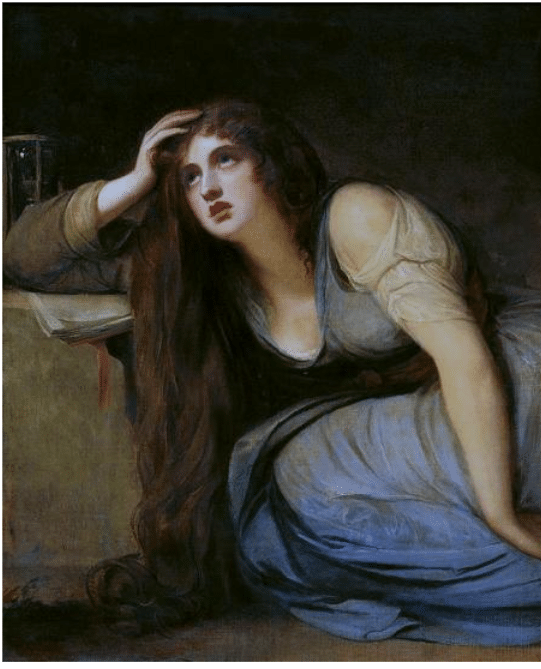
The Magdalene (before 1792) by George Romney
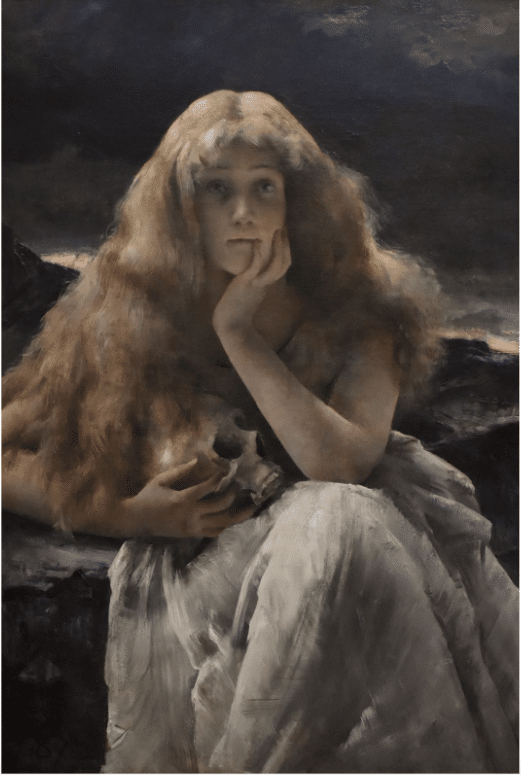
Sarah Bernhardt as Maria Magdalena (1887) by Alfred Stevens, oil, 44 in × 30.4 in
Perhaps her most provocative portrayal (“Sarah Bernhardt as Maria Magdalena”) is that of Alfred Stevens, painter of fashionable Paris, who met the popular actress Sarah Bernhardt in about 1887 and did several portraits of her. In a number of these she posed as a character from history or from literature, including this painting, Mary-Magdalene. What commands attention here is the explicit sensuality and the melancholy, almost hallucinatory stare with which Mary-Magdalene looks straight at the viewer.
This painting was commissioned by the Parisian dealer Georges Petit. Its provocativeness, even though it corresponds entirely to what Mary Magdalene represented, shocked the general public because they preferred to see her portrayed as the remorseful penitent the Medieval era made her out to be.
Exhibitions like the one in Sicily this summer are important to more than understanding the history of painting. Even a brief survey of how one motif, such as that of Mary Magdalene, has changed over time can teach us so much about the society we live in and how much power imagery and symbols (and of course art and artists) have to reflect the past and present and change the future.
Portraiture is arguably the primary genre involved in depictions of the disciple Mary Magdalene. If you’re looking to develop your own skills at the portrait, check out the dozens of videos to choose from for professional guidance here.