
I recently took in an exhibition of classical Dutch art at the Peabody Essex Museum in Salem, Mass. At the beginning of the exhibition, titled “Saints and Sinners,” I encountered a painting of the patron saint of artists – the evangelist Saint Luke – in the form of a 16th century triptych.
Made for private worship, this small triptych could easily be placed on a table to Windowsill. The central panel shows Saint Luke painting a portrait of the Virgin Mary and the infant Jesus. The Benedictine monk looking on at the right likely commissioned this intimate triptych as a visual aid for use by praying.

Triptych with Saint Luke Painting the Virgin Mary and Jesus, 1520-30, oil on panel.
Luke is said to have painted the first Christian icon, a portrait of the Virgin together with her son. Greek and Russian Orthodox Christians have a long tradition of venerating icons of holy figures. As icons, though, they’re to be thought of differently than “paintings,” according to some commentators. An icon is supposed to be thought of not as a painting of a saint, Mary, or Jesus so much as a physical /metaphysical link between the divine figure and the worshipper.

Icon-like painting of Saint Luke painting an icon. How iconic!
How different artists handled the motif over the centuries says a lot about art history’s shifts in style and subject matter (as does the fact that it’s no longer a commonly known motif in art). The focus changes quite tellingly as we move from the essentially Medieval Byzantine (Eastern Orthodox) “icon” style of the 1300s into the Renaissance or the 1400-1500s and then the Baroque period that begins roughly around 1600.
In the earliest portraits, the emphasis in solely on clearly indicating the figures and the qualities or actions they’re associated with.

Detail, a typical Byzantine/Medieval (c. 1300s) treatment of perspective and the figure.
Later, during the 1400s, with the arrival of the Renaissance, the emphasis shifts from the symbolic to the representational, from the figure alone to the figure in a setting rendered with the newly discovered methods of perspective drawing.

Master of the Holy Blood, Netherlandish, “Saint Luke Painting the Virgin and Child ,” 1520, 43.6 x 32.4 cm (17 3/16 x 12 3/4 in.) Oil on oak panel
The motif remained popular in European painting throughout the 15th and 16th centuries. The panel above is by the unidentified painter known as the Master of the Holy Blood. Since Luke purportedly painted from life the image that became the prototype for later representations of the Virgin and Child, he was the patron saint of painters and painters’ guilds. (from the Harvard collection’s curator)

The Renaissance finds the artist as interested in conveying the reality of the scene as in conveying its symbolic, religious content. This is by Derick Baegert, “Saint Luke painting the Virgin Mary,” oil on panel (112 × 81 cm) — c. 1485-90 Westfälisches Landesmuseum, Münster.
By the time we reach the Baroque period, the artist is reveling in oil painting’s new-found mastery of detailed, scientific perspective. In Gossaert’s painting of Saint Luke painting the Virgin’s portrait, there’s greater realism and i9s given primarily to the setting, perspective, painterly textures, contemporary art, literature and sculpture and the elaborate architecture that marked the period as one of intense yet increasingly worldly humanistic knowledge and sophistication (the Baroque period is when opera was invented – that’s got to tell you something).
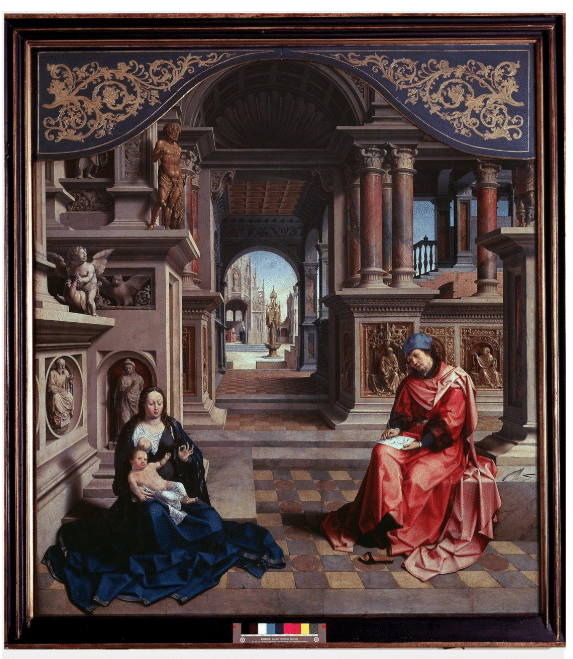
Jan Gossaert dit Mabuse (1478 ca-1532), “St Luke Painting the Madonna” (1515) Prague National Gallery)
Old master painting and drawing isn’t dead, by the way. In fact, it’s more accessible than at any pervious time in history; have a look at all the streamable videos right here.