One look at the paintings of Martin Geiger (b. 1997) and it’s evident where his artistic education took place: the Pennsylvania Academy of the Fine Arts in Philadelphia, where he earned a certificate after four years studying drawing and painting.
There he trained under the influential instructor Scott Noel (b. 1955), best known for inspiring the Perceptual Painting movement more than a decade ago. Those who follow this approach aim to paint their direct responses to the visible world with a focus on space, volume, color, and shape.
Sadly, the storied Pennsylvania Academy of the Fine Arts (PAFA), founded in 1805 by the artists Charles Willson Peale and William Rush as the first art school in the United States, is closing its college at the end of the next academic year beginning this September, as announced in January. The venerable museum will remain open and continue to offer k-12 and continuing educational programming, but no longer will the art school provide official degrees.
“The higher education environment has become increasingly complicated by rising costs, expanding requirements, and dwindling enrollment,” stated an open letter announcing the closure. “Colleges and universities in our own region and across the country are struggling with these trends. PAFA, unfortunately, is no exception.”

Landscape by Stuart Shils, one of the artist’s many “perceptual paintings” of the coast of Ireland made during a residency at Ballycastle.
For many decades, PAFA’s painting program was second to none. Influential artists Stuart Shils and Alex Kanevsky both taught in the program.
Noel’s “perceptual” or experience-based approach requires close, careful observation and thoughtful reflection. It suits artists with an admiration of, the physical world and curiosity about how we really see and inhabit it.
“The world itself almost seems like an immense playground of sorts,” Geiger writes. “Everything in my surroundings feels and looks intensely interesting at all times. It seems always about ready to reveal itself, almost like a piece of music leading up to a crescendo. It’s clear that there is something very important just beneath the surface for the artist, and making art is my best attempt at excavating these ever-present patterns and showing them to the world.”

Scott Noel, Still Life with Poppies, 2016, Oil on linen, 46 x 42 in. Source: artist’s website
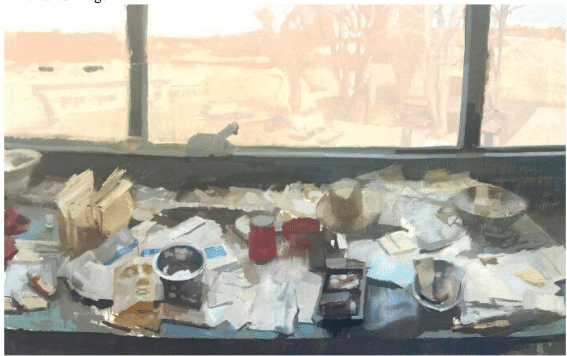
Not unlike many of the PAFA-bred Perceptual Painters, the subjects Geiger feels compelled to paint range from figures and landscapes to interiors and architecture, but fidelity to true seeing and the formal elements of light, space, color, and design are consistently the main subject. In Geiger’s “Table/Tribute to Scott Noel,” (top of page) for instance, the artist made two contrasting light sources the main characters of his visual narrative while giving a nod to his longtime mentor.
“This painting depicts a messy table covered with various overlooked envelopes, containers, and other detritus in a seasoned artist’s studio,” Geiger explains. “The dark interior and cool light bathing these items are contrasted with a blazing, luminous exterior landscape. This theme of outside versus inside was a hallmark of Scott Noel.”

Martin Geiger, New Bern White House, oil on canvas
Born in Charlottesville, Geiger has returned to Virginia and now makes his studio in Staunton. There he is an instructor at the Beverly Street Studio School and also serves as head assistant at Bronze Craft Foundry in nearby Waynesboro. Geiger has won two grants from the Elizabeth Greenshields Foundation (2018 and 2022) and considers those experiences instrumental in helping him realize several large-scale works.
Parts of this article first appeared in Fine Art Connoisseur. Learn more about the magazine and subscribe to the beautifully produced print version here.

Kevin Macpherson, If it’s Wednesday it Must be Arles, oil
Master Artist Kevin McPherson judged last year’s (July 2023) PleinAir Salon. He takes a very observational-Impressionist approach to plein air and studio work. Several of his popular teaching videos are available, singly and in a special bundle, here.
The monthly PleinAir Salon rewards artists with over $50,000 in cash prizes and exposure of their work. A winning painting, chosen annually from the monthly winners, is featured on the cover of PleinAir magazine. The deadline is ongoing, so visit PleinAirSalon.com now to learn more.
Richard Sneary: Watercolor Master

Richard Sneary, Carrie Furnace #6, watercolor, 15″ x 22
Precision. Design. Mastery of light and color. These are the qualities you notice right away in the watercolors of Richard Russell Sneary.
Richard Sneary was born in Baltimore, raised in Kansas City, and educated at the University of Kansas. Sneary has been drawing since the age of 5 when a piece he executed in kindergarten was published in the local paper.

Richard Sneary, Carrie Furnaces #5, watercolor, 20 x 12 in.
That same year, Sneary’s aunt gave him a book, How to Draw Dogs by Walter Foster (although very worn and tattered he still has the book) as a Christmas gift. It was those two events that started his successful art journey and encouragement kept him drawing and painting through high school and college.
Sneary attended the University of Kansas. He started by majoring in architecture, and he worked for various architectural firms in Kansas City during the summers. As part of the curriculum for a degree in Architecture, students were required to take drawing, painting, and sculpture courses. Sneary was fortunate to have gifted artist — Professor James Sterritt – as one of his instructors, whose influence still guides him today.

Richard Sneary, Scarlet Catch, watercolor, 7 x 10 in.
Sterritt’s classes were an oasis of creativity to all studying architecture at KU in those years. As Sneary states, “We could step away from architecture and explore art and Jim made it fun.”
Sneary started his career as a painter in 2011 after 40 years working as an architect, architectural illustrator, and educator. During the early part of his artistic career, Sneary worked primarily en plein air. Sneary prefers painting subjects that reflect mankind’s presence in our environment…buildings, bridges, industrial structures, fences, telephone poles, people…and the natural landscape.

Richard Sneary, Boquillas Canyon 3, watercolor on paper, 11 x 14 in.
Sneary is a signature member of the National Watercolor Society, and his resume boasts a long list of top-tier affiliations and prestigious awards.
His teaching video, RICHARD RUSSELL SNEARY: WATERCOLOR MASTERY – LIGHT & SHADOW is on sale here.