Recognized for her expressive brushwork, contemporary compositions, and intelligent use of color, Nashville native Lori Putnam paints small to medium-sized works en plein air and creates large paintings in her studio. Having painted in 16 different countries and hundreds of small towns and villages, she believes, as she told us in an interview, that creating work from life helps her maintain freshness in her studio paintings as well.
Read part one of our extensive interview with Lori here.
How do you approach color? Do you use only local color, or do you change the color to make a better painting? How?
Depends. If I’m outdoors and working on my own for growth, I put down what I see. That’s the knowledge-gathering part. If, however, my job that day is to paint a great painting, I’ll make choices in the planning stage about where to put the most intense color and think about what that color will actually be, as well as choices on where I may need to sacrifice some color that is really in the scene by making it more neutral.
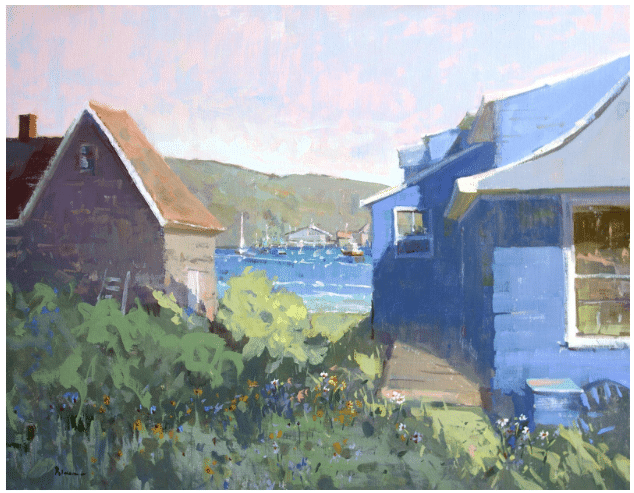
Lori Putnam, Cape Cottages, 24 x 30 in.
What’s the biggest challenge you see with students and color? What advice do you give them?
Everyone who studies with me wants to be more colorful. Usually, they are using too much color to begin with. My paintings are really pretty neutral, with some places slightly more intense. If you have a lot of neutrals, you do not need much chroma to make a painting really seem filled with it.
Oftentimes, my workshops are taught with a primary palette of just three colors and white. Learning about colors happens on that level. Take the phthalo green and Prussian blue off your palette and just work with cad yellow, naphthol red, and ultramarine blue plus white for the next 50 paintings. You will be much better for it.
How do you think through the composition of your piece? What does a painting need to have to have a strong composition?
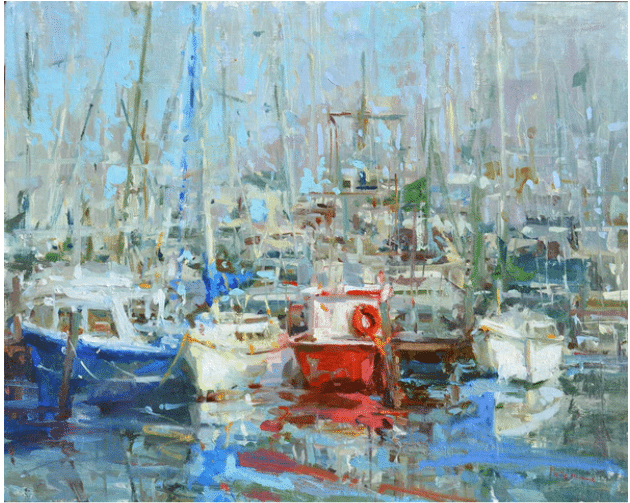
I view design and composition as different ideas. Design is the abstract. It involves balance (better yet, imbalance) and weight and ultimately supports the composition. The composition, on the other hand, must be put together in such a way as to tell the viewer what it is that you want to say. Everything in the composition should bring clearer understanding of the visual statement. Anything that does not strengthen the statement should not be part of the composition. It’s just detail. Leave it out.
I look for strong design first, and edit elements in the scene to support that. Students will ask me about my focal point. Not every painting’s statement needs one. I know … shock and awe. But it’s true. And if it does have a focal point, it doesn’t have to scream at you, “Hey, I’m the big red barn. Look at me.” There are more subtle ways to handle a focal point if it is your intention to have one.
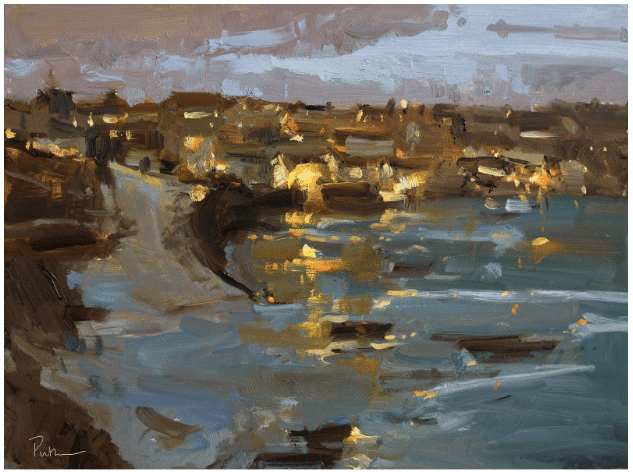
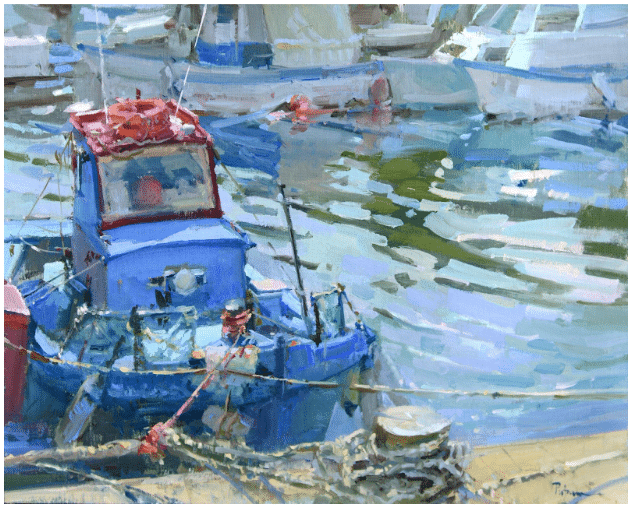
Lori Putnam, Harbor Nights, 9 x 12 in.
Plein air painting can feel intimidating to a painter of any skill level. Any advice to a beginner?
Remember these things:
Plein air painting will be the toughest sport you’ve ever played. The reward is worth it.
You will get discouraged, bitten by bugs, rained on, and your easel will fall over and break. It is likely that all of this will happen on the same day. On day two, you’ll feel more successful because at least one of those things probably will not happen.
They don’t all turn out well. No matter what you think, not every painting actually works. That is true for every painter you can name …every painter. Ty Cobb batted .366 over 24 seasons, making his career batting average the highest in Major League Baseball. If, in the course of your career, you average four out of 10, you’re batting better than Ty.
The best news? Every painting has a lesson. Sometimes it is what to do; sometimes it is what not to do. Either way, it’s time well spent.
What do you want from your brushwork? How do you get that?
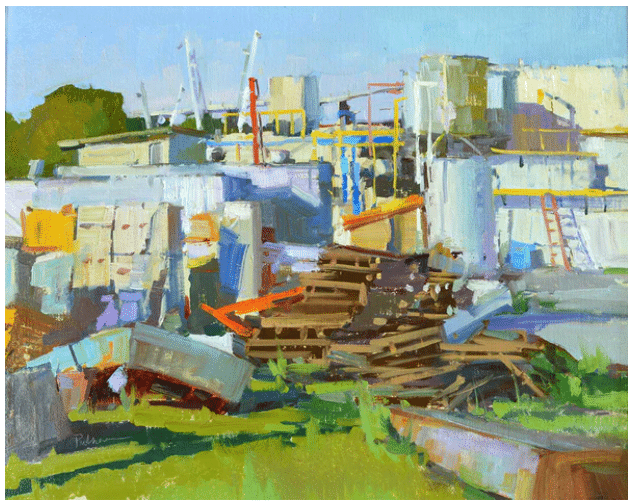
Movement or silence — every stroke has a purpose and is meant to evoke either one or the other. Having the right tools helps me do that. Each type of brush, its composition and its shape, offers unique mark-making, and it isn’t always what your first impression of the brush is. I experiment a lot with brushes and other tools and am always finding new ways to use them.
Students are often surprised to see how I use a specific brush. One thing is certain — a brush has many sides and surface areas. Because I use mostly those with the longest shapes (extra-long flats and egberts), I can really load the brush on all sides and hold it parallel to the painting surface. Then, by altering the pressure, I achieve whatever shape and edge I want. Understanding brush pressure and paint consistency is a steep learning curve. Because I love to paint wet-in-wet, one effect I particularly like is to use stiffer brushes such as Rosemary & Co Classic series in the earlier stages, then slowly move to slightly softer and slightly softer, like to the Ivory series, then the Evergreens, and finally either Master’s Choice or pure sable for the final layers.
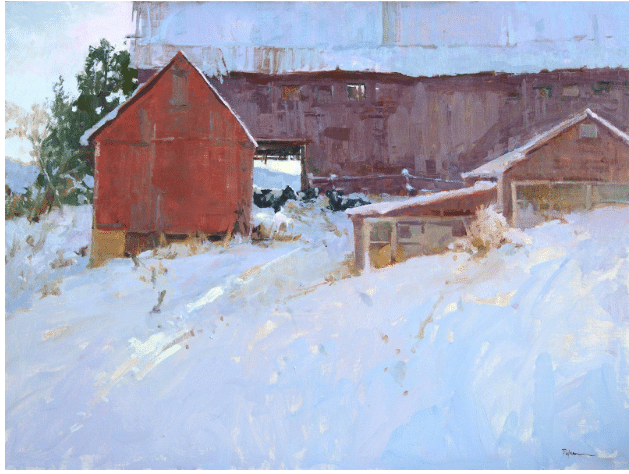
Lori Putnam, “Morning on the Farm,” 30×40 in.
How do you assess a piece after it’s finished?
The temptation is to immediately post it on Facebook. That is rarely a good idea. If it’s a studio piece, I may show some progress shots or create a video of the process, but setting it aside for a few days and then revisiting it is always a better choice. Many times, at the end of the day, I will think I really liked something. The next day I wonder what in the world I was thinking. Of course, it’s better when the opposite happens and the thoughts I have all night about how horrible a painting is turn out to be false when I wake up in the morning. If all of the shapes have been resolved to my satisfaction, then I know it is finished.
Lori Putnam teaches her methods in a detailed yet easy to follow video titled “Bold Brush Strokes and Confident Color,” available here.
PLEIN AIR CONVENTION & EXPO at LAKE TAHOE
It’s not too late to snag tickets for the 12th annual Plein Air Convention & Expo in beautiful Lake Tahoe May 19-22, but there are under 150 tickets left and they’re going fast. If you want jump in, register here!
There’s a new plein air trip this year too – Switzerland! Eric Rhoads has designed an extraordinary and exclusive 11-day luxury painting tripthrough Switzerland’s secluded Alpine valleys and charming villages to create the ultimate body of work and a lifetime of memories. Paint the same scenery that inspired Sargent, Monet, Renoir, Sorolla, Courbet, Cassatt, Pissaro, Bierstadt, Levitan and many, many others! More info at https://www.paintswitzerland.com