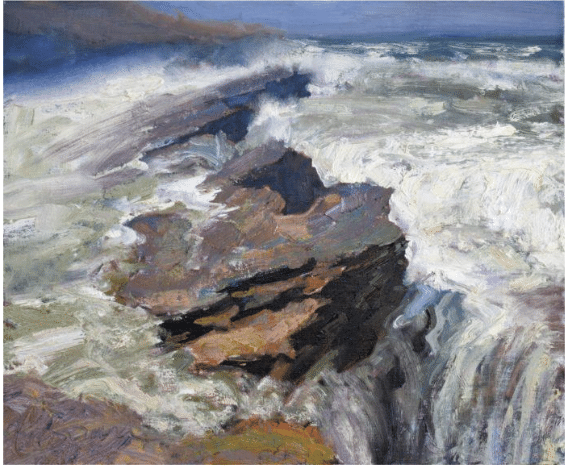
Robin Caspari’s painting, “The Edge,” (above) celebrates the raw power of surging ocean waves and jagged rock with expression and skill, qualities that won it first place in the May 2022 PleinAir Salon.
“In this painting,” said Salon judge Karen Hagan. “I saw great composition and sense of place paired with varied brush work. I loved the depth of field and the foreground detail leading to the gray mistiness of the background. Mostly it’s the movement that the artist captured that got my eye! It’s an exciting painting, one I’d like to see every day in my home.”
The artist herself tells the story of this painting’s making below.
On Painting “The Edge”
by Robin Caspari
My Inspiration
The rushing water over the rocks and portraying the feeling that man didn’t, or couldn’t, belong in this space was the inspiration behind the painting. I wanted viewers to feel the raw power of water and rock colliding. My goal is to paint a large piece of this design to really enhance the “fear factor” or adrenaline rush that comes with encountering nature in its dangerous and raw state.
My Palette
What is mostly unique about my process is my “Valor Palette.”<< https://www.robincaspari.com/valor-palette/standard_products/valor-palette This simple invention allows me to work the value scale and the color wheel simultaneously while I paint. I slowly invented it over the years, and shared it with my students.
Once I added the color wheel around the perimeter, it just popped! We all love it because it’s information at our fingertips, and allows us to get into the flow of our painting instead of wasting too much energy thinking about value and color.
I keep my palette simple with the three primaries of Quinacridone Red, Ultramarine Blue, and Cad Yellow Light, and Titanium/Zinc White. I then mix my secondaries from my primaries. I have been adding in some radiants by Gamblin so that I can shift value and color at the same time. It’s just a time saver. At this point, I have eliminated all browns and neutrals that are from a tube. Not because it’s better, but because that’s just where I am right now. I’m loving how clean my darks are without using dark browns.
When I limited my palette to the primaries and secondaries I noticed an immediate harmony to my work. Recently, I have been playing around with a VERY limited palette, and it has been magical to understand the large band width I still retain, and the harmony is on steroids seemingly. So much to learn in this game of painting!
My Composition
I spotted the composition within a larger photo reference I had taken while visiting Point Loma, CA. I zoomed in, and then began playing with shapes. I painted three or four small studies until I found the one that was most powerful.
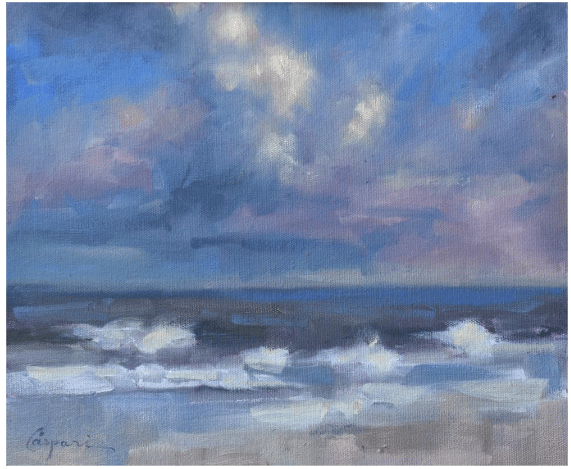
Robin Caspari, “North Beach,” oil, 12 x 10 in.
Challenges
I see painting as a juggling act. You have all these balls in the air that have to move in rhythm together. If one ball falls at any time, the whole painting falls apart. The artistic flow is of utmost importance. I do see a difference in training and performing.
Tools
I like to use a variety of brushes when I work so I can achieve interesting strokes. I tend to like angles and filberts as my go to. My all-time favorite workhorse brush is the Catalyst by Princeton #6. It was given to me by a vendor when the Plein Air Convention & Expo was in San Diego. I teach with this brush because I can make a million shapes with it on many different paintings.
Derek Penix introduced me to the Shiraz Filbert by Rosemary. The #10 is a great brush for large strokes with some control.
Carolyn Anderson introduced me to Rosemary’s Ultimate Pointed Round #4. I use it to make interesting smaller shapes and start a painting. I also love Rosemary’s Extra Long Filberts. They are great for all around use. In general, I hold the belief that one should use the biggest brush possible in the space they are filling with paint. I’m sure I used all of these brushes while making “The Edge.”
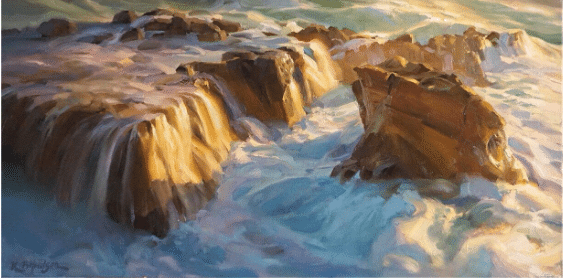
Kathleen Hudson, Surf Patterns, Oil on canvas, 15 x 30 in.
Creating a compelling seascape is as much about composition and patterning as it is about depicting water and foam in light and shadow (as Salon judge Karen Hagan remarked regarding Caspari’s “The Edge.”). Artist Kathleen Hudson has all of these moving parts working together in her painting, titled “Surf Patterns,” above.
You can follow along as Kathleen teaches her method for painting dynamic seascapes in her video, Creating Dramatic Atmosphere in Landscapes.
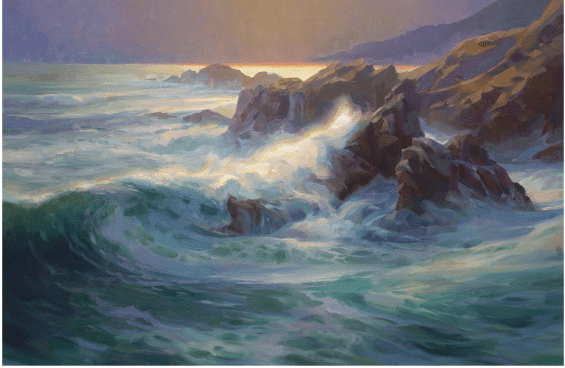
Kathleen Hudson, “Garrapata Surf,” Oil on linen, 20 x 30 in.