
What You Should Know
The legend of the “lover’s leap” is found all over the Americas and the world. It was a particularly popular motif in one form or another during the Victorian period, peaking around the 1870s and ‘80s.
Mythologist Kirsten Ellen Johnsen finds an early embodiment of the lover’s leap in the legend of the ancient Greek poet Sappho. Although it’s probably untrue, a story from the Roman poet Ovid suggested that Sappho threw herself from a cliff when her heart was broken by Phaon, a young sailor. As represented by European poets and painters, the image of the woman poised on the clifftop, crashing waves below, partakes of the sublime.
However, consider the painting The Chimera (below) by nineteenth-century French master of the fantastic Gustav Moreau. In Moreau’s painting the “leap” isn’t down so much as up – the lover jumps off the cliff and instead of falling finds herself lifted straight into the sky.
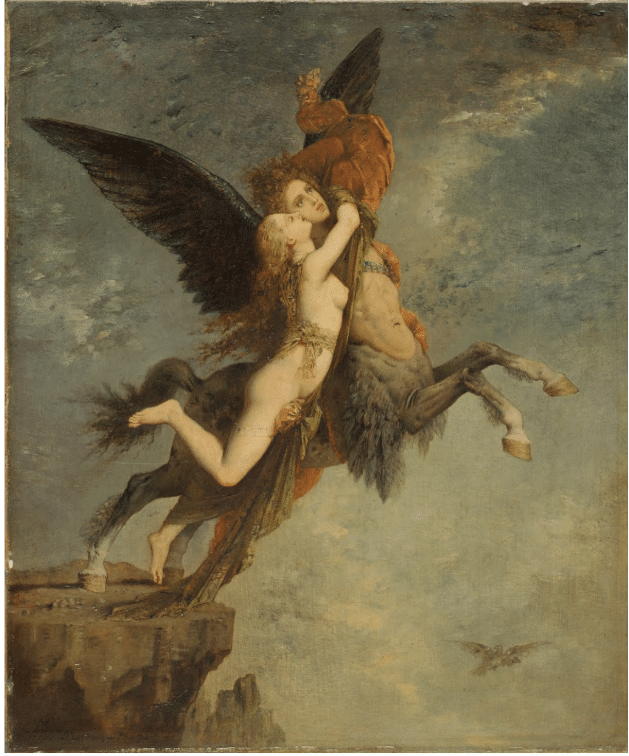
Gustave Moreau, The Chimera, oil on canvas, w27.3 x h33.0 cm
(1867) Harvard Art Museums/Fogg Museum, Bequest of Grenville L. Winthrop
Why You Should Care
The Lover’s Leap can be considered an archetype – a powerful image appearing in various narratives and media with potent psychological resonance. Seizing and reimagining such a symbolic or archetypal image can empower you to create new meaning and to dare to consider your life and work in new ways.
As an image of the helpless heroine, the Lover’s Leap motif is finished – long out of date. However, as an archetype, THE LEAP can be reconsidered as a positive action, full of conviction, courage, and intention: They who leap give themselves to something larger, something perhaps on the scale of Nature or the Cosmos – for artists it’s Imagination, Inspiration, the New. Getting out of your own way is done by a leap of faith, a letting go that is not a surrender but an affirmative act of joining with the wider currents of the whole.

Marcus Stone, The Lover’s Leap, engraving, 1878
What You Can Steal
Classical realists like Selva and Moreau often used colors blended into moody, yet harmoniously related hues. The palette of these painters is neglected today; most contemporary painters don’t know it or don’t think about using it. Mixing various pigments via trial and error would yield this or an equivalent series of fascinating and unusual hues.
A palette of such muted yet beautiful colors (especially that of the top painting by Selva) would make a drop-dead gorgeous contemporary portrait, still life, or seascape even without the figure; Selva’s approach, on the basis of color alone, is striking and seductive, and it’s there for the taking.
How This Can Inspire You
In the painting by Moreau (middle), the lover (the winged centaur figure) is the Chimera, a fantastical creature from mythology sometimes used to represent the imagination. Escape stale routines on the wings of inspiration. The way out is up!

Antoine-Jean Gros, Sappho, oil on canvas, 48” x 39” (1801)
Something to think about: What’s an area of your life or your art where clinging to the familiar is holding you back? What kind of art would you make if you leapt off into the arms of the unknown?
Wish you knew how to paint like the “old masters” painted? Check out the video from Juliette Aristides, Secrets of Classical Painting.
The Artist’s Dilemma: A Color Snapshot

Angela Bandurka, Chromatophilia, acrylic on cradled panel.
Angela Bandurka painted the work above, titled “Chromatophilia” in 2021. The word chromatophilia refers to the love of color.
“It’s a sensation I’ve felt since I was a child,” the artist says. “This painting was created from a photograph I had taken inside the gorgeous art supply store L Cornelissen & Son in London, England. The way they have displayed raw pigment and tubes of paint is just so delicious – you want to live inside that store! I loved every inch of it.”
The figure, complete with a subtle halo of illumination around his head, “represents all of us artists” she says, prone to the state of being “indecisive and at the same time energized and in awe.”
Angela Bandurka took her place among the many teaching artists who shared their painting techniques in the first Acrylic Live that took place this past March. It’ll happen again next year, so put it on the calendar if acrylics are your passion.