
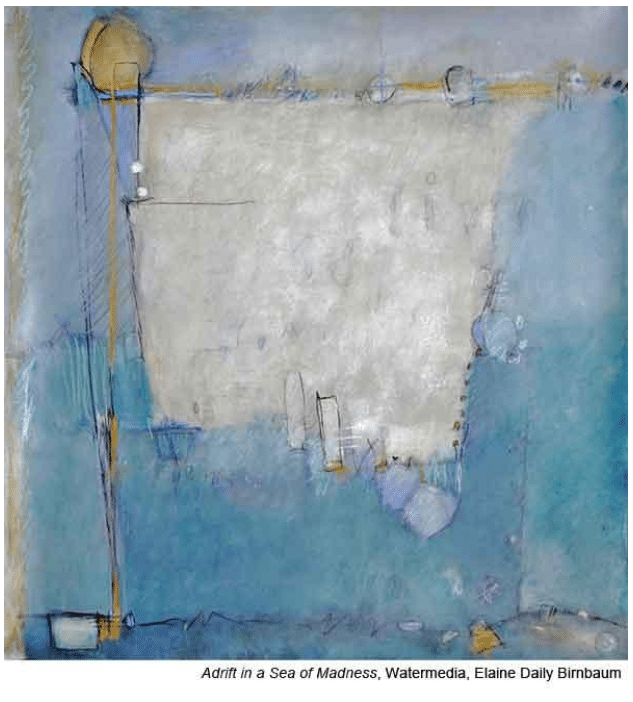
Elaine Daily-Birnbaum is a mixed media painter. Her abstract work is deeply personal and very much process centered. She is a member of the National Watercolor Society and the American Watercolor Society. We asked her about her work and what draws her to abstraction.
What are the biggest misconceptions you come across about abstract painting? What are your responses to those misconceptions?
One major misconception about abstract art is that it is simply the random, haphazard application of paint without direction or reference, and some might even say, artistic skills. This view is most generally held by one not educated in art.
However, the principles of composition and design elements are even more crucial to a successful abstract painting than to a representational or realistic painting. Without a distinct subject, an abstract painting must depend solely on the successful application of these principles and elements to create an image of visual interest and intrigue. An abstract painting must overcome the brain’s natural desire to identify an object.
What is it that you love about abstract painting? What does the subject give you as an artist that another subject wouldn’t?
Even before I ever painted abstractly, I was drawn to abstract paintings…. paintings that provided me with a unique, subjective experience, paintings that provoked an emotional or psychological response, paintings that flirted with my mind. I prefer not to be told everything, but rather be allowed to experience the qualia of a painting.
To me, suggestion can be more powerful than reality. I agree with Albert Einstein that “The most beautiful thing we can experience is the mysterious. It is the source of all true art and all science.”
In addition, I love the freedom of expression that abstract painting affords me. That process of exploration and discovery with paint is what I find so exciting. The outcome may or may not be satisfying, but, oh, the ride getting there.

What are the general steps you take between a blank page and a finished painting? What are you focusing on at each step?
I begin each painting by applying a warm or cool color paint to the entire paper. The specific color often depends on what’s remaining on my palette, although there are times I purposefully choose a particular color for this initial coat.
Next, I may draw on the paper with crayon d’arche or inks in a somewhat exploratory manner. These marks become part of the background, some “history,” that may or may not be revealed in the final piece.
From there, I continue to apply many thin layers of watermedia (watercolor, acrylic, gouache, inks, etc.) wiping after each layer to remove some and leave some, thus furthering the “history” and depth of the painting. (At times, I think I take off more paint than I put on!) During this process, I am totally immersed and almost hyperacutely aware of what’s transpiring visually and begin to find my anchor and get a sense of the direction I wish to pursue. This becomes more firmly established with each additional brush stroke or mark as I inwardly explore a concept or idea in paint.
I continue working and re-working the painting until it begins to speak to my soul. Many times artists I paint with have suggested I stop….. that the piece I am working on is finished. They are dismayed that when they next see it that I have painted over it or changed it in some major way.
However, I am not driven to paint for anyone but myself. The painting has to speak to me and stopping short of that is impossible.
It’s interesting that, as artists, we know how to utilize composition principles and design elements to purposefully direct the visual experience of the viewer. We know the neuroscience of vision and can manipulate that. However, what is more important, in my opinion, is the emotional response to a painting. I can only address my personal response. I can only paint to satisfy me. That anyone else reacts positively to my paintings is a bonus but not a goal.

If you’re interested in getting creative with water media, check out the crash course you get with this specially priced “Watermedia Discovery Bundle,” It’s a veritable go-to quartet of high-quality teaching videos that will open new creative vistas and techniques in your painting.