What can you do when a painting isn’t working (besides give up ☺)?Oil painter/pastellist William Schneider has an answer! (Okay, It’s ONE answer but it has four parts. But they’re all related!) Schneider’s compositions are at once compelling and remarkably stable. According to him, here’s something he learned from another artist that makes a big difference.
By Contributing Writer, William Schneider
“Bill Parks, my life drawing instructor at the American Academy, gave us a four-part question,” he says, “that solves most problems”:
- Is the drawing right?
- Are the values correct?
- How about the edge relationships?
- Are the color temperature relationships right? (i.e. if the light is cool the shadows will be warmer; if the light is warm, the shadows will be cooler.)
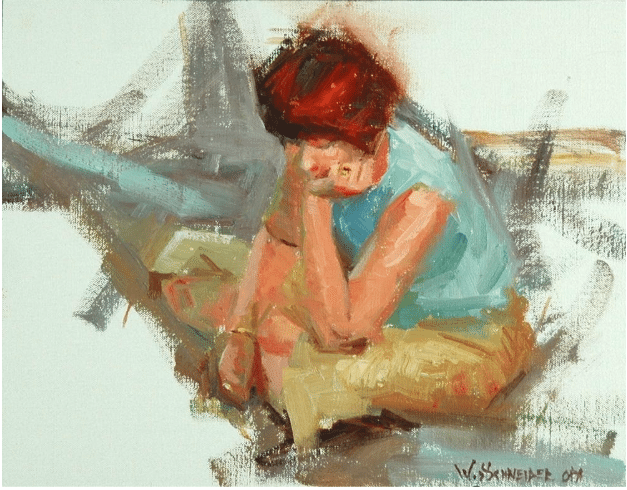
William Schneider, Nan – Unframed ‐ Oil ‐ Linen on Panel ‐ 11 x 14 x .2
If we pose the four-part solution to the painting above, it might look something like this:
- Is the drawing right?
The figure’s proportions etc. are anatomically sound. More importantly, the foreshortening of the figure because of the pose (a matter of perspective) is perfect. The way Schneider left the legs fairly unresolved keeps our attention on the more well-delineated features of the face and the body language (hunched over but not uncomfortably, chin in one hand, other arm art rest). Beyond accuracy, the drawing conveys the inner workings of the figure’s psyche.
- Are the values correct?
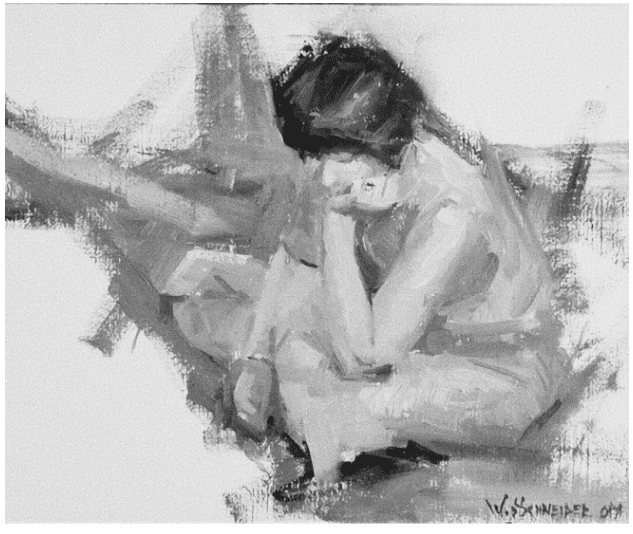
Taking out all the color in a graphic program allows us to see how well the values work here. The dark hair and the equally dark shadow below the figure grab our attention and hold it, as if sealed in a container. The bold darks give permission to the more subtle tonal planes and transitions to be themselves without having to be as explicitly attention-grabbing.
- How about the edge relationships?
The edges are sharp where they need to get our attention (at the edges of the hair and the dark under-shadow) and soft (or “lost”) where the eye needs a smooth, unhurried movement through the otherwise complicated forms of the body.
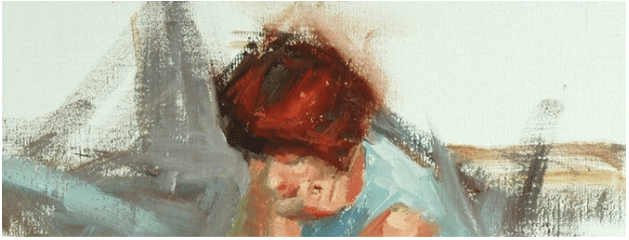
Detail of the painting above showing where hot (hair, flesh) meets cool (background).
- will be warmer; if the light is warm, the shadows will be cooler.)
Keeping his background cool, (super light blue and gray) ensures the warm flesh tones (warm pinks and salmons accentuated by dashes of hot orange-red). All the better to show off the riveting red hair.
“I would add a fifth question,” Schneider says: “Is the distribution of light and dark shapes interesting? In other words, does it have a strong design?”
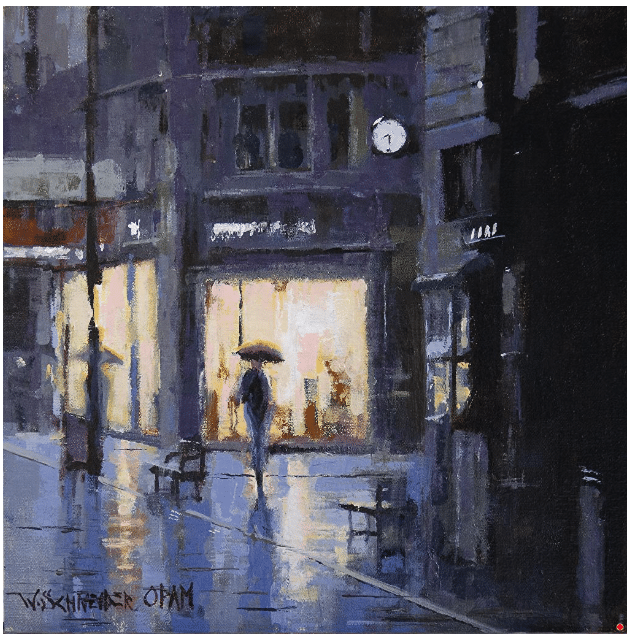
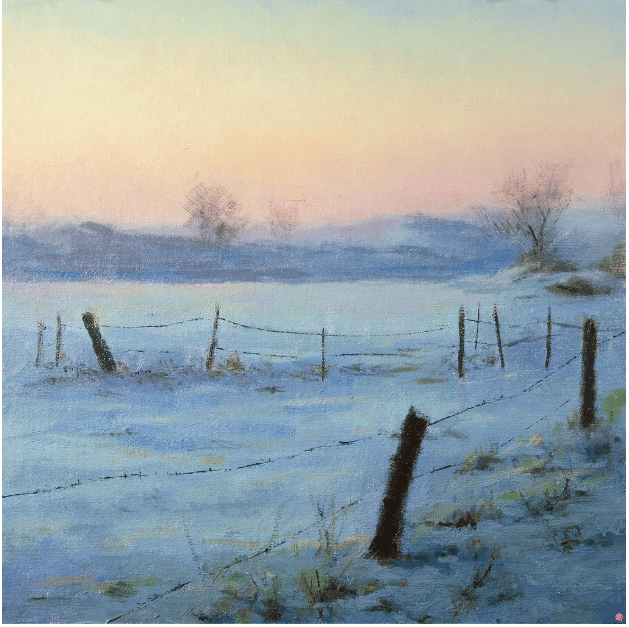
William Schneider, Window Shopping, Oil ‐ Linen on Panel ‐ 12 x 12 x .125
“The answers to the first four questions can save a painting that is in process,” he says. However, “the design usually needs to be worked out in the beginning; it’s often not possible to salvage a painting that wasn’t well-planned at the start.”
William Schneider offers numerous videos covering technique, including composition, mediums (oil and pastel), color, and the most crucial aspects of the figure. Browse his many popular teaching videos here.