Bouguereau: The name is synonymous with the golden age of the world-renowned French salon. Even today, realists the world over revere William Adolphe Bouguereau’s beautiful paintings of creamy skinned peasant girls, comely Madonnas, and nude, mostly female figures adapted from Greek mythology.
Until recently less well known are the works of American artist-in-Paris Elizabeth Jane Gardner Bouguereau (1837- 1922), who added William’s name to hers after they married. Gardner’s work is steadily becoming becoming better known and appreciated in its own right.
Elizabeth Jane Gardner arrived in Paris in 1864 and initially supported herself by selling copies of Old Master paintings in the Louvre to American travelers and residents in Paris. Her own work debuted at the Salon in 1868, and Gardner became along with Mary Cassatt, who was also chosen that year, one of the first American women to exhibit in the annual gala. Gardner would have the longest (50 years) career of any expat female artist, eventually showing a total of 36 paintings at the Salon, more than any other woman of any nationality.
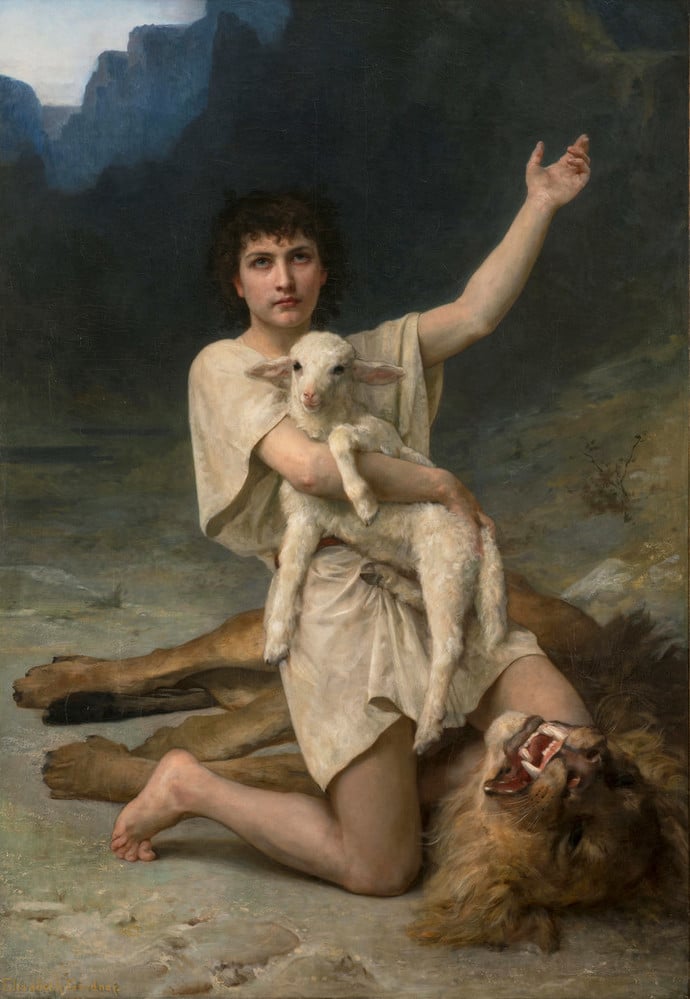
Elizabeth Jane Gardner Bouguereau, The Shepherd David, ca. 1895; Oil on canvas, 60 1/2 x 41 3/8 in.; National Museum of Women in the Arts, Gift of Wallace and Wilhelmina Holladay; Photo by Lee Stalsworth
She was born to a well-to-do family in Exeter, New Hampshire. After graduating from private girls’ schools there, she began her studies in art at Lasell College in Newton, Massachusetts. In Paris she could study contemporary and old-master paintings, but while Paris beckoned all late 19th century artists, women were still barred from studying at the prestigious École des Beaux-Arts. Undeterred, Gardner enrolled in private classes at the Académie Julian, where she took classes from William-Adolphe Bouguereau, the man she would marry years later (in 1896, long after she’d established a successful career). Still, like her contemporary Rosa Bonheur, she applied for police permission to dress in men’s clothing in the all-male classes and kept her hair short to make her attendance seem less indecent.
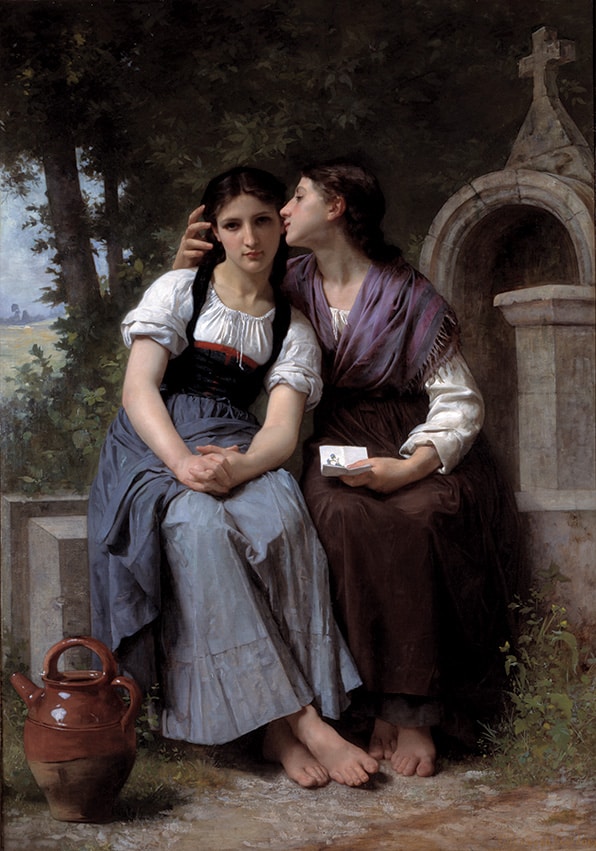
Elizabeth Jane Gardner Bouguereau (American, 1837–1922), La Confidence, c. 1880. Oil on canvas mounted on aluminum, 68 x 47 1/8 in. Georgia Museum of Art, University of Georgia. Original gift of Mr. George Seney to the Lucy Cobb Institute, Athens, GA. GMOA 00.67. Courtesy of American Federation of Arts
With time, arduous study and hard work, she became one of the earliest examples, in American art, of a woman artist living entirely off the sale of her work. Soon enough she started turning down multiple offers and and time-consuming commissions, confident she could break into the big time. In 1887 Gardner had the distinction of becoming the only American woman to receive a Salon medal. On May 30 of that year she wrote to her brother John back in New Hampshire:
My pictures at this year’s Salon have just received the medal which I have waited for so many years. I hasten to write you by the first mail for I know you will All sympathize with me in my happiness. The jury voted me the honor by a very flattering majority – 30 voices out of 40. … No American woman has ever received a medal here before. You will perhaps think I attach more importance than is reasonable to so small a thing, but it makes such a difference in my position here… and I hope it will be a good thing for the sale of my paintings. … Monsieur Bouguereau is very happy at my success.
The painting that earned her such a distinguished position among expatriate and French artists was The Farmer’s Daughter. It can be considered a landmark painting in the history of American and French art, as it documents the long and arduous efforts of women painters like Gardner who aspired to professional careers within the male-dominated exhibition and training sites of mid-nineteenth-century France.

The Farmer’s Daughter would bring further fame to the artist in 1889, when it was given a place of honor in the Main (“Expatriate”) Gallery of the United States Section of Paris’ Exposition Universelle.
The Farmer’s Daughter sold at auction for $495,000 in 2010. Southeby’s, the famous action house, says the following:
“One contemporary source describes how the artist came to paint this scene: “one afternoon, when Miss Gardner was on a sketching excursion, she was overtaken by rain and was forced to seek shelter in a barn. While there, she saw the “farmer’s daughter” feeding her fowls, and was so struck with the picturesqueness of the scene that she made a drawing from which grew her prize picture” (Undated newspaper article, Elizabeth Gardner Family Archives).”
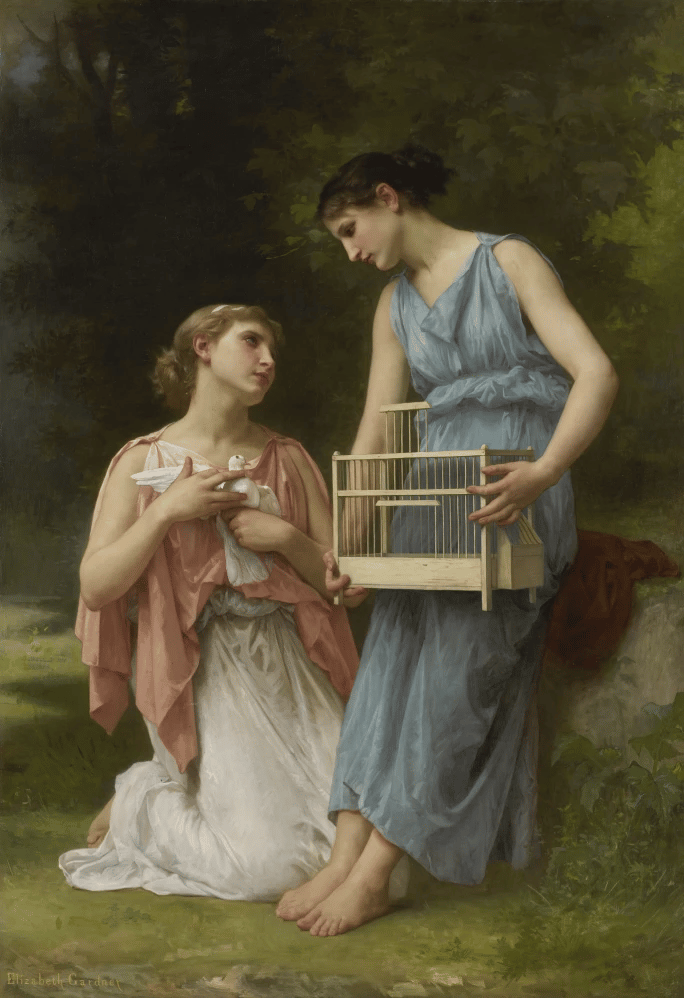
Elizabeth Jane Gardner, The Captive, 1893. Sotheby’s photo
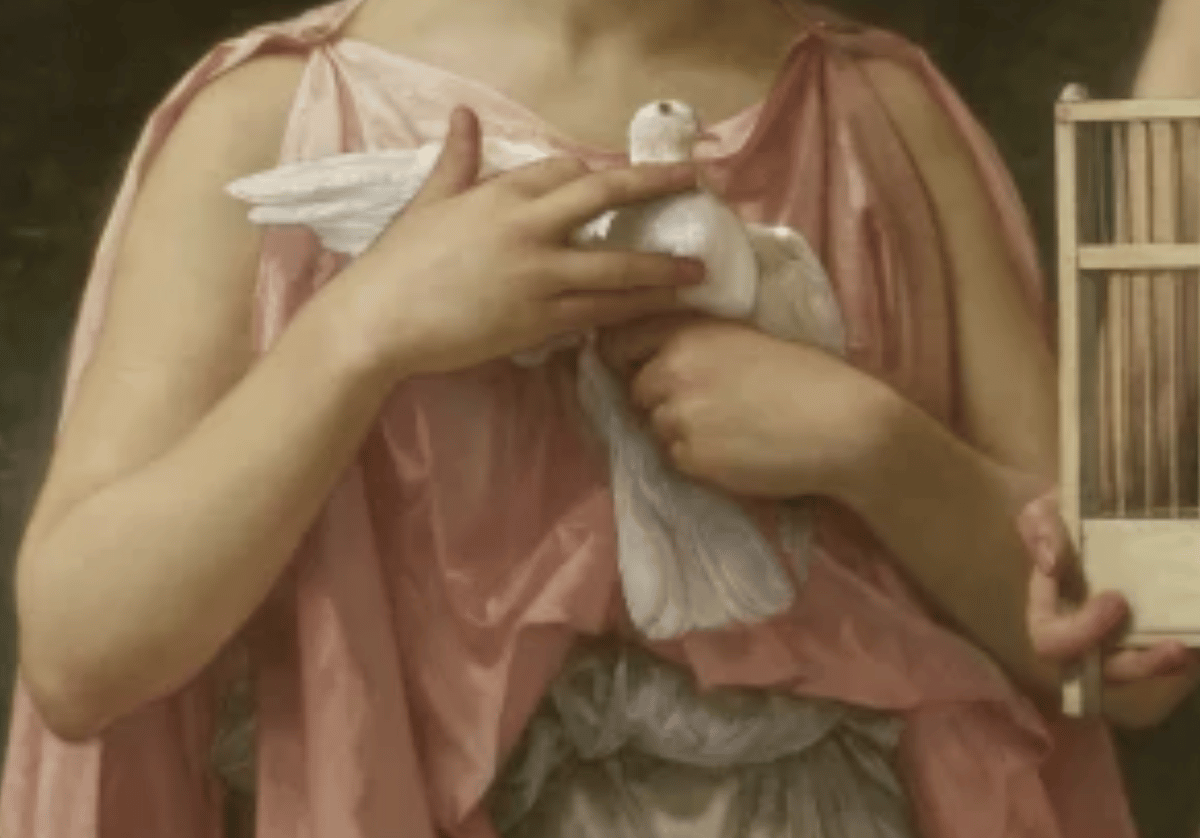
Whereas many women felt pressured to stick to the “appropriate” subject matter for “lady painters,” Gardner dared to compete in the male-dominated domain of full-length allegorical figure painting. Fully clothed women and children were the core focus of her figural groupings, as they are in La captive, exhibited at the Salon of 1893 (above).
Southeby’s, which sold “The Captive” at auction in 2019 for $500,000 ay about it: With La captive, Gardner acknowledges the viewer’s understanding of the white dove’s many symbolic attributes such as peace, love, purity, nobility, and freedom. While the painting’s title underlines a more traditional reading of the narrative, at the same time the dove’s uncertain release from its cage may also allude to the loss of innocence or the status of contemporary women in a time of transition. Beyond a didactic narrative, the expressive treatment of Gardner’s composition ultimately may have been best admired for its delicate and chaste subject placed in a nostalgic, timeless landscape.
Art critics of the time often disapproved of her painting style, saying that she copied her husband’s style too closely. But Gardner was also an astute businesswoman and an excellent linguist, switching from her native English to French, Italian or German, to make her guests and potential clients feel at ease. She excelled in the social graces and knew how to manage publicity and nurture relationships that would help her further her career. Her ability to work her way into the social networks in Paris earned her sales and commissions.
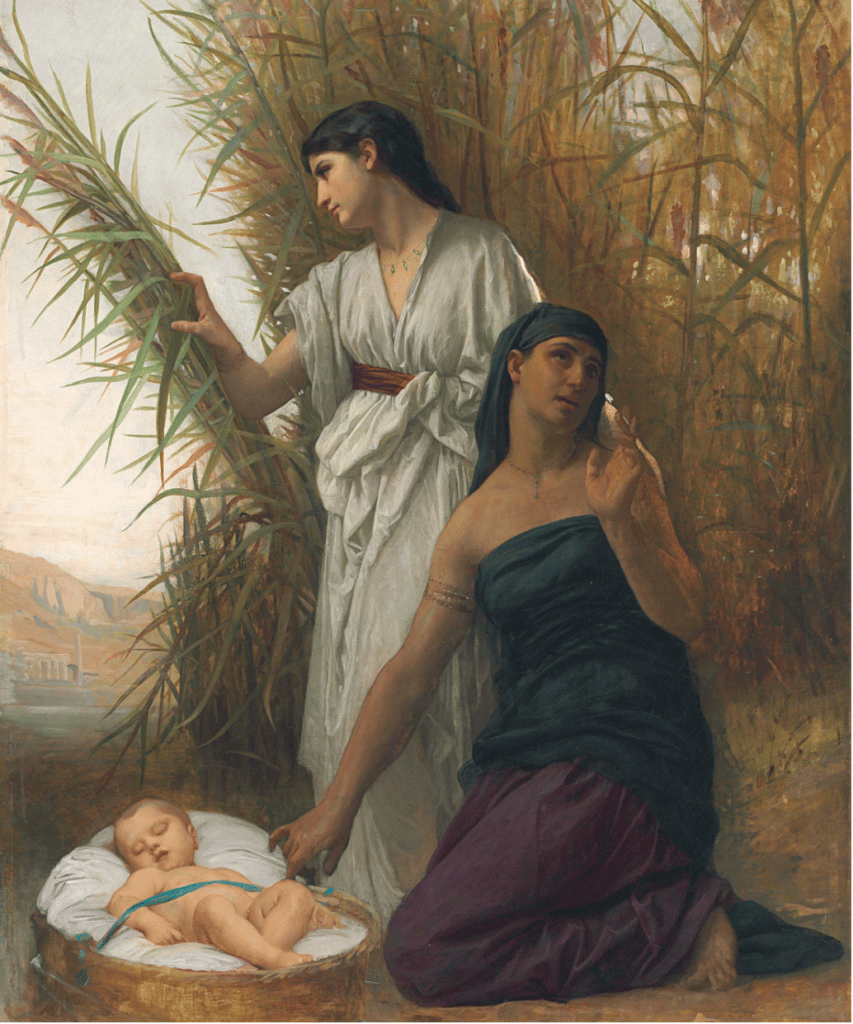
Elizabeth Jane Gardner Bouguereau, Moses in the Bulrushes, oil,
49¼ x 34¾ in. (125 x 88.2 cm.) Source, Christie’s
For the years 1901 through 1903, William Bouguereau served as President of the Society of French Artists. Gardner persuaded her husband to use his influence as President of the Society, Head of the Salon, and President of the Legion d’Honneur, to convince the Ecole des Beaux Arts to open its doors to women for the first time in history.
And although she stopped painting for a while because, sue said, her husband “was alone and needed her,” after William’s death, Gardner “returned to the brush” and turned out about four large pictures a year. Bouguereau, the man, was considered one of the greatest painters in the world by the academic art community. Simultaneously he was reviled by the Impressionists and other progressive painters who saw his work as detached from reality and lacking in depth.
Elizabeth Gardner Bouguereau died January 28, 1922 at her summer residence in St. Cloud, a western suburb of Paris, and was buried, like her husband, in the Cimetiere de Montparnasse in Paris.
She will always be remembered as the”Parisian artist from New Hampshire” who challenged the French art establishment. She lit the way for other women artists to finally break the lockdown men had on the art world until the late 19th century.
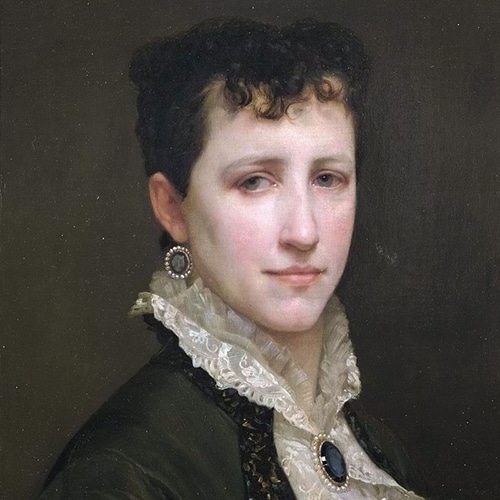
William-Adolphe Bouguereau, Portrait de Mademoiselle Elizabeth Gardner, 1879, Chimei Museum, Tainan, Taiwan
SOURCES
Wikipedia: Elizabeth Jane Gardner
Wikipedia: William Adolphe Bouguereau
Art Renewal: Elizabeth Jane Gardner Bouguereau
Elizabeth Jane Gardner: the resolute and tenacious artist
The Salon Lives On!

Devon Roberts, Earth and the Moon, oil, 30X 40 inches, Honorable Mention, “Water” Category, November 2022.
Enter your work in our own, contemporary version of the famous Salon in Paris, the monthly Plein Air Salon. Artists receive great exposure and over $33,000 in cash prizes, with the overall annual winning painting featured on the cover of PleinAir magazine. The next deadline is soon, so visit PleinAirSalon.com now to learn more.