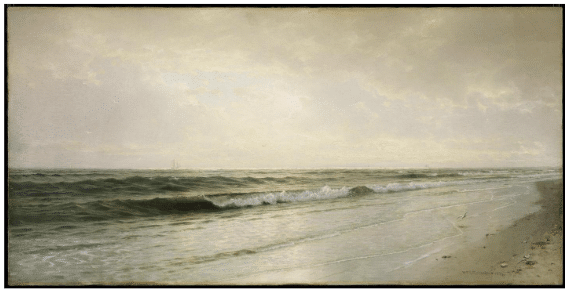
Almost literally luminous, the seascapes of 19th century American artist William Trost Richards (1833 – 1905) can claim an honored place in the history of American landscape painting.
Though unjustly not exactly a household name, even among painters, William Trost Richards singlehandedly took the Hudson River School’s cinematic “widescreen” format with its evocation of spirituality and beauty in nature and applied it to the seascape with understated yet majestic calm.
Richards’ seascapes convey the wildness and untamed power of the ocean tempered by 19th century notions of “timeless beauty.” In doing so, he accomplished Thomas Cole’s prescription for American art: the “union of the picturesque, the sublime, and the magnificent” in paintings with “the power to mend our hearts.”
For Cole the goal was “the sublime and beautiful bound together in an indissoluble chain,” by which he meant appreciation of the native land’s raw wildness refined by contemplation in tranquility. American art, he said, should be about the marriage of “grandeur and loveliness … the sublime melting into the beautiful, the savage tempered by the magnificent.”
Much of the magic comes from the sense of the vastness of open space. The contemplative, introspective mood is set by the subdued harmony of colors. With the shimmering reflections of the clouds taking up nearly all of the foreground, light and air seem to suffuse the canvas from above and below. The perspective creates long diagonals, shown in the diagram below.

There’s a subtle shaft of light (white lines) that quietly divides the diagonal-filled space into balanced halves, bringing incandescent illumination and adding to the sense of calm.
The yellow lines reveal how the diagonals of the foreground and ocean waves are counterbalanced by more diagonals subtly designed into the clouds, all of which conveys the feeling of sweeping distance and wide-open space.
But this is not a big sunny blue-sky day; none of Richards’ seascapes are, and for good reason. He gives, rather, a mixed message, a gray day – silvered by clouds and diffuse light yet lifted by sliver of pale blue sky hovering in the background.
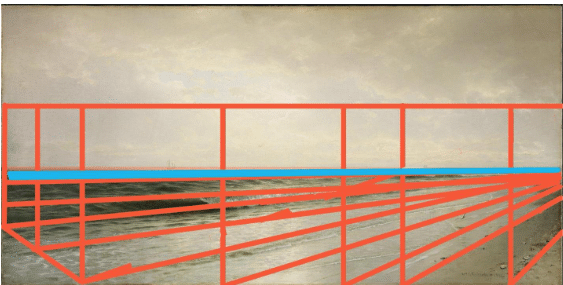
Don’t you hate it when people try to prove how clever they are by imposing ugly, unnecessarily “technical” diagrammatic lines over perfectly good images of beautiful paintings?
In the diagram above, I’ve tried to show that the wide parts of the perspective lines grow widest in the viewer’s foreground and narrower as they recede toward the distant edges of the horizon. Remarkably, only a tiny strip of actual, distant, lying-down ocean is showing – denoted by the “thin blue line.” The WHOLE REST OF THE THING is waves and foam, as seen up close by the viewer – the nearest wave crests on the left, the largest area is foam and shallow water reflecting the light from the cloudy sky, and the sand cuts off to the right, its lines leading past the perspective point for the rest of the painting.
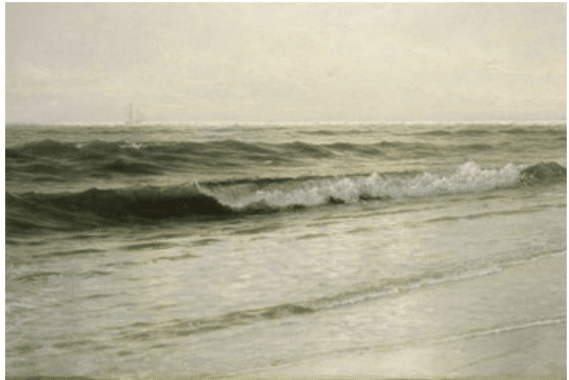
Closeup of the waves in William Trost Richards’ “Quiet Seascape”
I suppose all this suggests that the artist plants the viewer right where he presumably painted the study; Richards was well-known for painting while standing in the water. More importantly, the effect within the painting is to telescope the distance by narrowing the horizon and diminishing the viewer in terms of scale. Keeping the ocean’s horizontal surface to a minimum maximizes the distance and fills the whole with luminous space, which the light opens up above, below, and before the viewer.
These techniques, coupled with the neutral silvery grays and near absence of other signs of humanity (only one or two tiny, fading ships dot the horizon), contribute to the feeling of “quiet” in the title.

William Trost Richards’ paintbox and palette, a 1994 gift from the artist’s granddaughter, Edith Ballinger Prince of Virginia Beach, was displayed in a 2016 exhibition of Richards’ seascapes at Virginia’s Chrysler Museum of Art.
William Trost Richards’ seascapes are introspective paintings, emotionally resonant with solitariness and not without, perhaps, a taste of the melancholy sense of transience in the face of eternity, something some generations of solitary walkers of the world’s shores may yet recognize in themselves.
If improving your ability to paint compelling seascapes is on your 2025 to-do list, check out some of these teaching videos for deep-dive knowledge and instruction from the pro’s on how it’s done.