
Acrylic artist Brenda Hozjan studied to become a third-degree black belt in Karate. She trained in Canada and finished the final part of her San Dan grading (third degree black belt) in Kyoto, Japan. A lot of the lessons that she learned on the dojo floor, she says, are actually lessons that she brings to the studio and her art practice. These lessons derive from both the philosophy that underlies a martial arts practice and the philosophy behind the actual physical training in a martial art.
Brenda Hozjan will be demonstrating her acrylic painting techniques at the inaugural Acrylic Live online event. Three days of professional-level instruction in acrylic painting, Acrylic Live is the only place you’ll find more than two dozen masters of the medium teach their admired styles and essential techniques. It runs THIS WEEK, March 25-28, 2025. Check out the premium faculty here.
By Contributing Writer Brenda Hozjan
I think of the dojo as both an actual physical space and also as a state of mind. Really, the dojo is anywhere you train or practice a martial art. The same can be said for the studio. Anywhere you set up your easel or your materials (be it a room, a corner of a table, or an easel indoors/outdoors) and block out the world around you to focus on your work is your studio. The important thing is taking the time to focus on your work.
And focus starts at the entryway to the dojo. Before students step onto the dojo floor, you will see them bow. They bow as a sign of respect to their training partners and also as a way to condition themselves to let go mentally of everything that is going on in the world outside of the dojo.
Their goal is to be completely in the moment. And this serves two purposes. It allows students the mental space to focus and to take in the lessons of the dojo, and it conditions them to avoid distractions. (This is really important, because distractions in the dojo can result in a punch to the face or gut, for example. Thankfully, this is not the case in the art studio!)
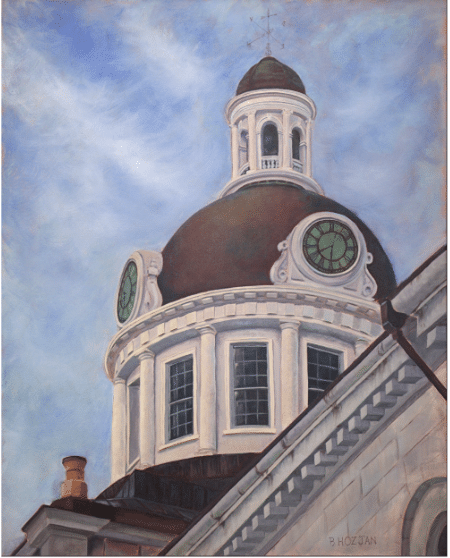
Brenda Hozjan, “Eyes Uplifted,” Acrylic on Canvas – 30 x 24 in.
A lot of artists I know try to do the same in the studio. Although we don’t bow, we try and condition ourselves to block out the distractions of the world around us. Some of us even have rituals that we perform when we first enter the studio. We close the door, put on music, set up our brushes, lay out our palettes, unwrap or prep our canvases, all things that suggest to our brains that we are getting ready to focus on the work at hand. Being able to block out the world around us, allows us as artists to take in the lessons, to experiment, and to allow the art to unfold.
This idea of focus relates to practice and to discipline. Martial artists value consistent practice and the discipline which results. Through practice, students are able to take the same basic techniques that they learn (which have been handed down for hundreds of years to students all over the world), and to master them and then make those techniques their own.
This is referred to as “Shuhari.” Art is the same. You can learn the basics by reading, by studying paintings, by taking classes, by watching other people paint. When you put in enough time at the easel practicing these basics, you will be able to take what you’ve learned and to master the techniques and to make them your own. (It’s true you don’t “need” to take classes or study under mentors – you can develop as an artist without that, but it simply might take you longer.)
Being in the moment, practicing martial arts techniques over and over again, is also meditative. Practiced often enough, the martial arts student is able to draw from that mental library of techniques, should they ever need to defend themselves. It is in that zone, for example, where you are practicing and responding to a group of people who are attacking you one after the other from all sides, or after you have been through an eight-hour belt grading, where your conscious mind gives way to your subconscious one. You rely on your training and simply respond with the techniques that you learned.
The same meditative mindset can be achieved in the studio. When you put in enough miles on the canvas, you are able to draw from your mental library and respond to the subject matter. No longer are you thinking about what brushes you should use, what colours, how to mix this or that, where your colours are located on the palette, etc. Many artists will recognize that zone, when you are painting or drawing, etc. and the painting seems to be falling off of your brush, and you look at the clock only to find that hours have magically passed. In both cases, that zone is where the “art” happens.

Brenda Hozjan, “White Throated Sparrow in Snow,” acrylic on archival canvas panel, 12 x 9 in.
At its most basic level, the aim of the martial arts student is to acquire a level of proficiency in the various techniques thereby enabling them to defend themselves if necessary. As you progress through the belt ranks, you begin to understand that martial arts are more about understanding the world around you and your place in it, and about avoiding having to defend yourself in the first place.
In this sense, the martial arts are meant to serve as a path to self-development and as a means to understanding the world around us. Ultimately this leads to a sense of harmony with your surroundings. I think that the same can be said for art. Painting (or whatever art form you practice, be it flower arranging, calligraphy, or the tea ceremony), allows for that same path to self-development and understanding.
When we concentrate on the process and not on the ends or the paintings themselves, and we practice and focus deeply on the world around us, we develop this sense of harmony through our understanding of the world and our place in it.
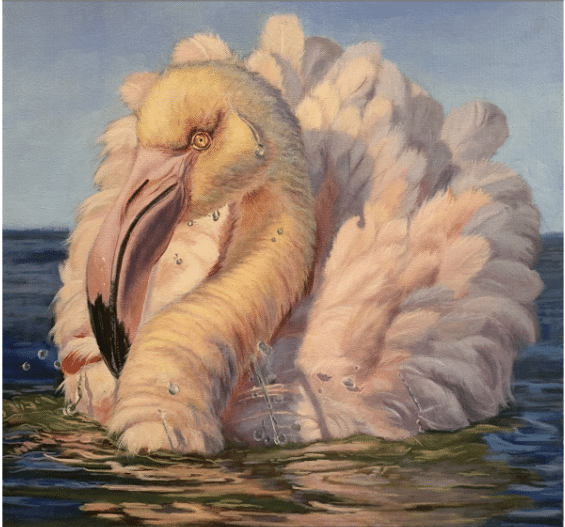
Brenda Hozjan, “Pretty in Pink,” 20 x 20 in., acrylic on canvas
What do you like about the medium you use?
Acrylics are really quite versatile. While many people don’t like that acrylics dry quickly, in my practice I use that to my advantage. Most people expect the caveat to their quick drying nature to be that you can’t get a soft look to acrylics because you can’t “blend” them. This is true, if you are looking to treat them like oil paints which you can physically mix a few hours/days after you’ve applied them. But you don’t require extended periods of drying time to achieve a soft look. There are other ways to develop that and because of that, you can achieve that look with acrylics. You can either blend them physically, by mixing them on your palette or by working wet into wet on your painting as you paint. Or you can let them blend optically by dry brushing opaque layers, applying transparent layers of glazes/colors, or by placing colors side by side, and letting the eyes blend them when you step back.
What are some aspects of art’s inherent value to people and the world at large?
I think that there is inherent value both in the viewing and in the creating of art. For artists, we spend a great deal of time getting to know our subject matter when we paint or draw things. We learn about the nature of our subject and of its place in the world.
For example, we watch how light hits an object and interacts with it, and how the subject is affected by that light and by the objects that surround it. When we are successful as artists, when we are able to translate that beauty and our understanding and appreciation for the world around us, the viewer picks up on that and our work resonates with them.
The viewer then, in turn, develops their own understanding and appreciation for the world.
Acrylic Live kicks of today with a bonus beginners’ day. Then its three solid days of professional-level instruction in acrylic painting, Acrylic Live is the only place you’ll find more than two dozen masters of the medium teach their admired styles and essential techniques. Check out the premium faculty and jump in here.