We continue our series on “The Course of Empire,” Thomas Cole’s epic series of five paintings charting the rise and fall of an imaginary Empire. As previously introduced, we follow the story Cole’s paintings tell, from pre-civilization hunter-gatherer tribes to utopian vision (and nest time, on to desolate ruins to be reclaimed by the cyclic tide of nature).
Self-tutored after initial training in Britain, Cole painted landscapes that embodied profound feelings concerning nature and humanity, beauty, the sublime, spirituality, and philosophy – he poured himself into his paintings as no one else in America had done before.
Born in the industrial north-west of England, Cole moved to the United States as a young man, and from that point on determined to capture in paint the two sides of nature – “sublime and the picturesque” that he encountered in the American wilderness. He is considered the first artist to fuse European Romantic landscape painting with North American scenery.
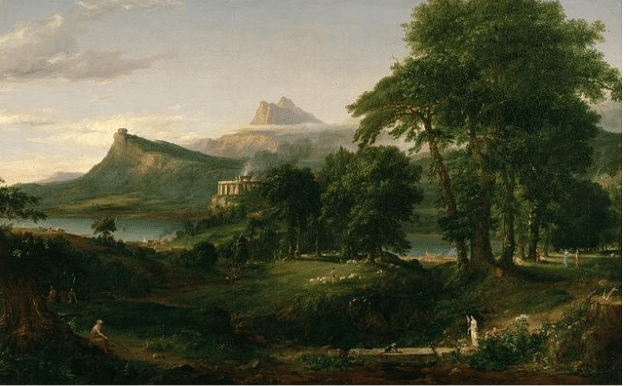
For the second piece in the series, it is the “morning of civilization”; Cole shifts the tone of color from dark and brooding to lighter and more hopeful. Closely resembling Homeric Greece, the Arcadian or Pastoral State of civilization has tamed the “savage” wilderness.

Here’s how to read this painting. There are three or four main “clues” or scenes within the larger painting, all arranged around the central image – a shepherd tending sheep on a grassy plane, itself an image constantly used in art to symbolize man in harmony with nature. We’ll deal with each center of interest at a time, because each one contributes to the narrative that constitutes the painting’s meaning.
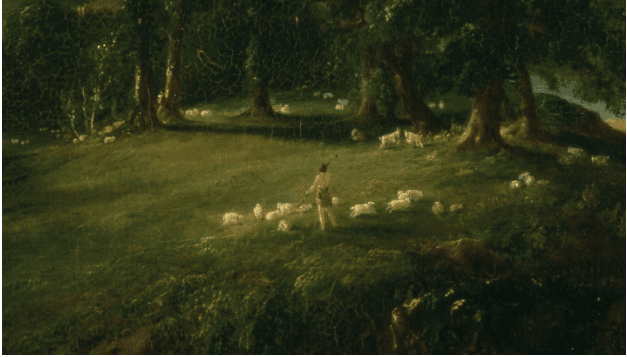
Closeup of a shepherd tending his flock in the center of “The Arcadian or Pastoral State” by Thomas Cole
In the center of the painting (red oval) we find a shepherd. Having come far from chasing a single deer through an endless forest (as depicted in the first painting in the series), civilized man now herds his own small flocks of animals, clears land, and cultivates small gardens. Humanity has begun constructing roads, boats, clothing, and simple farming implements. A sacred fire burns within a pagan (nature-worship) temple and a small town of boats and wooden houses reposes at its base.
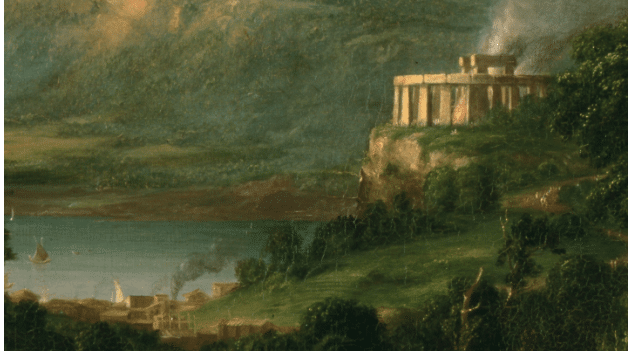
Tiny worshippers in white gowns gather in a paleolithic temple to the gods while below it a small village of houses and boats is flourishing.
Remember now, Cole’s “The Course of Empire” as a whole depicts the potentially destructive course of human civilization when it refuses to check the relentless devastation of the natural world and the ceaseless spread of industry in the name of expansion, profit, and power. This was Cole’s warning to the American project. Cole saw these processes as potentially transgressing God’s natural will for harmony between man and nature, and various of Cole’s works imply that, in the end, a moment of judgement or catastrophe could be inevitable.
Even this first stage of civilization, however tranquil, holds, the seeds of warfare, or at least the need for armed law-keepers to “guard the peace” (i.e. to protect personal property).
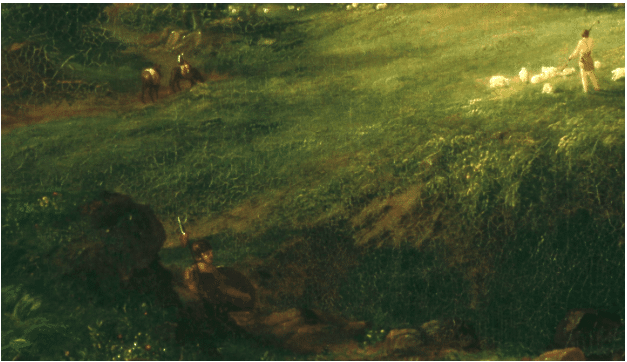
Detail from the center foreground: an armed guard.
In the detail above, a man with a shield, helmet and spear, adorned with a blood-red ribbon has left his patrol (seen on horseback, in the back) and walks toward a young man drawing a stick figure on the stones – this is the birth of art! – watched over by a goddess, or more likely, one of the muses.
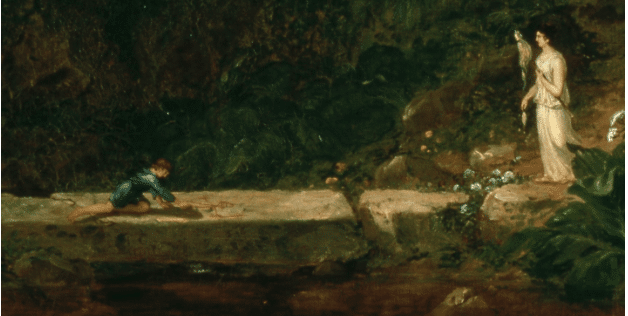
Detail from the center foreground: a budding artist watched over by a divine muse.
It’s hard to see in a tiny image like the one immediately above, but the figure the boy is drawing holds something up that could be either a sword or a magic wand. With the military figure approaching from the left, and the goddess figure from the right (one with a sword and the other with a magical staff), the imagery suggests this is humanity already caught between the ideal (spirituality) and the conflicted (power struggles, violence and war), even in the very cradle of civilization.
On the other, left side of the painting’s foreground, a figure such as Archimedes or Pythagoras discovers the properties of geometry and mathematics – so foundational to the development of large-scale civilization.

Detail from the left foreground: a philosopher/mathematician traces a geometric figure onto a patch of cleared ground
The early mathematician’s musings attract the attention of one of two people on horseback, one who’s holding a large knife and the other who’s got a quiver of bows. Are they hunters or soldiers?
Note that all of man’s creations — his exercise of power over nature — remain well below the heights of the rocky mountaintop. But that changes in the next painting in the series. The next painting, titled “Consummation of Empire,” is so full of amazing details that we’ll have to save it for next time.

Thomas Cole, “Consummation of Empire,” Oil on canvas, 1835
Love the Hudson River School? Contemporary artist Erik Koeppel has reverse engineered everything from the colors they used to the way they depicted rocks, trees, clouds, and skies. His works have been avidly collected over the years, during which Erik has carved out the time to make two professional quality videos teaching what he knows. Check out his video Techniques of the Hudson River School Masters Volume 1 and Volume 2