

William A. Schneider, “Near DePaul,” Oil 8 x 8
When someone tells me, “I just love your colors,” I, of course, appreciate the compliment, but I think the real key lies in getting accurate value relationships. The artists’ cliché, “Value does the work, but color gets the credit!”, is absolutely true! It’s like being a lineman in football; the big guys upfront slug it out to create space for the running back to dance through. The RB gets the girl, the glory, and the endorsements. The lineman gets icepacks and the whirlpool!
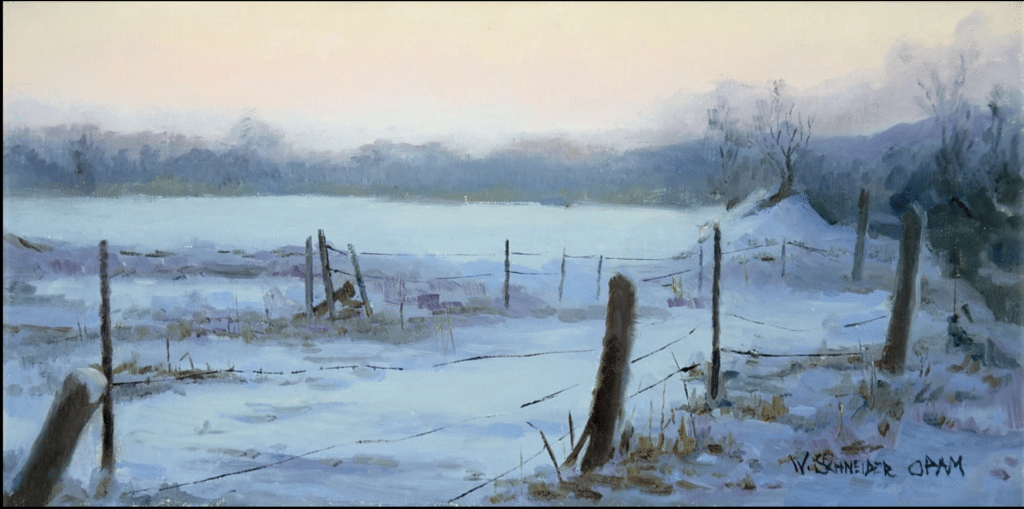
William A. Schneider, Snow Near Haligus ‐ Oil ‐ Linen ‐ 10 x 20 x .75
Value is not only the key to successful color choices, but it is also the key to design. Composition or design is, at its heart, the distribution of three or four large, interesting, value masses on the picture plane. (What makes those shapes interesting? According to Master Artist Quang Ho, they are unique and specific.) Noted teacher, David Leffel, has said, “a painting composed of a number of small value shapes will appear small and petty.”
There are two problems:
1. Seeing the correct value relationships
2. Painting them
So, what are the solutions?
Chunking
Bryan Mark Taylor in his instructional video, The Master’s Mind, talks about chunking as the most efficient way to master a new skill. He describes a process of isolating and rehearsing one “chunk” of information until it is mastered, rather than trying to do everything at once. (BTW the video is well worth the price; here’s a link https://lilipubsorders.com/search?type=product&q=the%20masters%20mind* ) Musicians do this routinely. (I’m working on improving my guitar playing, so I practice scales in five positions up and down the fretboard. Using a metronome, I gradually increase the speed.)
The traditional way to develop a good understanding of value was to draw from the plaster cast, trying to render the light and shadow in five values. Drawing in graphite or charcoal takes color out of the equation. That’s how Bouguereau, Sargent, Sorolla, and Zorn all learned! When I studied at the American Academy in Chicago, my instructor, Ted Smuskiewicz, had me make my first paintings using only mixtures of white and black paint. I wasn’t making finished pieces; I was learning to see the relative values! It’s interesting to note that Jeremy Mann actually sells his stunning large monochromatic cityscapes which he gives titles like “Composition 172”. You can see his work at redrabbit7, here’s another link https://redrabbit7.com/cityscape
Quick Fixes
For those of you who want some “quickfix tools” here are four ways to help you see the value structure in any subject:
- Squint – (and compare). At the American Academy I was told to squint…oh, about 10,000 time! Squinting simplifies the world into five or six values.
- Use a red acetate film – It take the color out and again lets us see the value masses.
- Use Notanizer– This is available in the app store; it reduces any scene to black & white (a “notan” – the Japanese word for “light and dark.” A notan is two values. You can also set the app for three or four values). The app costs a couple of bucks but has saved many a painting!
- Use Photoshop – You can go to “image – adjust – hue and saturation” to de-saturate the image. Then go to “filters – artistic – cutout” to reduce the image to 3, 4, 5, or 6 values (Adobe calls them “levels”) It does the same thing as Notanizer.

“Drink From My Cup” reference and value “cutout”

“Drink From My Cup” 20 x 16 Oil – finished painting
How to paint them
The good news is that the hard work of seeing the value structure is done. The bad news? We still have to execute. Here are a few “hacks” that might help:
- Grisaille (pronounced like Versailles) – This is an indirect painting method developed during the Renaissance. The artist first makes a complete under painting in 5 or 6 values of grey. After the grisaille dries, the artist glazes transparent layers on top of it, finally arriving at the full color painting. (You have to allow each layer to dry before applying the next). Time consuming, but artists like Bouguereau and Ingres created stunning masterworks using this technique.
- Monochromatic block in – Richard Schmid and others sometimes use a single color (raw umber, or transparent oxide brown, for example) to create an underpainting. By wiping out the light areas with a rag and deepening the darker areas with more paint, one can arrive at a very believable full value representation. The artist then paints into that underpainting with opaque paint, working “wet into wet.” Hint: you need to do this on oil-primed linen or canvas…an acrylic primed support can’t be wiped all the way back to white! This technique is much faster than using a grisaille.
- Paint big value masses – Think of areas as opposed to things. For example, the shadow on a figure might bleed into the shadow on the wall behind the figure. Zhaoming Wu (a master who teaches at the Academy of Art University in San Francisco) calls this a “unified shadow shape.”
- Make “puddles” – When I paint a portrait I mix a single “puddle” for all the colors that I see in the flesh in the light. Part of that puddle might be redder, part greener, part more violet etc. but the values are tight, meaning there are no unintended value jumps when the hue changes. The key is, there is no space between the colors in the puddle.
- Check your work – Notanizer, Photoshop, or even your red acetate film come in handy to make sure that you did what you intended.
Happy painting!
Family Heirs Announce Restitution Agreement for Klimt Portrait
After years of collaborative provenance research, Ronald S. Lauder and the Beran family heirs have announced a restitution agreement for the portrait painting “The Black Feather Hat” by Gustav Klimt.

From the official statement on the restitution:
This agreement, which includes the restitution and reacquisition of the painting from the Beran heirs, is the result of several years of collaboration during which Mr. Lauder and the Beran heirs have worked with the assistance of expert researchers to advance a new understanding of the painting’s provenance.
Depicting a pensive female sitter adorned with a wide-brimmed hat, “The Black Feather Hat” is first documented as being owned by Irene Beran (1886-1979) in 1928, though it entered the family collection years earlier through her father-in-law Alois Beran. Recent research has confirmed that the painting remained in Irene’s possession in Brno, now part of the Czech Republic, through at least 1934. Its whereabouts from that time until the late 1950s, however, remain unclear.
The portrait of the unidentified female sitter is rendered in a monochromatic palette of pinks and light browns and offset by the fashionable black hat that sits atop her auburn hair. The work is central to the public’s understanding of Klimt’s oeuvre and his legacy.
Read more of this story online here