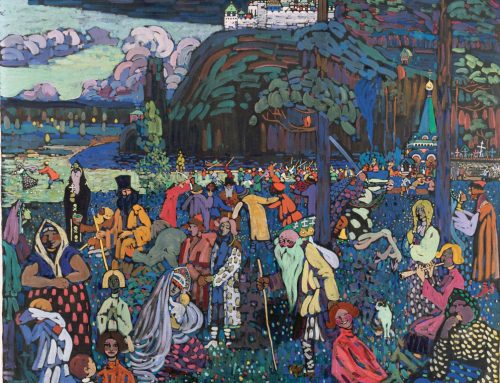
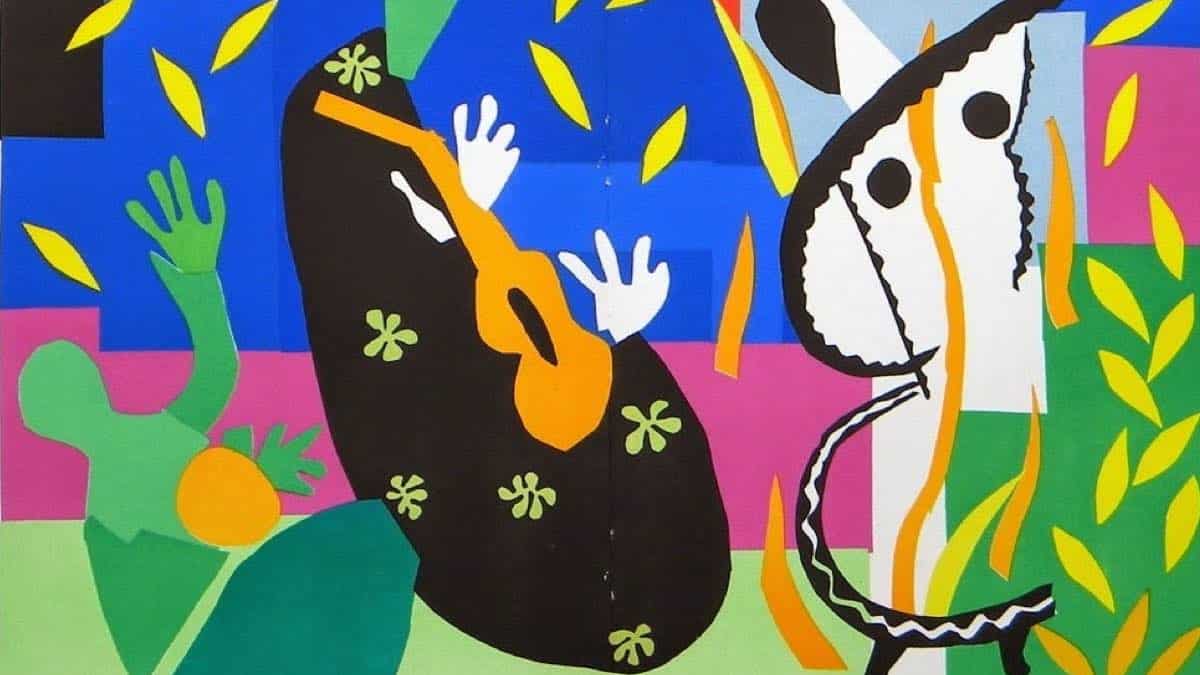
“Don’t try to be original. Be simple.” – Henri Matisse
Matisse championed originality; but the way to get there, he said, was to stop trying. “Be good technically, and if there’s something in you, it will come out.” An artist’s job is to discover in themself what it is they have to say and to say it as clearly as possible.
“Learn the rules so you can break them,” they say, but they never tell you how to break them. Obviously “they” (whoever they are) don’t mean chuck everything you know about good painting out the window.

Albert Marquet, Posters at Trouville, 1906
Maybe there are two kinds of disorder in art, one bad, one good. The “bad” kind – ranging from “incorrect” drawing to anarchic chaos – results when artists either don’t know the hallmarks of good painting or purposely break them without substituting something new in their place.
The “good” kind of disorder happens when artists know the ins and outs of good and even great painting well enough that they can combine and recombine elements from the storehouse of technique and design and much of the world’s art, past and present, to honestly say something they feel is worthy of expression.

Claude Monet, Impression: Sunrise, 1872. 18″ x 24″
The “first Impressionist painting,” Monet’s Impression: Sunrise celebrates the misty half-light of the waterfront at dawn. He wanted to make the atmosphere so dreamy that you can barely make out the boats through the gloom being chased away by the rising sun. To do that, he needed to ignore each and every one of the French Academy’s rules of good painting. A critic scoffed at what he jeeringly called, after Monet’s experimental painting, “Impressionism.” And a movement that changed the future of painting was born.
Not long after, Matisse’s work was so radical for the time that critics called the movement he inspired les fauves (the “wild beasts” moniker was coined by the critic Louis Vauxcelles when he saw the work of Henri Matisse and André Derain in an exhibition in Paris, in 1905).
Matisse’s paintings no longer look like the work of a rebel, because Matisse wasn’t breaking the rules just to break them. Matisse merely jumped tracks, from representational realism as practiced since the Renaissance to his own idea, influenced by Japanese prints and textiles, of what art could and should be in the world.
The same principles apply to breaking rules within realism as well. It’s why we still revere Sargent and Sarolla as high kings of painterly realism. Both painters were impeccable observers, but that’s not why (so were hundreds of other realists). Their real greatness lies in how they were unafraid to put imagination, or “vision,” first and to adapt and adjust (not just break) the rules in order to express something authentic to them that they felt someone needed to say.

John Singer Sargent, Group with Parasols, 1905
In John Singer Sargent’s Group with Parasols of 1905, there artist was clearly in love with the the colors and the light he observed in this scene. As a painter, he saw how the light and color could be played up to reflect the buoyant and leisurely mood of a lazy afternoon outing. The paint itself – the strokes, lines, and dashes of the lights and colors in this painting – seem almost so vivid as to leave the subject, the figures and their setting behind, and to drift like soft, just-burst fireworks across the field of vision.

Joaquin Sorolla, Fishing Boats, 1915
In his Fishing Boats of 1915, Joaquin Sarolla was obviously, delightfully, dazzled by the motion, color, and light of his Spanish town’s traditional fishing boats coming to shore. As in Sargent’s picnic, the only way to express that vision – that sense of the bigness and beauty of everyday life – was to mint a fresh, dynamic compositional format and to treat the shapes and the color less like academic tools of precise draftsmanship than a series of festive scarves and paper-scrap confetti strewn across the canvas.
Monet, Matisse, Sargent, Sarolla. Were they rebels? They were. Were they braggarts, were they trying to impress anyone, were they anarchists out to shock the world? Nope.
They were artists.
Still need to learn those rules?
- Nail down the basics with this extensive collection of videos on technique, composition, and design.
- Master Sargent’s methods, from composition and “drawing with shapes” with the brush to the last, expressive, finishing brushstroke, with Sargent Techniques of a Master taught by Thomas Jefferson Kitts.
- Discover the secrets of Sorolla’s technique and his use of light in Sorolla, Painting the Color of Light
Are You Ready for your Breakout Year as an Artist?
Look for free, inspiring videos on building or expanding a booming art career at EricRhoads.com/interviews (Publisher of INSIDE ART). You’ll find a wealth of truly valuable advice and insight from a super successful art-world-entrepreneur’s point of view.