Carl Bretzke spent 30 years as a surgeon before he became a full-time painter — and the transition, it turns out, was less dramatic than it sounds. Both disciplines, he will tell you, are fundamentally about seeing. “In medicine, you see what you know,” he says. “In painting, you paint what you see. You must know it, to see it, to paint it.”
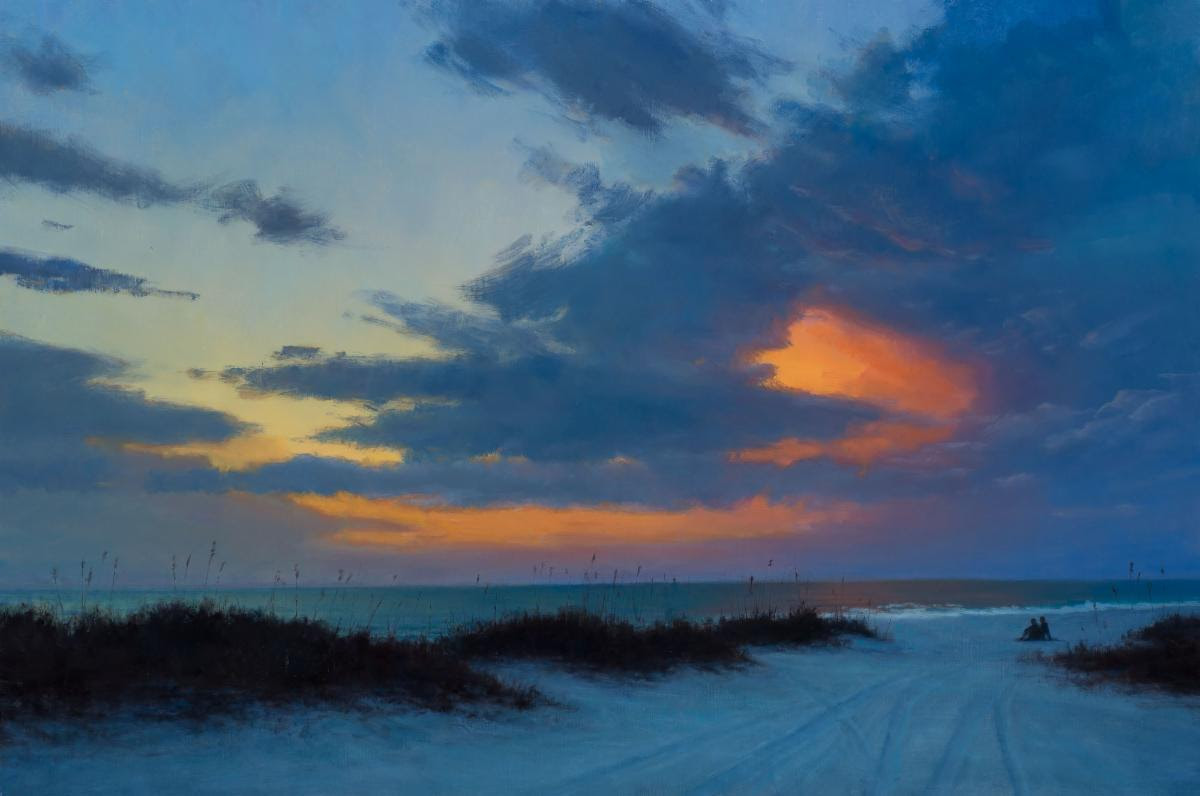
That philosophy drives everything about the way Bretzke works. A plein air painter based in Minneapolis, he is drawn above all to the behavior of light — not the obvious drama of a golden-hour sunset, but the subtler, stranger transformations that happen at the edges of day, when light shifts in color as much as in intensity. “What most people don’t notice is, as the light drops off, the color of light changes,” he says. “You must see where the color changes and where the light is coming from.”
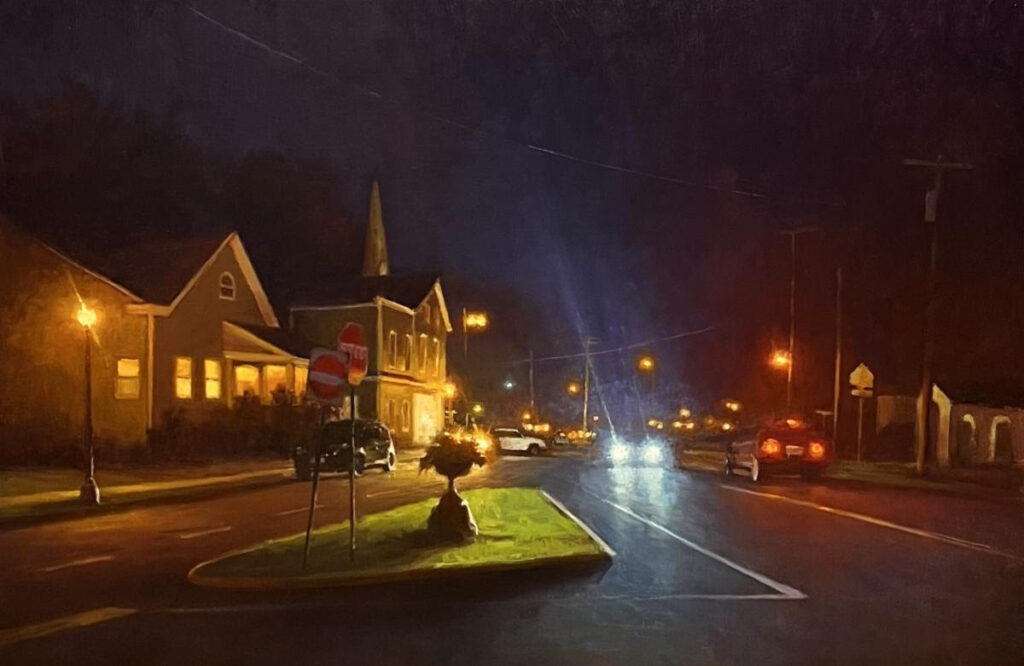
“Division Street at Night,” 24 x 36 inches, Oil on Linen
Seeing those changes — and capturing them in oil on linen before they disappear — is the central challenge of his practice. Like all serious plein air painters, Bretzke works against the clock, knowing that the shadow he is painting will move, the quality of light he is chasing will shift, and the scene that compelled him to set up his easel may look entirely different 20 minutes from now.
Nowhere is that exploration more compelling than in his nocturnal work. Division Street at Night — a 24 x 36 inch oil on linen — orchestrates multiple light sources across a rain-slicked urban street with the precision of a conductor managing an orchestra. Two oncoming headlights form the dominant light source: bright white orbs that cast luminous beams upward into the darkness while simultaneously reflecting against the wet road below. That stream of white light, Bretzke understands, is not simply white — it reveals the rich blue that lives inside what most viewers would call a black sky. Street lamps along the perimeter radiate in a burnt yellow-orange, their spheres of warm light entirely different in character from the cold brightness of the headlights. A backlit flowerpot on a triangular traffic island and a glowing storefront window add further layers. The painting is less a scene than a study in the prismatic nature of artificial light — and a reminder that darkness, properly observed, is never simply dark.
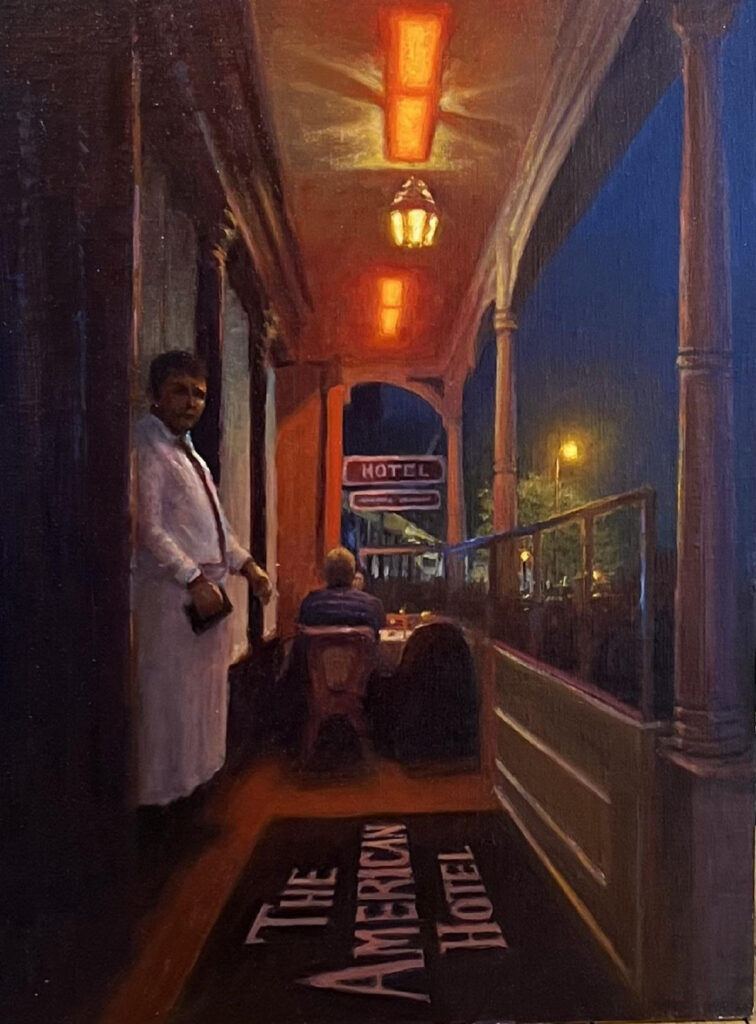
“Waiting for the Check,” 18 x 24 inches, Oil on Linen
His daytime paintings carry a different quality — one that critics and gallery visitors have consistently compared to Edward Hopper, though with a warmth Hopper rarely permitted himself. Waiting for the Check, painted at the historic American Hotel in Sag Harbor, places the viewer at an outdoor table on the porch, a waiter framed in the doorway, the street beyond alive with movement. The painting has the cinematic ease of a scene observed rather than constructed — Bretzke’s Midwest painter’s eye for American life transposed to a New England village, finding there the same human textures he finds at home.
His winter landscapes extend that sensibility further still, painting the silence of fresh snow as precisely as he paints the noise of a nighttime street — the footfall on powder as legible in paint as the glare of headlights in rain.
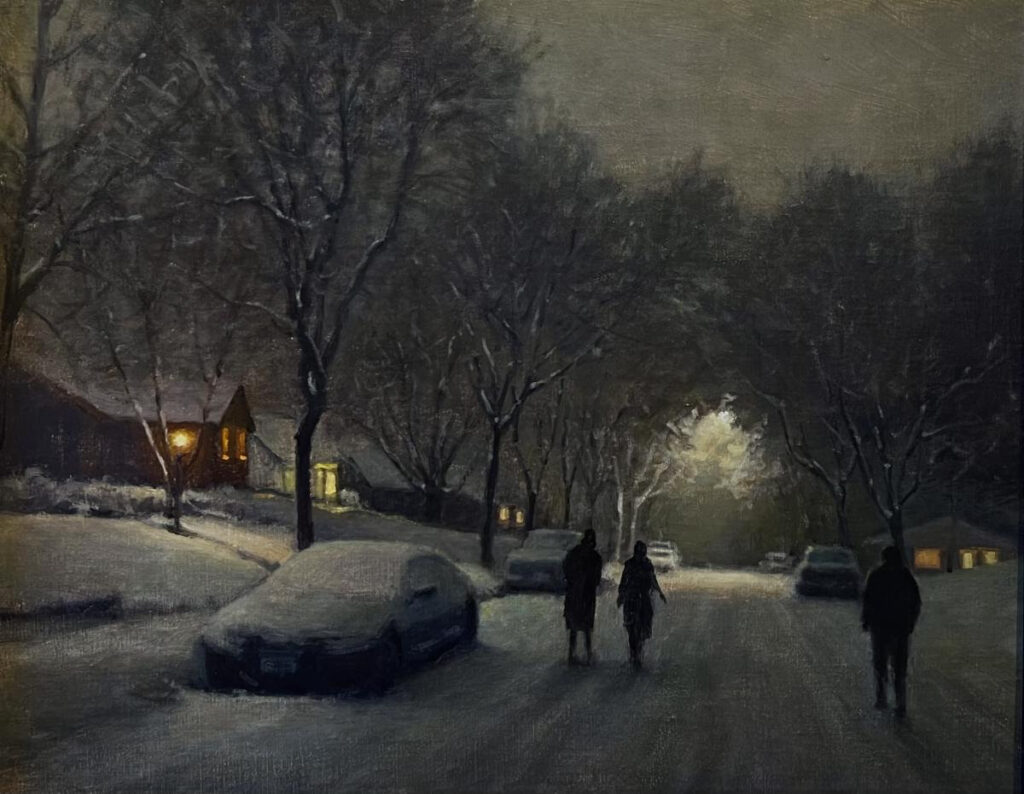
“Unshoveled Sidewalks,” 16 x 20 inches, Oil on Linen
What unites all of it is the same quality that made him a good surgeon: the ability to see what is actually there, rather than what he expects to find. In painting, as in medicine, that turns out to be everything.
The same discipline that shapes Bretzke’s paintings — the precise observation, the attention to light and color relationships, the commitment to seeing what is actually there rather than what you expect to find — is what he brings to his teaching. Learn from him and other top oil painters — Kami Mendlik, John MacDonald, Michele Usibelli, Turner Vinson, and Cherie Christensen — at Oil Painting Boot Camp. Designed to take painters from the very beginning, this brand new online event will take you from what to buy, how to start, and how to build a painting step by step.