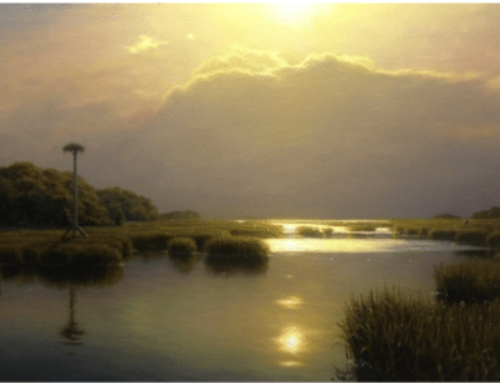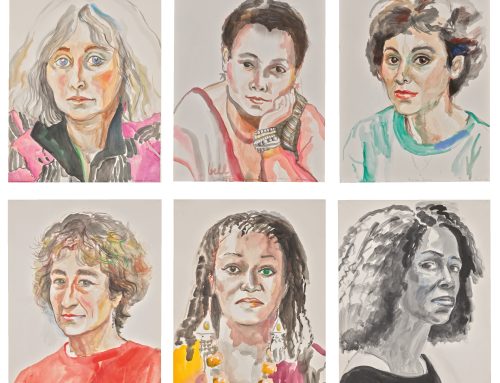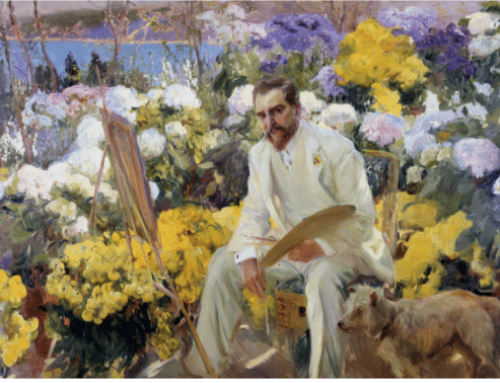
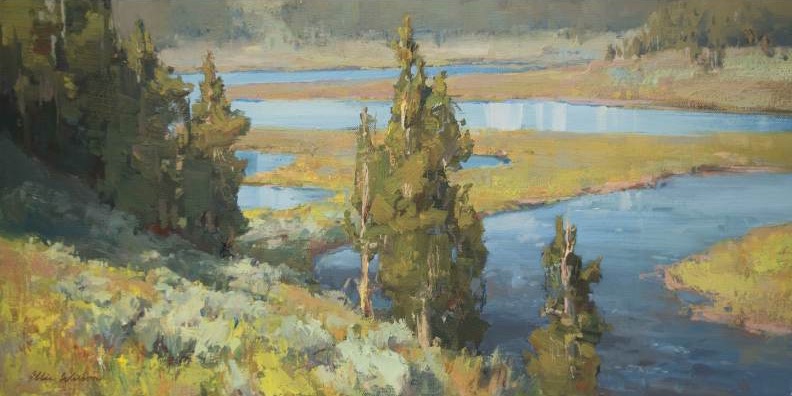
At a glance, a landscape can feel overwhelming — an accumulation of trees and rock, atmosphere and light, foreground and background. The painter’s challenge is to distill that complexity into something understandable, something that invites a viewer in. For landscape painter Ellie Wilson that requires physically experiencing a place — hiking it, moving through it, and seeing it from multiple vantage points.
ACCEPTING AND APPRECIATING INTERRUPTIONS
Understanding the land is a slow process — but painting it often isn’t, or can’t be. For Wilson, who has a toddler and a preschooler, that contrast makes efficiency in the studio not just helpful, but necessary. “I get to be in the studio six hours a week,” she says. “I’ve always been a decently fast painter, but I think plein air painting probably helps a lot.”
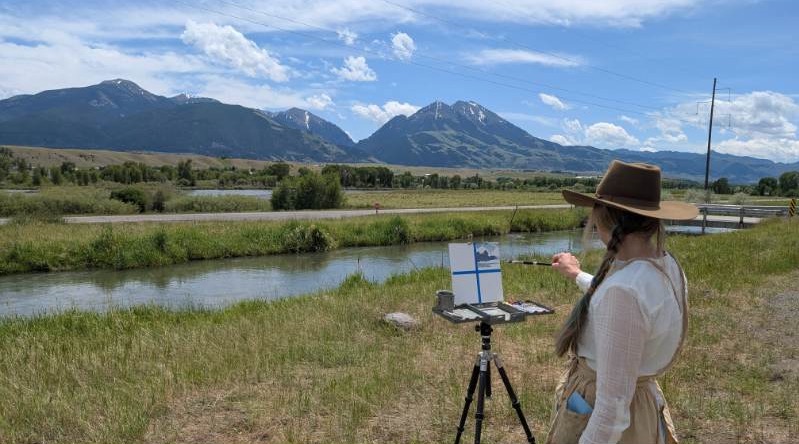
Ellie Wilson painting in Yellowstone
To make that time work, she’s built a system around speed: a compact, lockable rolling setup, a palette she can preserve between sessions, and a workflow that lets her set up or clean up “in three minutes or less.”
But the bigger shift is more mental than logistical. “I used to overwork paintings a lot,” Wilson says. “I’d think, ‘I need to keep working, I need to keep working’… but just putting paint on the canvas isn’t necessarily helpful.”
That instinct traces back to her early years learning oil painting, when she taught herself to mix color directly on the canvas rather than premixing on a palette. Working intuitively with pure pigments helped her develop a deep sensitivity to color relationships — an approach she still uses today, often working from a limited palette of the primaries plus white.
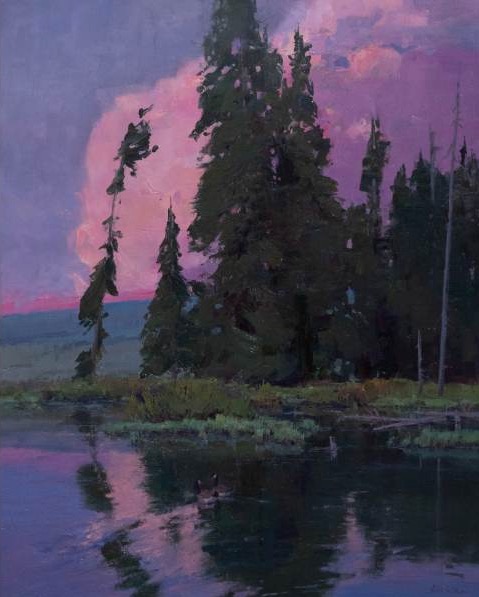
“I See It Both Ways” (oil on canvas, 24 x 30 in.)
Interruptions that were once frustrating have become essential. “Having kids is great because of the interruptions, because you’re forced to stop,” she says. “There’s never a time when a pair of fresh eyes is unwanted.”
Stepping away brings clarity. Returning reveals problems or confirms what’s working. “Every time I step away and come back,” Wilson says, “it’s like, ‘oh, there’s something that needs to be fixed.’”
Over time, those intervals stretch out. Eventually, the painting reaches a point where nothing obvious needs changing — and that’s when she lets it go. “A painting is never finished,” Wilson says, recalling advice from her mentor, landscape painter Scott Christensen, with whom she studied during a formative one-on-one internship in Idaho. “It’s always just abandoned.”
Even within a session, she builds in distance, often testing changes digitally in Photoshop before committing them in paint. “I can upload an image and paint over it and ask, ‘What if the sky was pink? What if I moved this tree?’” she says. “Just really quick little changes that make a huge difference.”
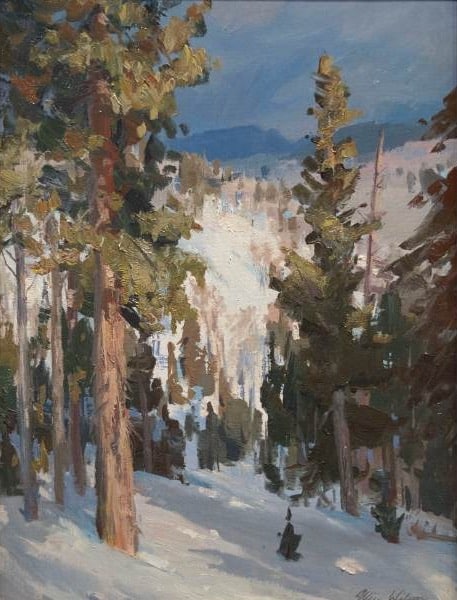
“A Break in the Storm” (oil on canvas panel, 12 x 16 in.)
PACKING LIGHT, EXPECTATION-WISE
Outdoors, Wilson removes pressure entirely. “I don’t ever think about plein air as connected to my studio painting at all,” she says.
Instead, plein air becomes pure information gathering. “It’s just about observing and getting the information down as accurately as possible,” she says, “and doing it fast so that I can do multiple pieces in a single session.” That shift frees her to work quickly and let go of outcomes.
Working small is key. Sometimes she divides a single panel into multiple studies, forcing simplification. “You can’t nitpick a tree when it’s less than a centimeter tall,” Wilson says. “It’s just, ‘here’s my light, here’s my shadow.’”
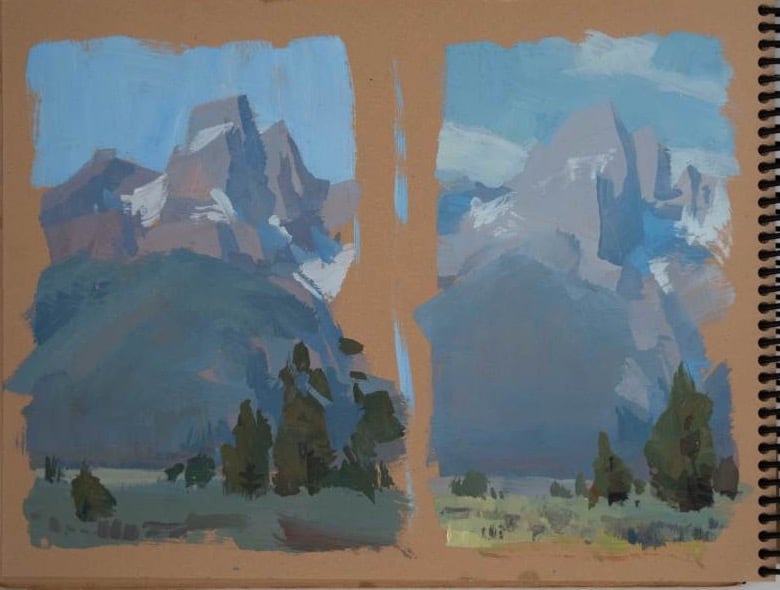
“One of my favorite plein air experiences last year was hiking 12 miles to visit three mountain lakes and gather reference studies,” Wilson says. “A single day like that can supply me with enough material for studio paintings years down the road.”
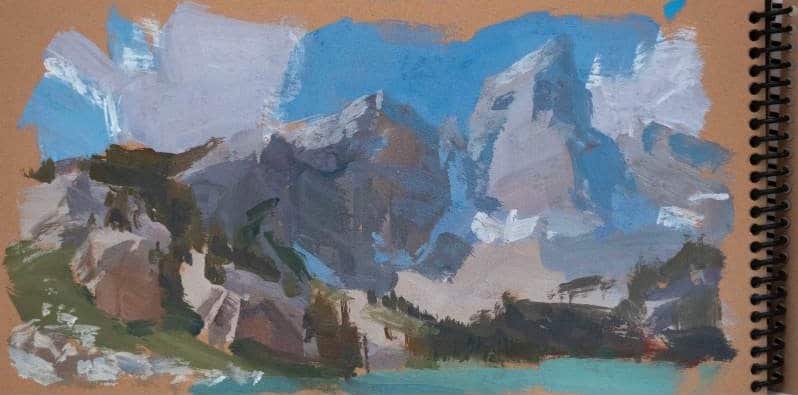
And volume matters. After years of painting across more than eight states and 18 countries, she’s learned that mileage — both literal and artistic — is essential. “There’s nothing worse than going on a trip and doing two or three paintings a day and coming home thinking I could have gathered so much more,” Wilson says.
Her goal is a visual library she can draw from later. “I have piles of plein air paintings,” she says, “and I fish through those until I find something that sparks an idea.”
This approach reframes failure. “Not every painting is going to work,” she says. “Half of them might go in the garbage — and that’s okay.”