Few symbols carry as much weight, or invite as many interpretations, as the American flag — and few artists captured its optimism quite like Childe Hassam.
In April 1917, the United States entered World War I, joining Britain and France against the Central Powers. Hassam commemorated the alliance with a series of 30 paintings of flags, the most celebrated of which — Allies Day, May 1917, now in the collection of the National Gallery of Art — depicts a parade on Fifth Avenue celebrating the new alliance, the flags of all three nations fluttering in the breeze of a bright spring day.
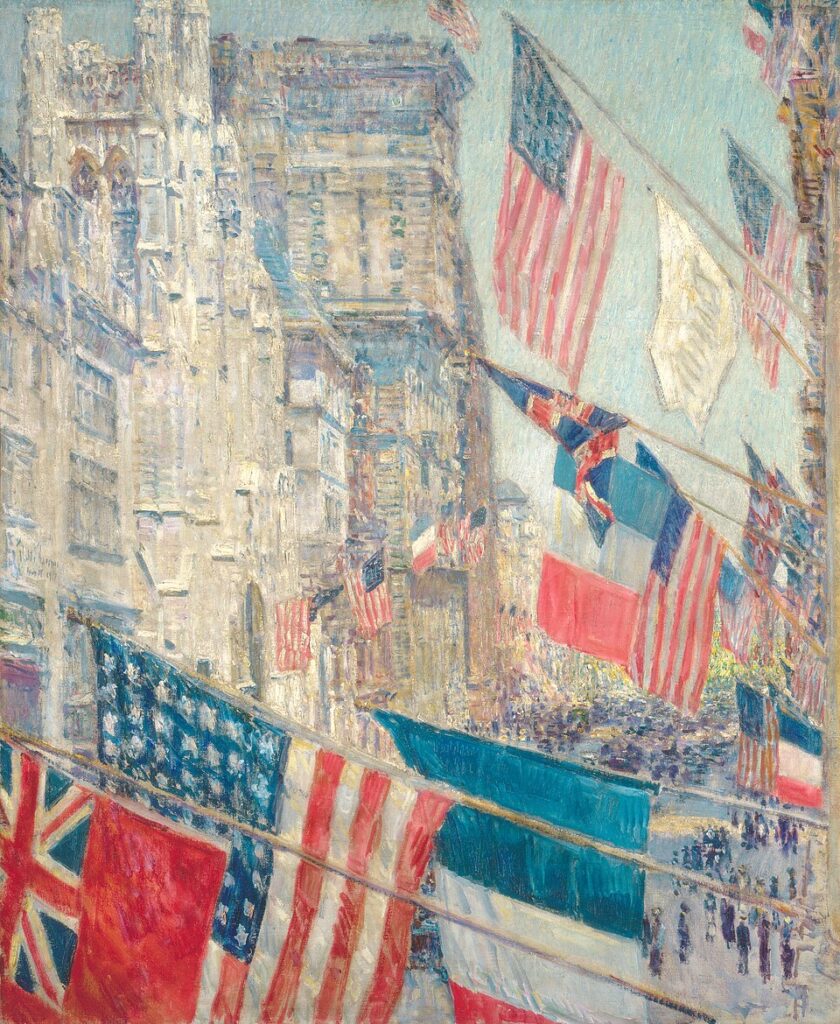
“Allies Day, May 1917,” Childe Hassam (American, 1859 – 1935), 1917, oil on canvas, 36 1/2 x 30 1/4 in., National Gallery of Art, Gift of Ethelyn McKinney in memory of her brother, Glenn Ford McKinney
Hassam was American, but his artistic education was thoroughly French. He and his wife moved to Paris in 1886, where he encountered the work of Claude Monet and Camille Pissarro and absorbed their approach wholesale — short, rapid brushstrokes built to convey movement and light rather than photographic precision. Up close, the canvas dissolves into navy blue and dark red strokes that are nearly unreadable; step back, and they resolve into crowds watching the parade below. Hassam rendered the gray and beige stone buildings of Fifth Avenue in Kelly green, pale blue, yellow, dark red, lilac, and turquoise — the same Impressionist trick Monet used in his Rouen Cathedral series, capturing how light fractures color across a stone façade.
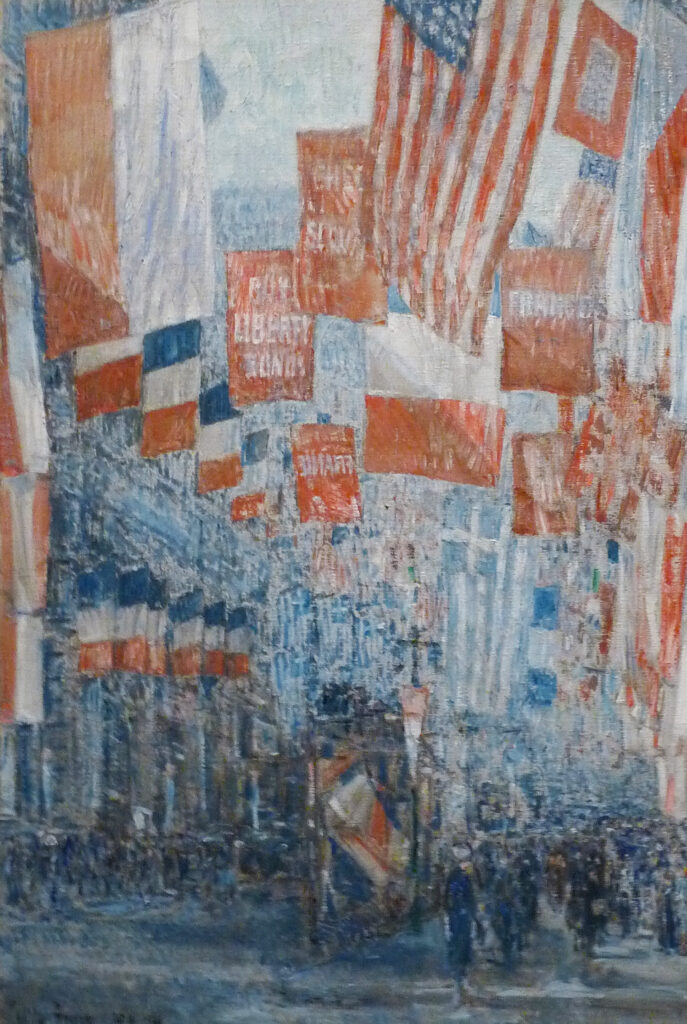
“Avenue of the Allies, 5th Avenue, New York,” Childe Hassam, 1917, oil on canvas, 37 x 26 in., Musée National d’Art Moderne
What makes the painting distinctly American, though, is its subject and its mood. Hassam was using a French visual language to celebrate something specifically national: the country’s optimism as it rose to international influence in the early 20th century. Remarkably, several of the buildings he painted that day — including Saint Thomas Church and the University Club — still stand on Fifth Avenue today.
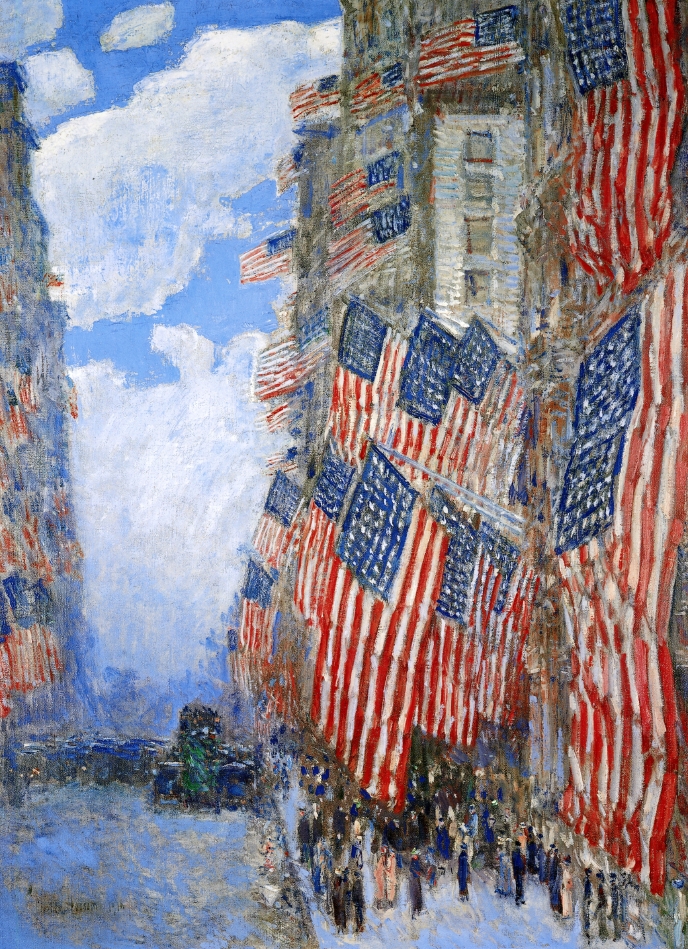
Allies Day was only one entry in a much larger project. Across the full series, Hassam experimented with different perspectives, settings, and times of day, charting the war’s course from the U.S. declaration in 1917 through the Victory Day parades of 1919 — and alongside the American flag, he painted the banners of Belgium, Brazil, Cuba, Italy, Japan, and other Allied nations. Throughout, the mood stays consistently hopeful: flags wave gently on a calm Fourth of July, or shimmer above a rain-soaked city street, often appearing as protective canopies floating over the crowds beneath them.
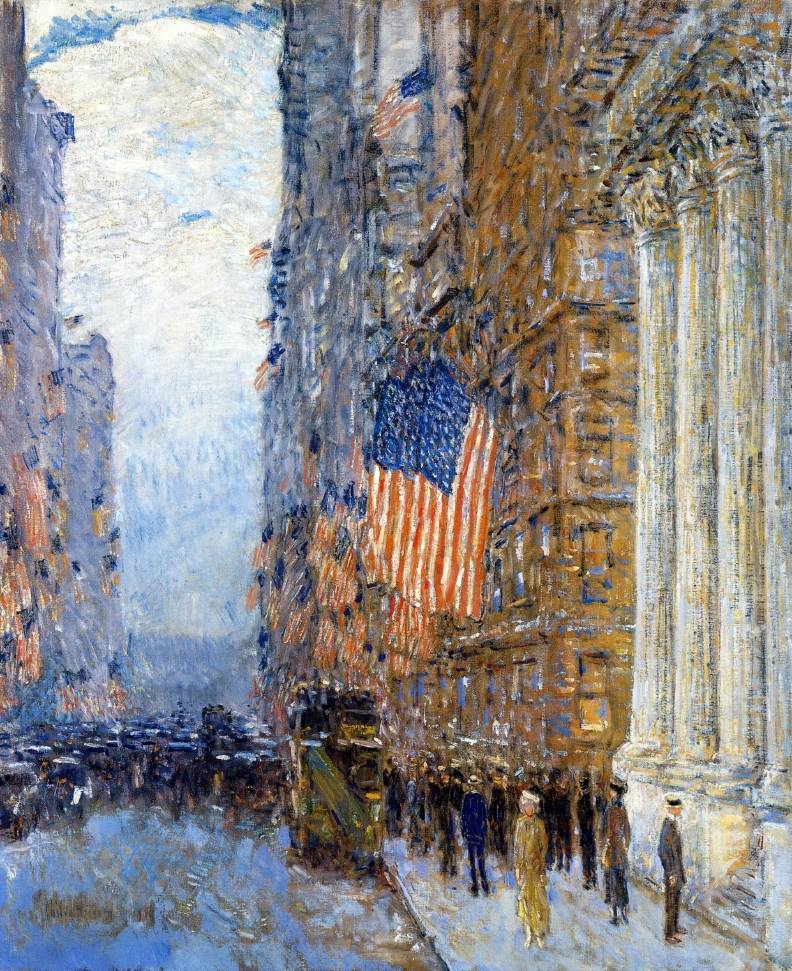
“Flags on the Waldorf,” Childe Hassam, 1916, oil on canvas, 36 1/4 x 31 1/4 in., Amon Carter Museum of American Art, Fort Worth, Texas
Hassam’s devotion to American art didn’t end at the easel. In 1932, he told a reporter that art made in the United States was “as good as any other in the world today” — and he backed the claim with extraordinary generosity. At his death, he left more than 400 works to the American Academy of Arts and Letters, with instructions to sell them and use the proceeds to purchase works by living American artists, which were then donated to museums across the U.S. and Canada.
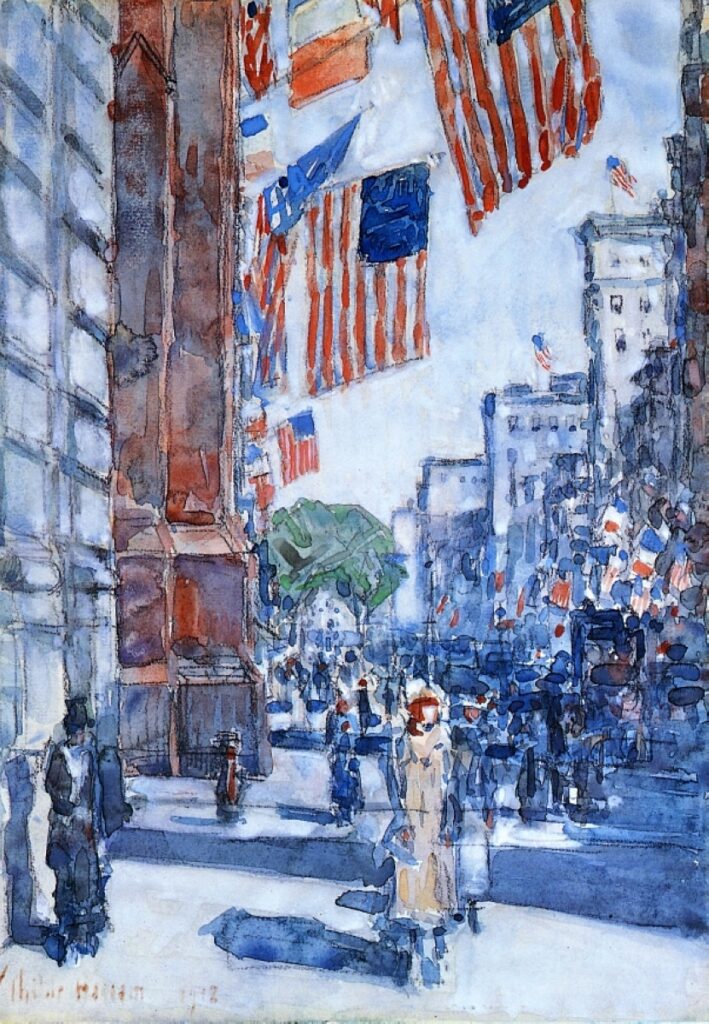
“Flags, Fifth Avenue,” Childe Hassam, 1918, watercolor
As the country marks its 250th anniversary this year, Hassam’s flag paintings feel like exactly the right works to revisit — not for nostalgia’s sake, but as a reminder that American art has always been in conversation with the wider world, even at its most patriotic. Hassam took a French way of seeing and turned it toward Fifth Avenue, finding in that fusion something unmistakably, optimistically American.
Happy Fourth of July from all of us at InsideART!