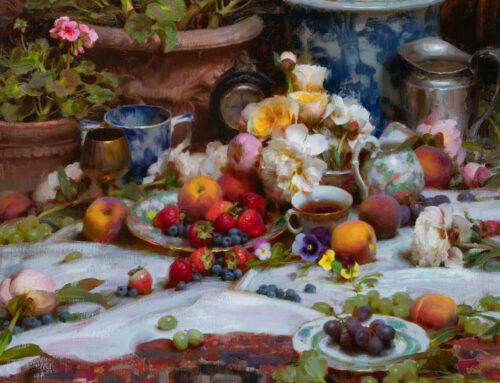

What color is joy? What’s the color of sadness, tranquility, or anger? Is it worth exploring for artistic purposes the psychological “power of color” to, as some believe, carry associations and even “frequencies” that can affect things like feeling and mood?
Many agree that music can convey feeling just through the relationships between notes augmented by dynamics such as loudness, softness, instrumentation, harmony and dissonance. By analogy, some artists say a painting’s composition, contrasts, color harmonies, linear notation and visual passages (all terms shared with or borrowed from music, by the way) can have a similarly expressive or emotive effect on a viewer. Consider the explosive “symphony” of light and color in a painting such as the Slave Ship by Turner <<https://collections.mfa.org/objects/31102 versus the “measured” and “quiet” tonalities in Whistler’s portrait of his mother.
You can think of the creative act of painting much like playing music, too. First you learn technique – in music that means things like scales and fingering, while in painting it’s skills like color mixing and paint handling. Eventually you can “forget” the technical stuff and begin composing your own “pieces,” or so the thinking goes.
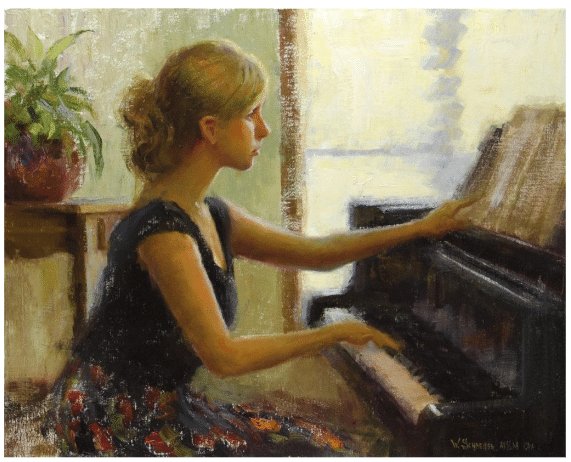
William Schneider (b. 1945), “Practice Makes Perfect,” 2013, oil on linen, 24 x 30 in., private collection.
But there’s yet another, deeper way to think of painting in terms of music. In jazz or rock, there’s a difference between playing a solo and jamming. Soloing is something you do on your own. Jamming is a group activity; it has to do with a special kind of creativity in which each bandmember takes a part in shaping and reshaping the music so that the whole thing evolves in real time.
In music, a solo can be improvised, or it can be played as it’s written into the music, or it can be imitated note-for-note from a recording. In any case, the band continues the usual background chords sans vocals, and the soloist takes the lead.
On the contrary, when a band jams, there’s an extended opportunity for the various other members not only to take solos but to “move the music” somewhere else by introducing themes-within-the-theme. In the best jam bands, all the members improvise together with the aim of creating variations of the entire song and “seeing where it goes” – it’s not about playing solos at all. It’s about collaboration and the creation of something new, with its own energy, that almost seems to create itself.
The origin is jazz. According to rock and roll lore, in the early 1970s one of the first major jam bands, The Allman Brothers Band, became disciples of Miles Davis and the way Miles’s horn solos, especially on his breakthrough album “Kind of Blue,” expand into musical space, taking the tracks in unexpected directions.
Creative Distance
For this to work, the band more or less must act as one. So each member has to distance themselves from their own playing and consider the piece as a whole. Within this creative distance is a balance of passively listening and actively shaping. During a jam, one band member, the bass player let’s say, will introduce a new riff. The others pick up on it and the result is a groove, where the whole band improvises together until someone else invents a new variation and the group takes it somewhere else.
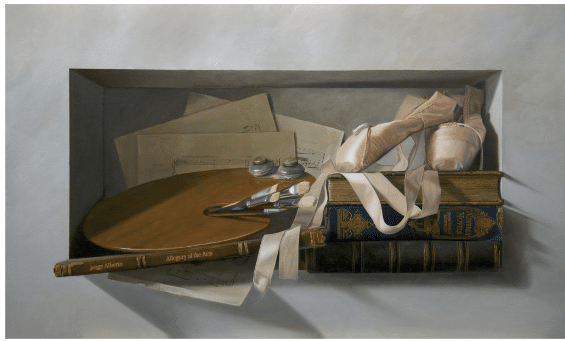
Jorge Alberto (b. 1949), “Allegory of the Arts,” 2016, oil on panel, 16 x 25 in., Troika Gallery, Easton, MD
Maybe as painters, because we’re making a thing that will live on independently of us, we run a greater risk than performers of getting too wrapped up in the final product. We forget that for viewers, part of experiencing a painting is appreciating the process. Our artistic choices remain recorded in the dried paint for all to see. Think of brushstrokes and how you “follow along” with the artist when you look at a Turner, a Monet, or a Van Gogh in person. An important part of experiencing art is appreciating the spirit of the thing and the choices the artist made in creating it.
All of this definitely seems to have something to do with being present – the point of a musician’s or a dancer’s performance isn’t to reach the end, it’s to be fully present and creative, in tune with the process.
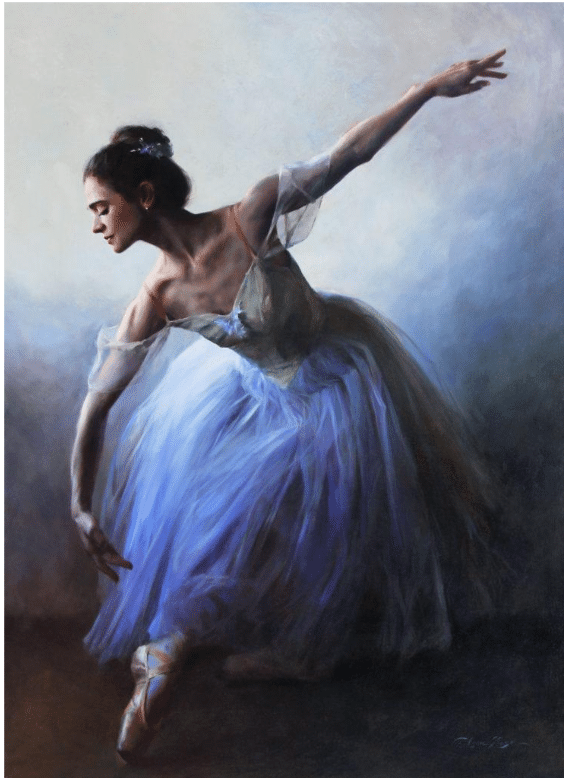
Anna Rose Bain (b. 1985), “Vintage Tutu,” 2017, oil on linen, 50 x 36 in., Saks Galleries, Denver
It’s often called “being in the zone,” and musicians, writers, and artists live for that moment. It’s where the magic happens. A creative writer suddenly starts channeling a character. A guitar player and a keyboard player find themselves moving into complementary patterns without knowing how it happened, as if linked by some psychic frequency. A painter mixes colors on the fly and every time she applies them, the exactly right thing to do next is clear – no laboring over the next move or worrying if a passage looks muddy or wrong. In music and in art, we do our freest and sometimes our best work when we don’t know what we’re doing.
That’s the paradox of it. For artists, the trick is getting the conscious, rational mind to relax so that one becomes aware of being “in” the painting, almost as if assisting in its creation, watching it paint itself. How this happens – and what takes place in the creative brain when it does – remains a mystery. All I know is what a musician friend of mine is fond of saying, “if you’ve got a horn, you best be bringing it – and playing it.”
Floating a melody over a cascade of changing chords; skiing down a mountain when you begin to relax and trust your balance; surfing or riding a skateboard, shooting pool like a pro without knowing how – that moment when you’re still exerting effort, but you mentally take a step back – and then you find you have a new measure of skill and control: Jamming is like that. If you step mentally back from thinking (or more likely, worrying) about your own playing, you can sense how things are fitting together and how your creativity can enhance the whole.
Like musical instruments
Abandoned in a field
The parts of your feelings
Are starting to know a quiet
The pure conversion of your
Life into art seems destined
Never to occur
You don’t mind
You feel spiritual and alert
As the air must feel
Turning into sky aloft and blue
You feel like
You’ll never feel like touching anything or anyone
Again
And then you do
-Poem By Tom Clark
Rock on.

Marc Mellon (b. 1951), “Marcelo Gomes as Apollo,” 2017, bronze (edition of 12), 26 1/2 x 10 in., available from the artist.
William Schneider teaches how to paint the figure in a series of pro-quality step-by-step videos you can browse through here.
Vote Here!
Acrylic painter Charlie Easton is coming to the Streamline Studios to shoot a painting demonstration and YOU get to help choose which painting he’ll demo and what you want to know about it.
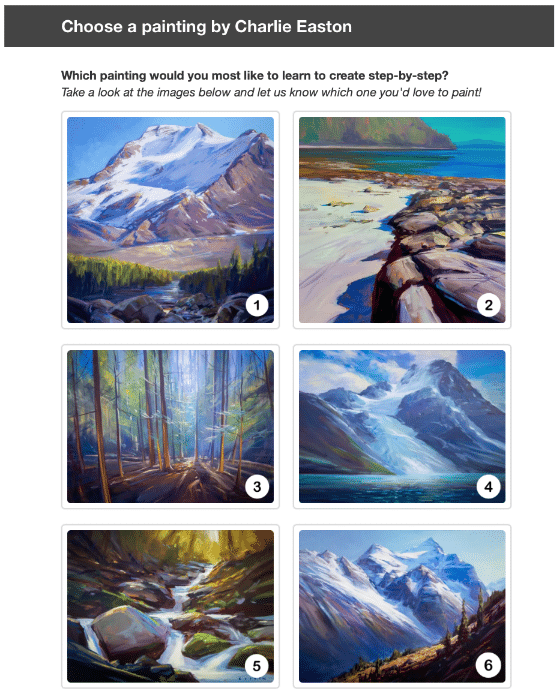
Choose a painting and let us know what you want to learn how to do! Streamline’s video folks will pool the answers and use them to help guide Charlie’s lesson plans.
CLICK HERE (or on the image above) TO TAKE PART IN THE POLL.