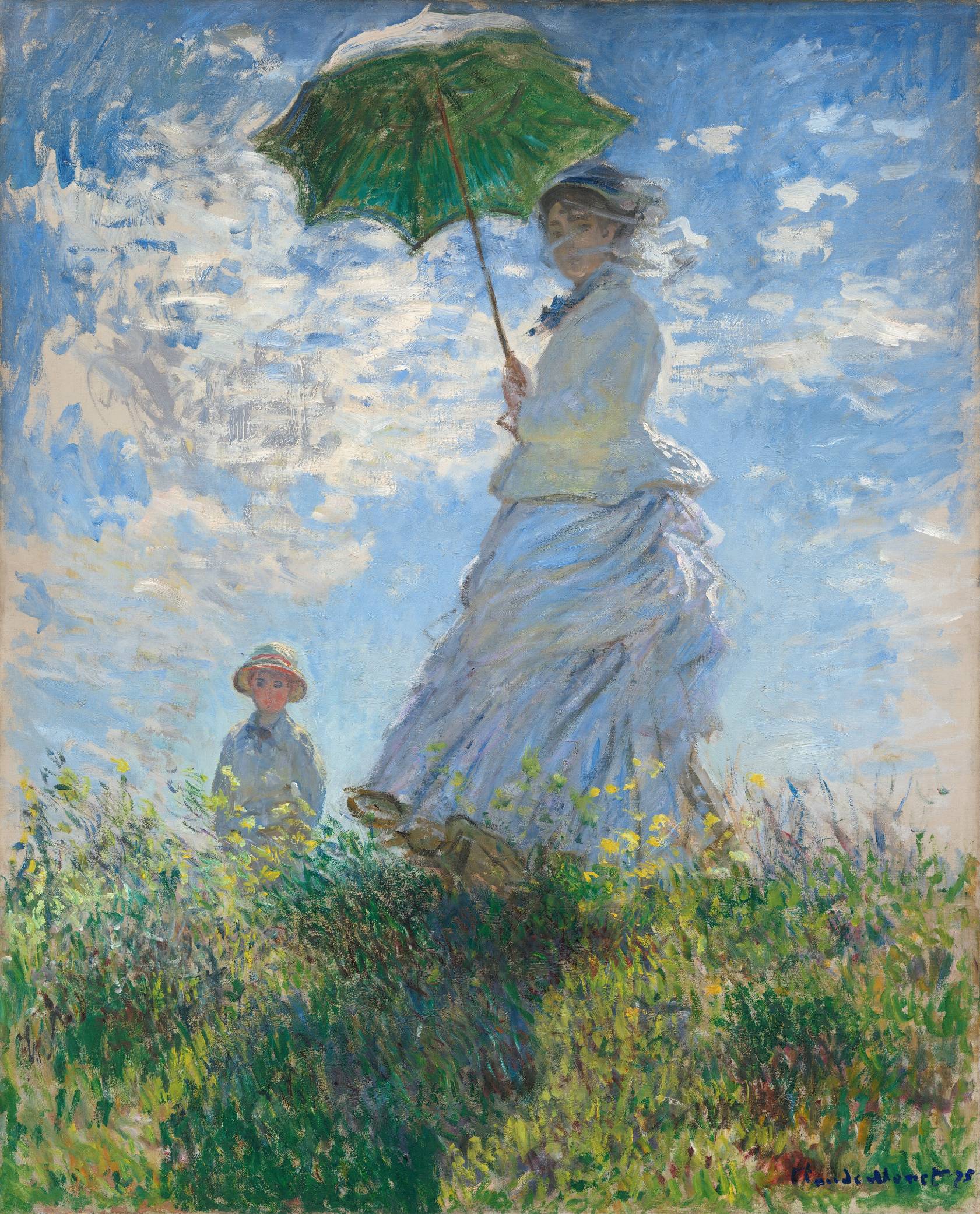
There’s a particular quality to light in the summer — angled just enough to catch every blade of grass, moving fast across a sky that can’t decide whether it’s clearing or building toward a storm. Claude Monet caught exactly that kind of light in 1875, in a single outdoor sitting that produced one of the most beloved paintings in the entire Impressionist canon: Woman with a Parasol — Madame Monet and Her Son.
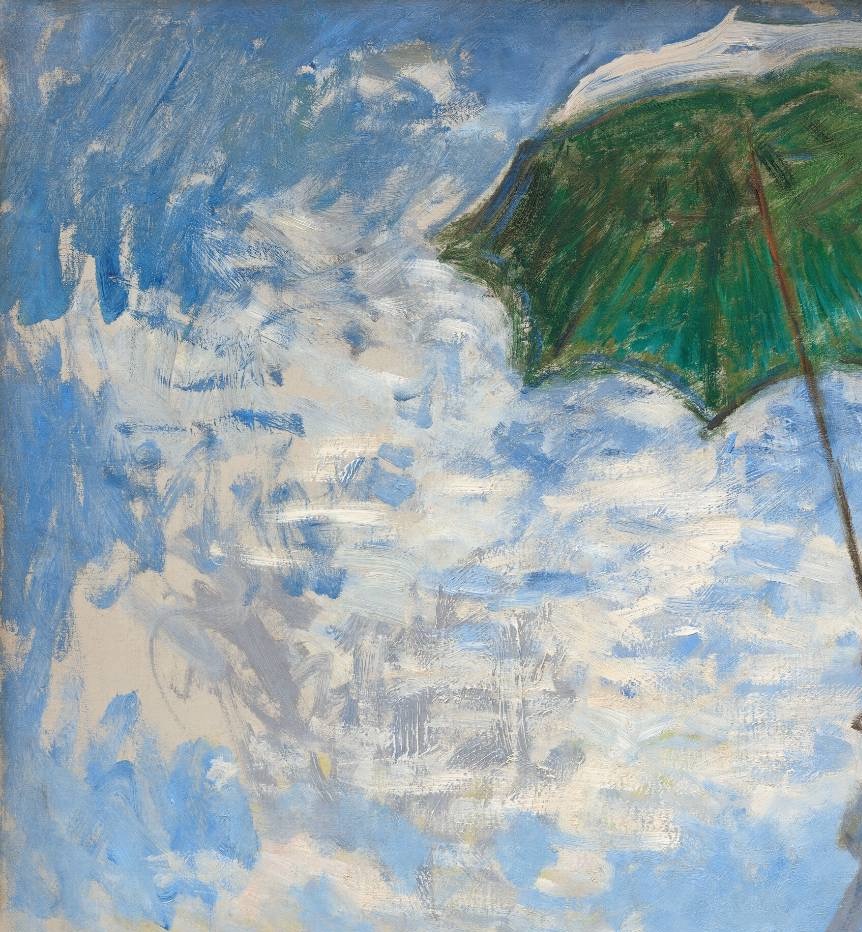
Detail: Monet’s sky, worked so fast that raw canvas peeks through where the brush never quite caught up.
The setup was simple. Monet’s wife, Camille, stood on a windswept rise near their home in Argenteuil, their seven-year-old son Jean tucked behind the hill so only his shoulders and head appear, like a second horizon line. Monet painted the whole thing fast — probably in a few hours, the largest canvas he’d attempt that decade, worked entirely en plein air. You can see the hurry in every stroke. The sky is a near-chaotic sweep of blue and gray, with bare canvas showing through in places he simply didn’t have time to cover. The grass beneath Camille is built from short, layered dashes of green, blue, and brown, punctuated by small flecks of yellow — buttercups, their color bouncing back up into the sleeve of her dress.
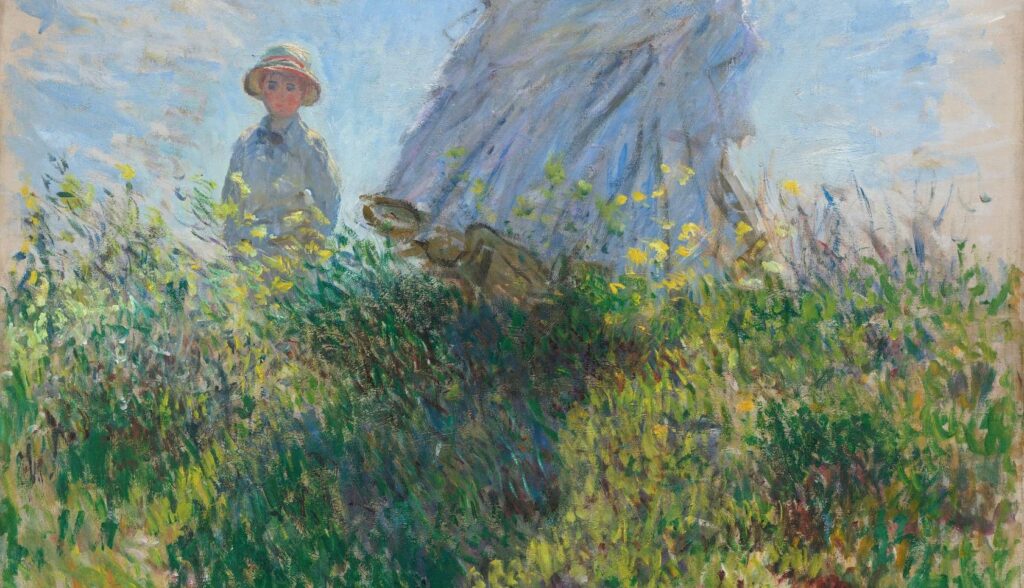
Detail: buttercups dot the grass in quick flecks of yellow, their glow echoed in the sleeve of Camille’s dress.
What makes the painting feel less like a record and more like a living moment is the wind. Camille’s veil lifts. Her white dress billows. Monet places the viewer low, looking up at her against a sky full of fast-moving clouds, so the whole composition seems to sway. It’s the kind of light and weather every plein air painter recognizes instantly: conditions that won’t hold still, that reward speed over precision, that demand you get the feeling down before it changes.
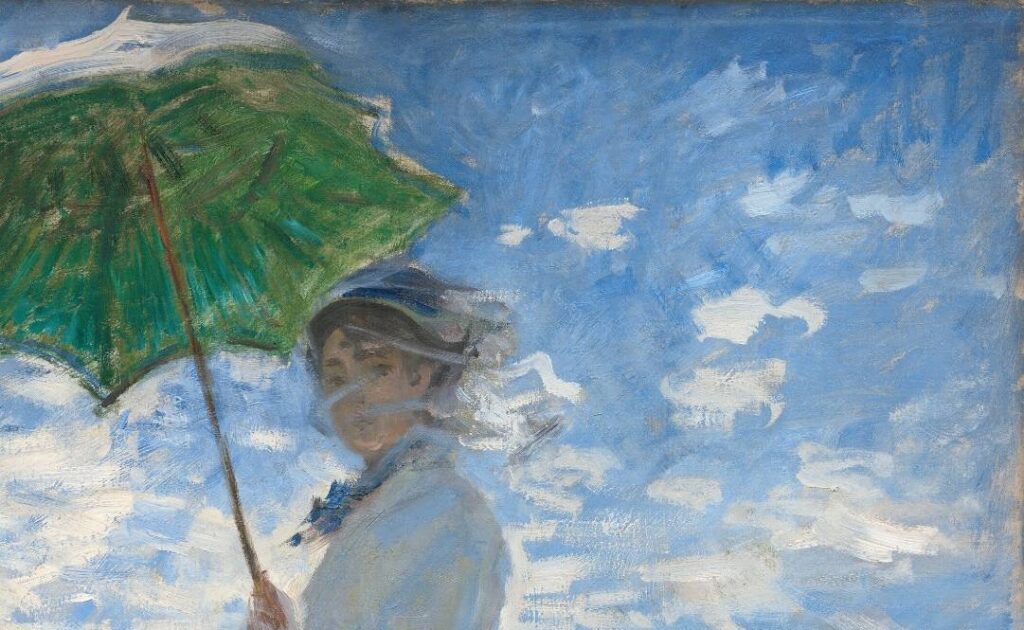
Detail: Camille’s veil lifts in the wind.
Monet clearly knew this. The slashes of brilliant white across Camille’s skirt and jacket aren’t rendered detail — they’re light itself, caught for a moment and then gone. That’s the gamble every outdoor painter makes in late summer, when the days are still warm but the light has already started to turn, moving lower and faster across the sky than it did in June. Monet didn’t paint the wind or the changing season directly. He painted what they did to color, to fabric, to the surface of a hillside — and in doing so, made a fleeting afternoon feel permanent.
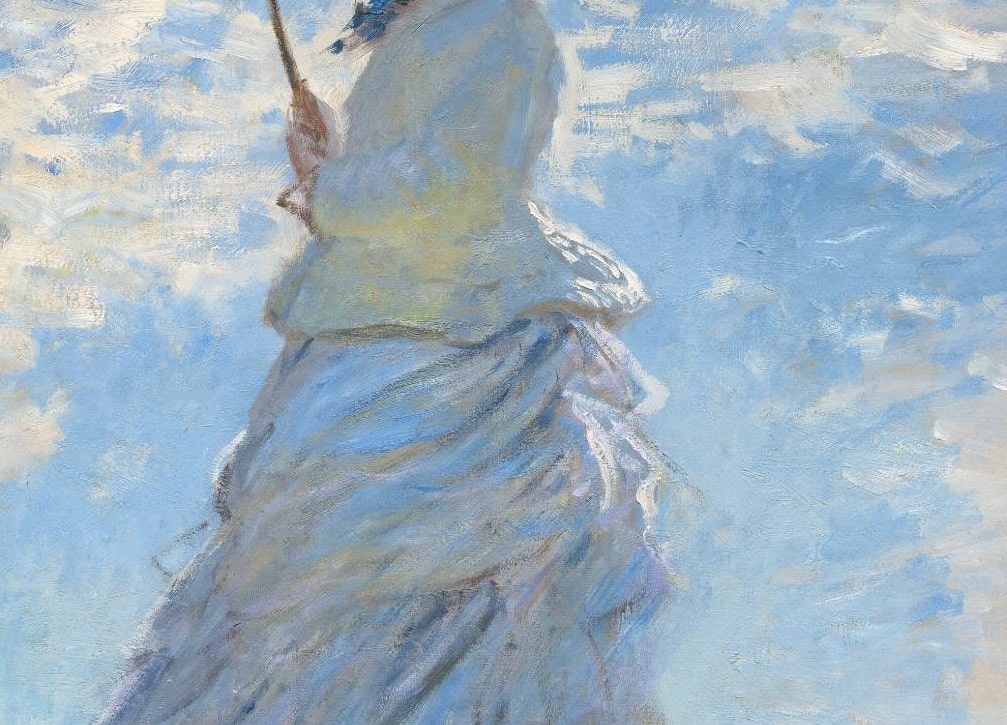
Detail: brilliant white slashes across Camille’s skirt and jacket — less brushwork than pure sunlight, caught mid-flicker.
Monet had no formula for capturing light like that — just instinct, speed, and thousands of hours spent learning how fleeting conditions behave on canvas. That’s exactly the kind of instinct Plein Air Live is built to help you develop. Over several days of in-depth instruction from today’s top outdoor painters, you’ll learn how to read changing light, work fast without losing control, and turn a fleeting moment into a finished painting — all from the comfort of your own studio.