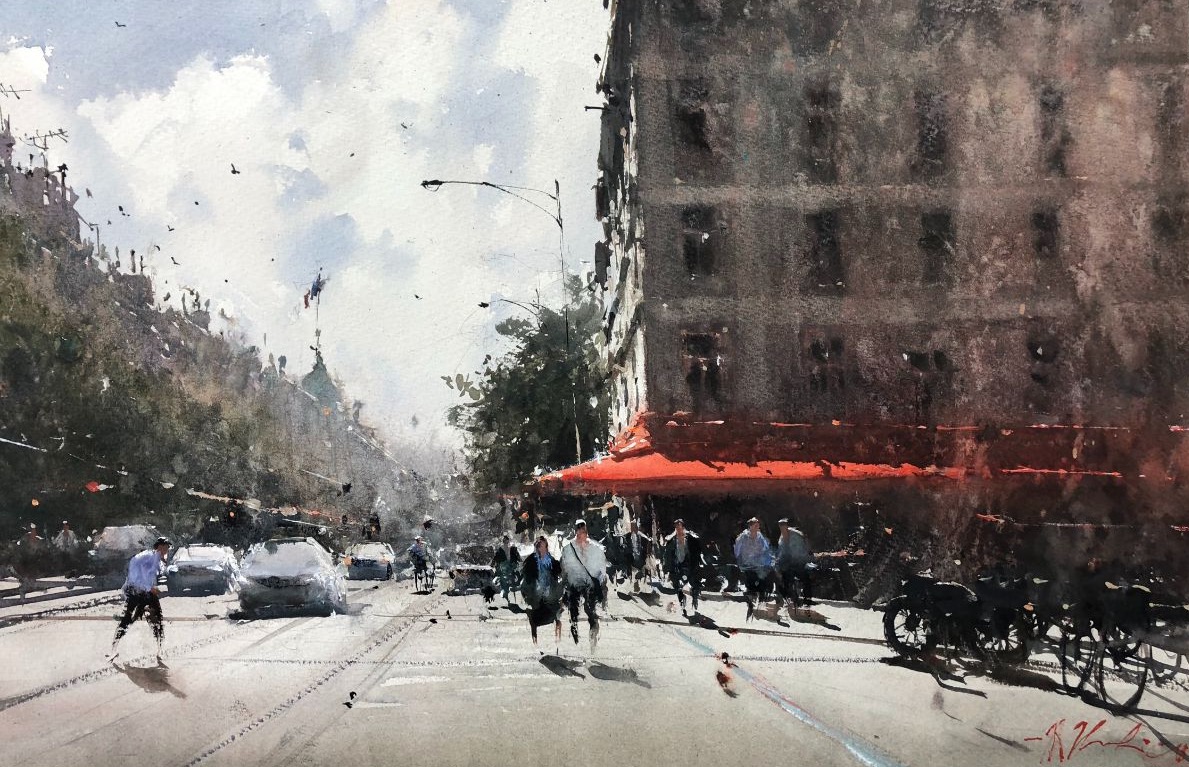
Most paintings ask you to stop and look. Joseph Zbukvic’s paintings capture something closer to a glance. “What I try to get is an illusion of a fleeting moment,” says the Melbourne watercolorist, “something like a small time capsule, the feeling that you have when you’ve just turned your head and glanced at a view rather than something that you have stopped and stared at for a long time.”
His subjects range from the hazy light of his hometown to crowded Italian squares and sunny Barcelona streets. Whatever the scene, the effect is the same: light, air, and movement captured with brushwork so loose and confident that it seems to have happened all at once.
In a sense, it did. Zbukvic paints outdoors and works fast, often finishing three or four paintings in a day and rarely spending more than an hour on any one. “If I fiddle with it more than that, I’m going to kill it,” he says.
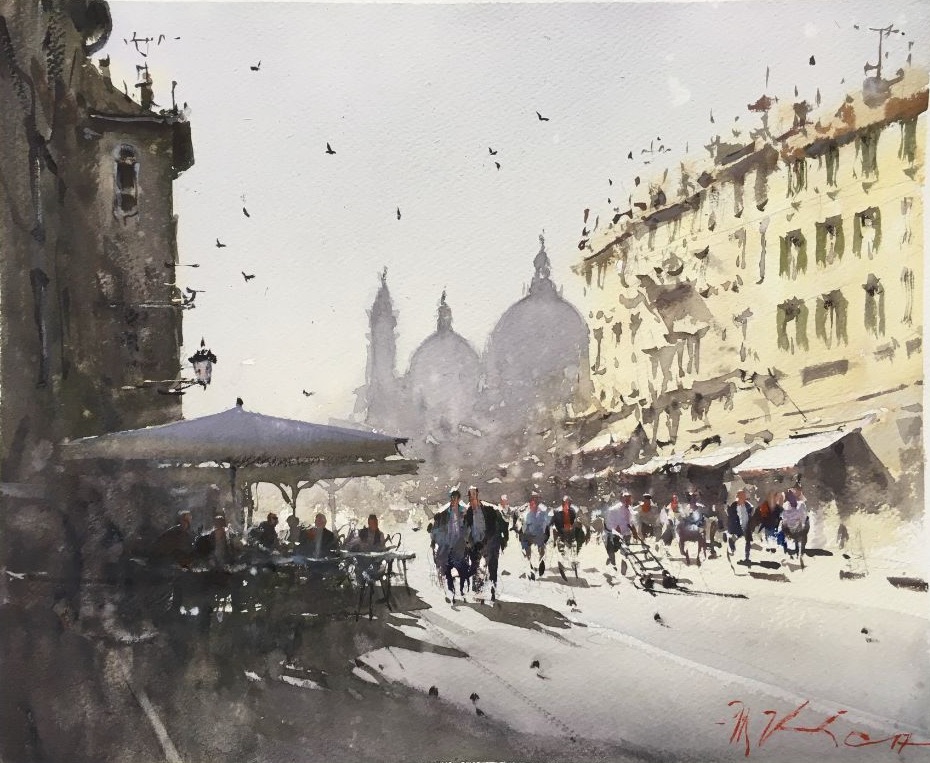
“Via Garibaldi, Venezia” (watercolor, 9 x 13 3/8 in.) by Joseph Zbukvic
Less Is More Engaging
Because he works so quickly, his paintings rely on suggestion rather than detail, and that’s deliberate. “If I define everything, it becomes boring,” he says. “There’s nothing more boring than a perfect circle, but if you make some dots in a broken circle, your eye will be drawn to it to complete it.” When a painter leaves something unfinished, the viewer gets to take part.
Those quick strokes carry another message, too. A crisp, broken edge left by a fast brush, Zbukvic says, signals confidence. “The viewers don’t know necessarily that it’s a confident painting, but they can sense it.”
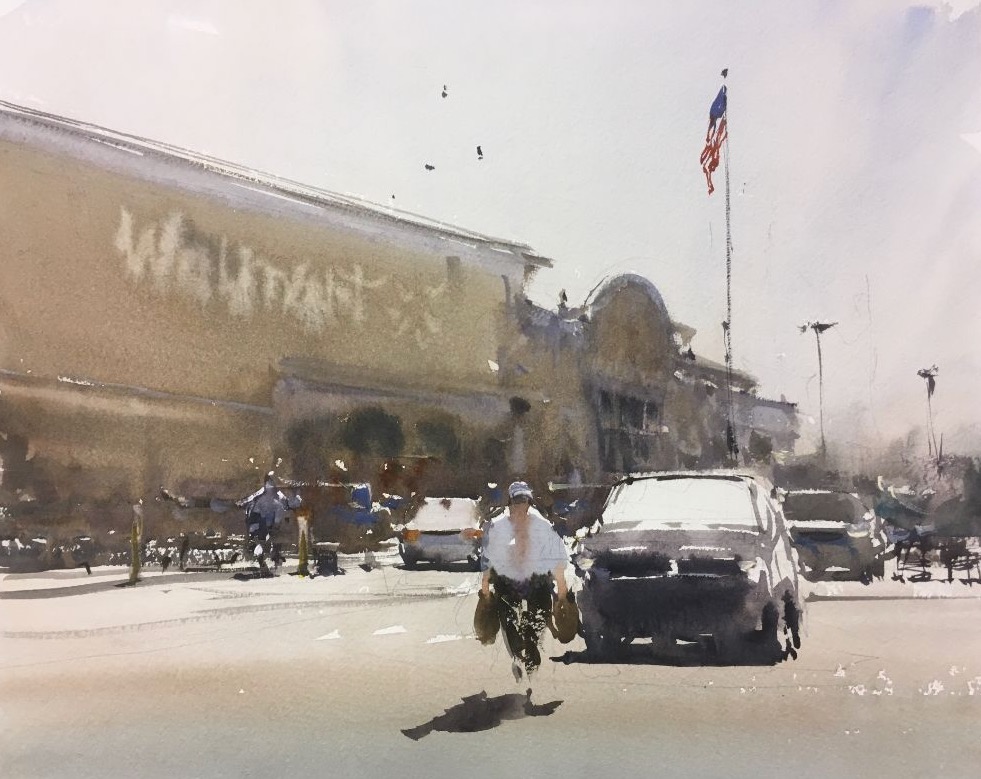
“Walmart Car Park in Dallas” (watercolor, 9 ¾ x 13 ¾ in.) by Joseph Zbukvic
Spontaneous, but Never Careless
For all their freedom, his paintings are carefully planned. Watercolor leaves little room for correction, because once a wash dries, its edge is there to stay. So Zbukvic has to picture the finished painting before he starts. Often the main subject, such as a ship at a dock, goes in last, with its white areas carefully preserved. He compares the process to surgery: “One wrong cut and the patient dies.”
To him, that tension sits at the heart of the medium. It’s a “strange dance” between romantic vision and technical precision.
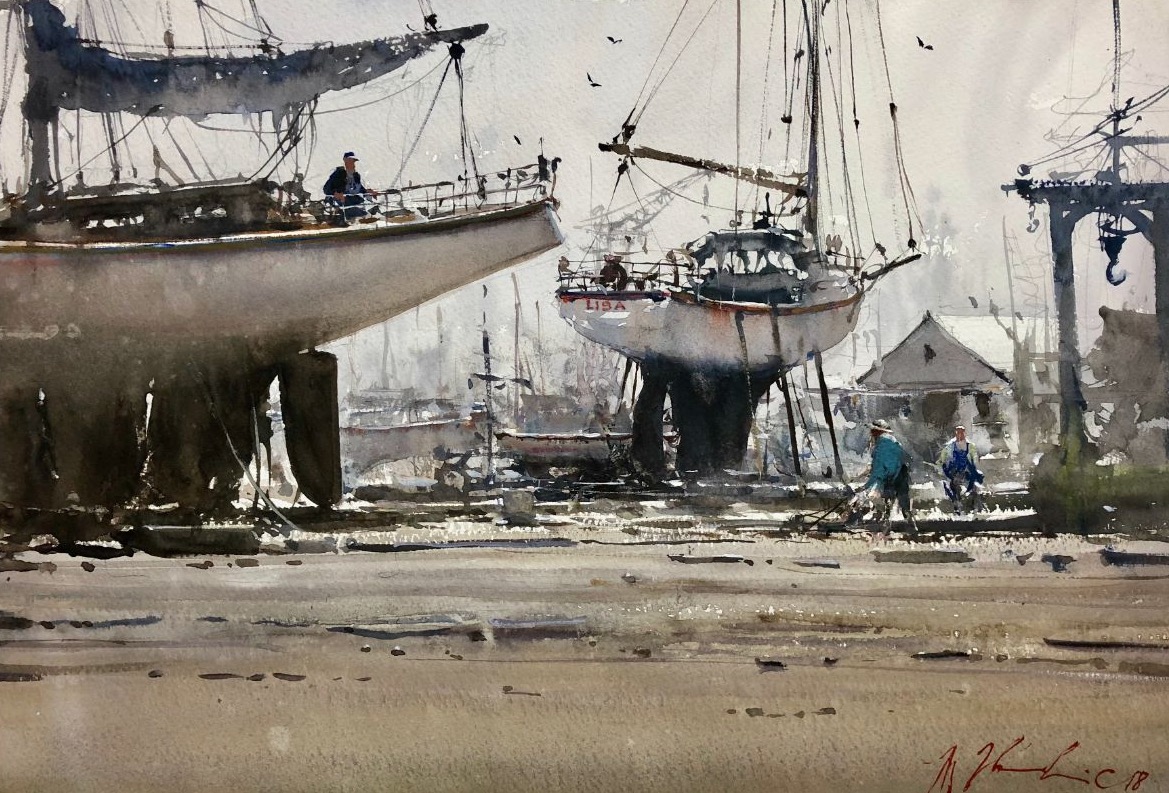
“Williamstown Harbour” (watercolor, 13 ¾ x 20 ½ in.) by Joseph Zbukvic
Why People Really Buy
Zbukvic has a clear-eyed view of why collectors buy art. Technique matters less than connection, he says. Most people buy a painting because “the image means something to them,” whether it’s a place where they vacationed, honeymooned, or spent their childhood.
Yet he never paints with sales in mind, and he doesn’t take commissions. “As soon as I try to get too clever and paint because I think something will sell or win a prize, I find I come unstuck very quickly.”
What matters more to him are the connections his work creates. He’s seen students he helped go on to become teachers. Once, a stranger stopped him on the street to say that watching Zbukvic paint years earlier had inspired him to become an artist.
His goals for his work are refreshingly modest. His paintings, he says, offer “quiet moments of joy.”
“I’m just a nice painter of watercolors,” he says. “I just paint and everything else comes after.”
Watch Joseph Zbukvic Capture the Moment, Live
Want to see how Zbukvic turns a fleeting glance into a finished painting in under an hour? He’ll be on the faculty of Watercolor Live, January 20–22, 2027. It’s three days of live online demonstrations from some of the world’s top watercolor artists, and you can watch from anywhere. You can ask the faculty questions in real time, connect with fellow painters, and catch the replays if you miss a session. Reserve your spot →