Our previous post on water-painter-extraordinaire Frits Thaulow (which you can read here)inspired a flood of emails from readers appreciating the Norwegian Impressionist’s work. A recent visit to the Saint Louis Art Museum gave me a chance to take a super close look at his technique.
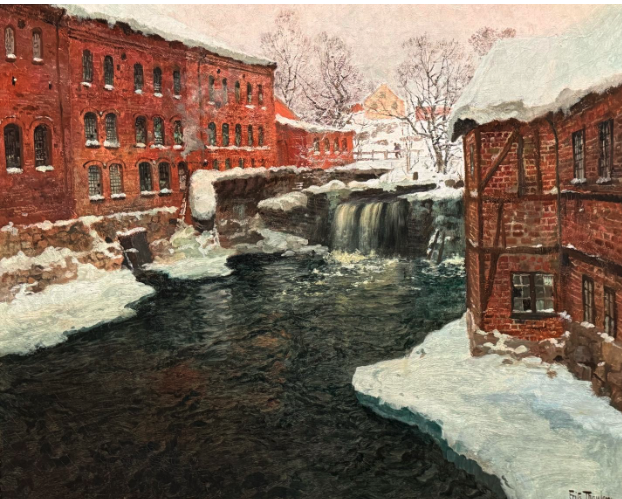
Thaulow’s “Mill Scene” (above) is one of a series of winter views he produced of factories on the Akerselva River in Oslo, Norway. The reds of the buildings offset the white of the snow and the inky blackness of the water; a tiny figure crosses a bridge in the distance. It’s the water we’re most interested in, though.
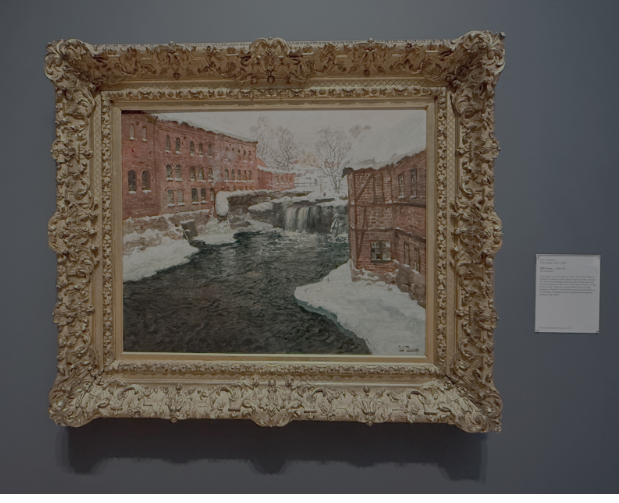
The painting by Fritz Thaulow, captured on camera “in the wild.”
Below you’ll find successively closer views of what’s really going on in the water. One of the most remarkable things about it is the way Thaulow rendered the water in motion. He seems to have observed and captured the actual currents as they flowed past and collided with each other on the agitated surface.
The water’s color, too, has the ring of truth. Although the sky is quite bright above the mill buildings, the water is dark. It’s that leaden (but not really, as we’ll see) color of ponds, lakes and rivers reflecting the gray skies of winter, when the bright blue is nowhere in sight.

He’s rendered the texture of the moving surface so well that it looks like impasto brushwork – the impression one gets is of intricate, three-dimensional ribbons of raised paint. But not so. Here’s a patch of water just off the jutting snowbank on the righthand side of the composition:
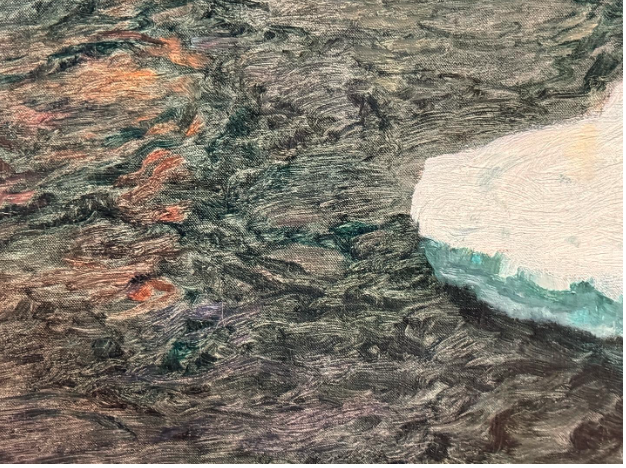
Even this close, in person anyway it’s hard to tell whether the paint is thickly or thinly applied, whether the brushstrokes are flat or raised. In fact, it’s the latter – he’s drawn a bristly brush through thinly applied paint, totally flat. The next two images are photographed closer and closer (I can’t believe a guard didn’t come over and tell me I was way too close!), so you can better see the quality of the strokes themselves.
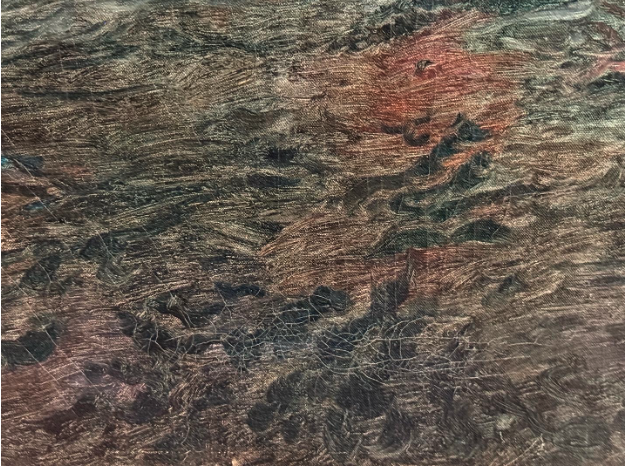
This gives us a chance to consider the color, too. There’s nary a neutral “leaden” gray in sight – it’s mostly low-chroma green-blues, off-whites, ochres, and brick-reds.
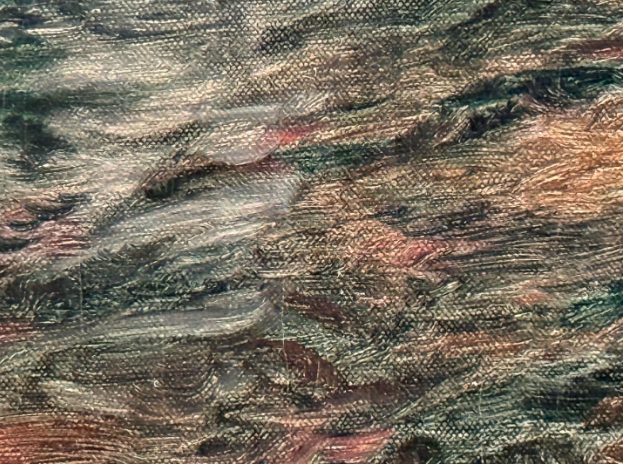
Wild, right?! It looks like he thinned his paint with turpentine and made each little wavelet individually by twisting the brush (probably a round), placing lighter strokes over or next to darker ones. And somehow it coheres into a hyper-realistic rendering that seems wet enough to not want to fall into.
Now that we can see the brushwork up close and get sense of how he did it, it’s interesting to go back to some of the other paintings and compare. He continued to create masterful water paintings, for example, in the final years of his life, which he spent in France.
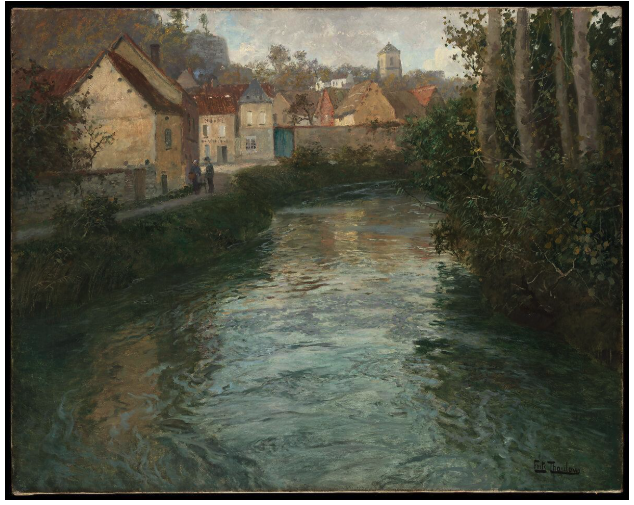
Picquigny (village of Picquigny, near Amiens on the river Somme, northern France), 1899, 28 3/4 × 36 1/4 in. (73 × 92 cm), oil on canvas
This canvas (above) shows the village of Picquigny, near Amiens on the river Somme, where he worked for several weeks in the late autumn of 1899. The one below, titled “A Stream in Spring” is another of these French river paintings with masterful, keenly observed and wondrously rendered surface currents and reflections.
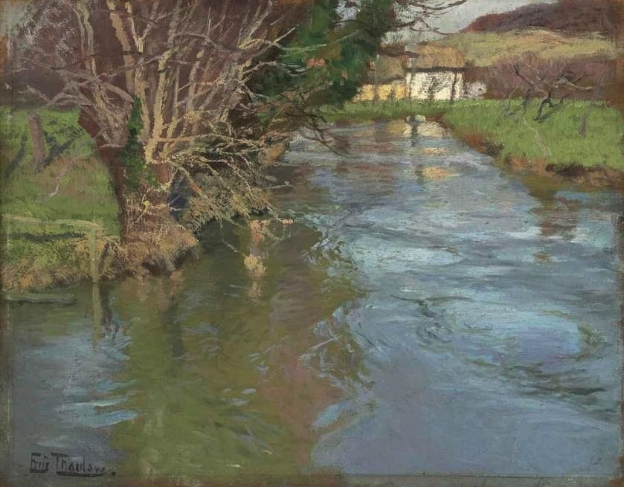
Frits Thaulow, “A Stream in Spring”
Ridiculous!
As mentioned last time, if you’d like to follow in Frits’s footsteps, there’s a great instructional video out from contemporary painter Kami Mendlik. Check out her video, “Mastering Water – The Secrets of Color and Reflection”
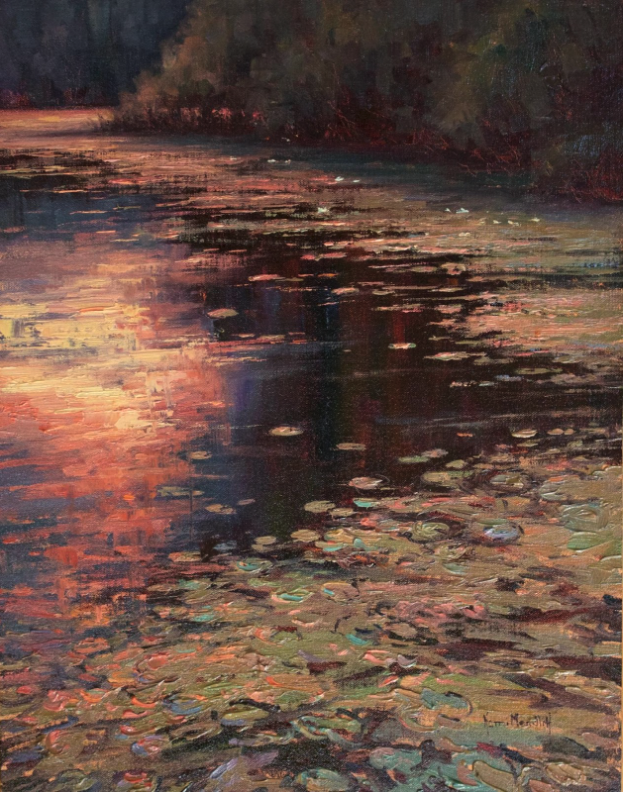
Kami Mendlik teaches you how to make this painting in her video, “Mastering Water”