Though renowned for his light-drenched figure paintings and portraits, Renoir’s lesser-known landscapes possess a similar poetry, elegance, and innovation.
Renoir’s famous boating parties and crowded outdoor café scenes dazzle and charm. Once seen, you never forget the lyricism of his perfectly contented figures enlaced in a hazy patchwork of filtered sunlight.
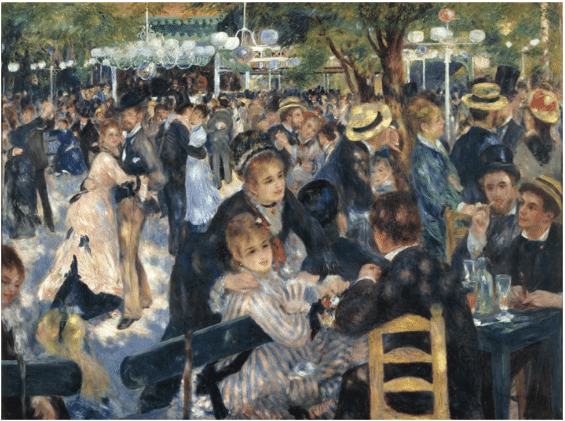
Pierre-Auguste Renoir, Bal au Moulin de la Galette, oil on canvas, 1876
The online news outlet The Guardian has aptly described the effect this way: “See how its sexy crowd of young Parisians are brought alive by dappled sunlight that glints and glances through the trees…. The play of light that makes this painting dance is something we recognize and know to be a typical natural effect – but amazingly, no one had ever painted such a broken light before. This quickness of sunshine, this fluency of shadows, had never been acknowledged in art before Renoir came along.”
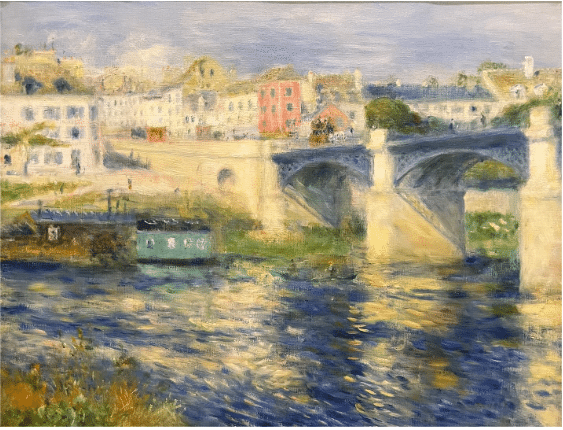
Nor has anyone really done it better since, as far as I know. In his landscapes, such as Bridge at Chatou at the top of the page, Renoir innovated by placing his easel facing this Paris suburb’s nondescript waterfront buildings instead of the conventionally beautiful surrounding pastoral land behind him. His focus is the voluptuous blue of the river and the contrasting yellow of the sunlit bridge and blurred reflections, by which he catches his sense of heightened appreciation of the ordinary in a moment of brilliant seeing.
Renoir’s signature style has a softness to it that makes you think of velvet. His paintings seem really to be made of light, or rather light projected onto fabric rippling in a mild breeze. He achieves it by eliminating hard edges with blending, applying his colors with a large brush using broad and breezy strokes of layered and scumbled paint, and avoiding even a whiff of fussy detail (suggesting rather than insisting on his forms). You can see all of this at work in the detail from Bridge at Chatou (below)
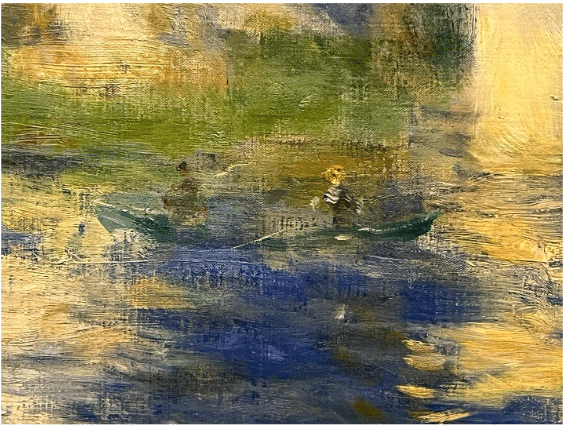
DETAIL, Renoir, Bridge at Chatou, oil, 1875
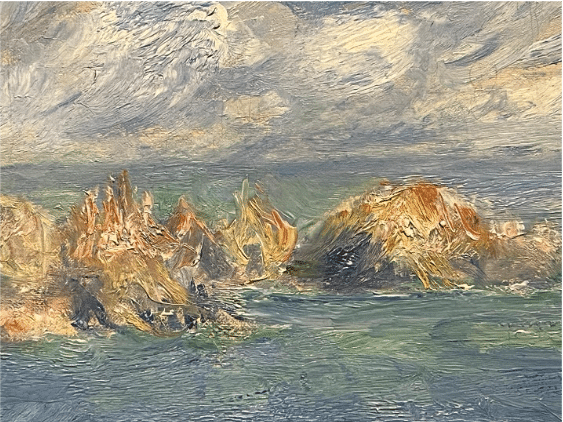
In his View at Guernsey, you can see the relationship between the Impressionists and the post-Impressionistic work of painters like van Gogh.

The detail below shows the vigorous and lively energy you see in Renoir’s brushstrokes when you view this painting in person:
In Low Tide, Yport, (below) Renoir painted in a busy tourist town on the Normandy coast, but you wouldn’t guess it from this view. Renoir ignored the vacation spots popular attraction, a casino, and went instead for a picturesque view of the town’s sulit bay, with irs cliffs, fishing boats, and rocky beaches. Again it was the love of the light that seems to have driven his decision-making; the parallel slanting brushstrokes with which he treated the various features and elements creates an image that, when viewed from a distance, expresses the feeling one has of standing in the breeze before the muddy seashore dappled in late afternoon sunlight at low tide.
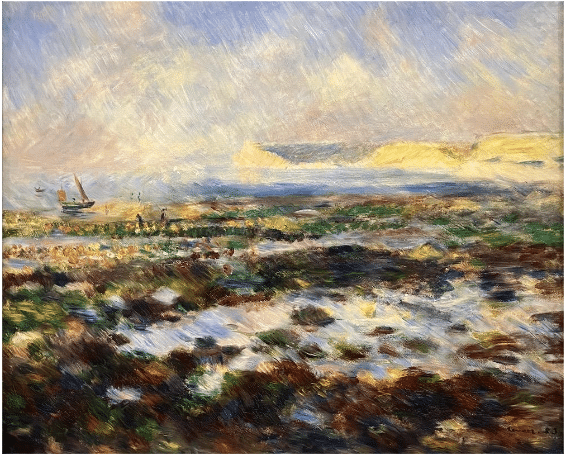
Renoir, Low Tide, Yport, 1883 oil
Renoir’s approach throughout these landscapes is to remain essentially modern and contemporary while channeling something of the charm and poetry of the best of the Western landscape painting tradition.
In 1874’s Wash-House Boat at Bas-Meudon, Renoir depicts a lavoir or wash-house boat, where Frence’s working classes could wash laundry. It’s significant that this is his focus is the laundry boat when the town it’s in was full of historical significance as the site of on of Louis X!V’s lavish royal palaces. Again, Renoir aggressively selected a scene from contemporary life, painting the water, trees, boats, and figures with uniformly thin brushstrokes, producing a quintessentially modern landscape.

Renoir, Wash-House Boat at Bas-Meudon, 1874
Renoir would have called the sunset painting below an impression, a finished painting of a dramatic atmosphere effect rather than a sketch of a specific site. The sea is heavily worked with layers of color, the sky painted in broad, rapid strokes.
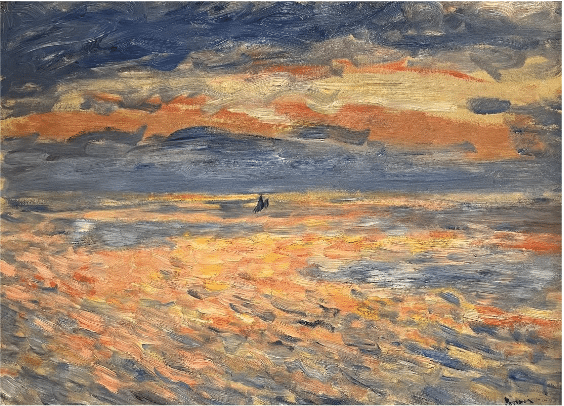
Renoir, Sunset, 1879 or 1881, oil
The painting recalls Monet’s Impression, Sunrise of 1874, the painting that became the shot across the bow of French Academic art and gave the movement a name when it was jeered by critics at the first “Impressionist” group show.
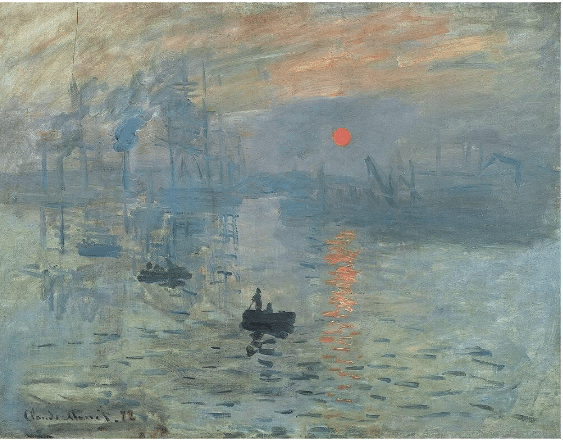
Claude Monet, Impression, Sunrise, 1874 oil
Painting the landscape as the Impressionists did remains a massively popular approach. There are several high-caliber videos available from highly acclaimed plein air painters available. Browse several of them all in one place right here.