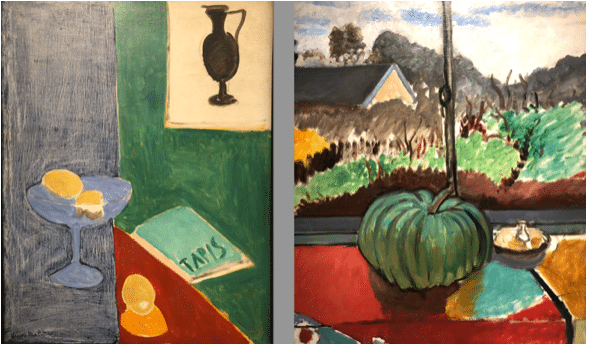
Beloved of artists and art-lovers alike, Henri Matisse painted from a place of exuberance and honesty – he took a joyful approach to the world as well as to painting. Matisse’s canvases show plainly he believed artists should translate the beauty they see in the world not into mirror images but into bright emblems of that selfsame beauty and joy.
The two still life paintings above live at the Rhode Island School of Design (RISD) in Providence. When you go to see them in person, the museum provides wall texts alongside these paintings designed to provide visual and aesthetic context, presumably with the aim of giving viewers a “way in” to the paintings.
It’s been especially important to provide an on-ramp to paintings in the Modernist style, because such works operate outside (or rather, alongside) the classical European tradition that even today provides the foundation for mainstream representational painting.
So let’s take a closer look at each of these two paintings and see what we can see.
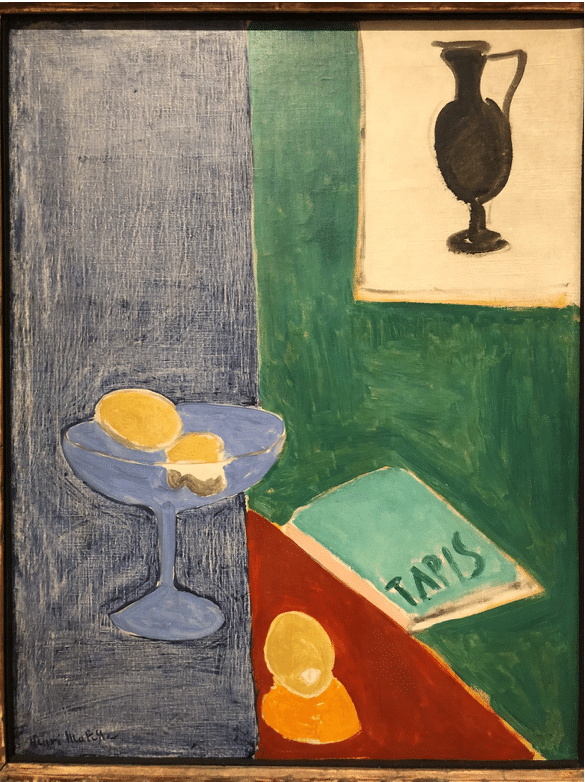
Henri Matisse (French, 1869-1954), Still Life with Lemons, ca 1914, oil, 27 5/8 x 21 3/16 inches
About this painting, RISD’s wall text has this to say:
Matisse used vivid colors to render the simple forms and geometric background of this composition. An extended title, Still life with lemons whose forms correspond to a drawing of a black vase upon the wall, points to an intentional relationship between the shapes. The pitcher echoes the curves of the plump lemons below, and its neck and base are repeated in the foot of the blue glass compote at lower left. A book (titled Tapis, or Carpets) neatly aligns with the brilliant red wedge on the surface of this painting, unburdened by mass or placement in space.
All well and good. And yet, not be rude, but so what? Why, specifically, should I care? That accurate if dry wall text succinctly describes the c. 1914 painting by Matisse called “Still Life with Lemons.” However, it does nothing to explain what’s “good,” or interesting, or important about it. It would be nice to have some context, or at least some encouragement for finding my own meaning within it. When I read the text above and look at this painting, it’s as if there are two versions, the museum’s and the one that I see.
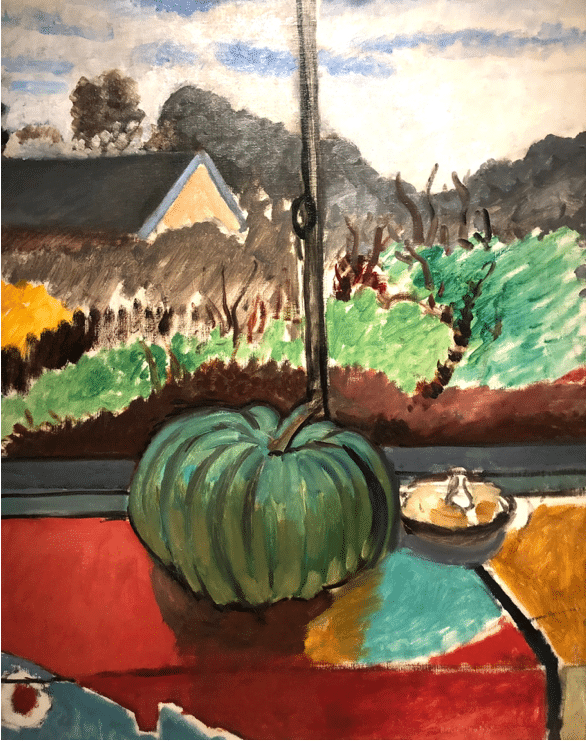
Henri Matisse, The Green Pumpkin, oil on canvas, ca. 1916
Here is The Green Pumpkin, from roughly the same time period. The wall text for this painting reads:
Part still-life and part landscape, Matisse’s painting presents a fat green pumpkin on a patterned textile against a view from his window in a Paris suburb. Windows were among Matisse’s favorite motifs, permitting him to organize foreground shapes while framing the image beyond. Here the window bisects the composition, neatly dividing the interior and exterior scenes. Matisse used dark outlines to graph the windowpanes and emphasize the pumpkin’s curves. Within these contained spaces, he employed a brilliant palette of autumnal reds and complementary hues of green, varying the direction and density of his brushstrokes to suggest atmosphere, distance, and mass.
Again, great observations, but why should I care? No one’s telling.
As if afraid to overstep, art historical commentaries confine themselves to the description of a work of art while saying very little about why it matters. Why do our art guides act as if it’s taboo to point toward the potential meanings (there doesn’t have to be just one) that we can get from paintings? There’s usually not all that much mystery…
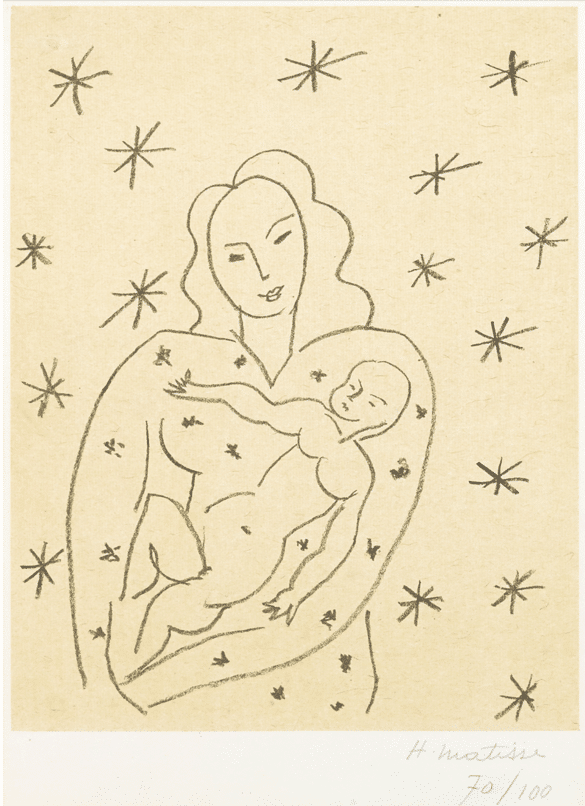
Henri Matisse, Vierge et Enfant sur fond etoile, lithograph, 1951
Taking a different approach, one could say, without either describing what the paintings look like OR telling anyone what to think, that Matisse’s painting is less a representation of lemons or pumpkins than a celebration of color, line, and form. With that one word, celebration, we’ve added the dimension of life to the painting. The word fits when you consider the context:
The idea of filling the world with soothing and enlivening imagery, or simply shapes and colors enjoyable for their own sake, hadn’t much occurred to Western artists as a worthy aim of art. The book on “carpets” lying on the floor in Still Life with Lemons playfully links the painting to decoration and interior design, aligning this work, that is to say, with feelings of pleasure and the desirability of colorful, comfortable surroundings.
“What I dream of,” Matisse said quite plainly, “is an art of balance, of purity and serenity, devoid of troubling or depressing subject matter, an art which could be for every mental worker, for the businessman as well as the man of letters, for example, a soothing, calming influence on the mind, something like a good armchair which provides relaxation from physical fatigue.”

Henri Matisse, Luxe, Calme et Volupté, (“Luxury, Calm and Pleasure”), 1904. Oil on canvas, 98 x 118.5 cm. Musee d’Orsay, Paris.
What a poetic and generous, big-hearted goal for an artist to have! As a leading Modernist, Matisse helped pioneer the power of abstraction in geometric compositions and startling arrangements of pure color. But it wasn’t just the prospects of geometry and linear composition that drove him. Matisse and other artists like him were exhilarated to find themselves pioneering a new role for art; works like Still Life with Lemons and The Green Pumpkin announced painting’s new-found freedom from cumbersome academic rules, oblique, heavy dramas and allegories, and weighty religious and philosophical subtexts.
That’s why Matisse’s paintings from this period seem about to burst from the wall with such bright, adventurous colors and seemingly simple, carefree, and delightfully fresh, rule-breaking drawing, composition and design.
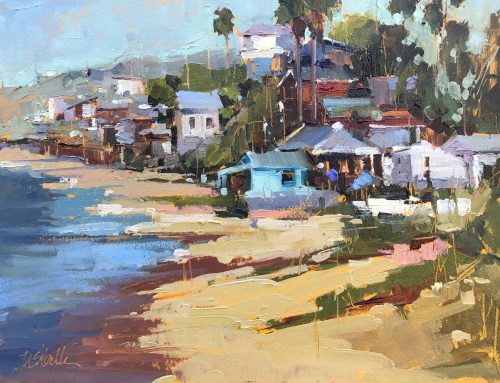
If I had to pick one aspect of painting to identify with Matisse, it would be COLOR. If you’re up for learning new ways of handling color in your own work, maybe check out a teaching video, such as Kyle Buckland’s Courageous Color.

Kyle Buckland, The Sitting Rock 48” x 48,” oil
Happening Now – 19th Annual Plein Air Easton

Plein Air Easton’s famous Quick Draw turns Harrison Street into a gallery exhibit. Register, paint and buy for one day only – July 22. (Photo credit: Ted Mueller)
Plein Air Easton is a 10-day art competition and festival in Easton, Maryland. The “Meet the Artists” event (cocktail reception, dinner, exhibit, and sale) is on July 15 at the historic Gross Coate Farm.
Plein Air Easton continues through with paint-outs, free art demos, a collector’s preview party, a quick draw, and much more.
4 Quick Facts about Plein Air Easton:
- Art sales for Plein Air Easton 2022 event topped $462,000 with 403 paintings sold over the course of the week.
- The usual sales pace for the Collectors’ Preview Party sees a painting sold every 45 seconds during a 90-minute period.
- Plein Air Easton’s Quick Draw is open to any artist (any age) with $10 and the ambition to create a painting in 2 hours or less. Nearly 200 artists paint for 2 hours in downtown Easton and the event culminates in an outdoor exhibit and sale along South Harrison Street.
- Plein Air Easton, privately-owned galleries, and arts organizations program demos, workshops, exhibits, and lectures throughout the week.
Find more details at pleinaireaston.com.