By Douglas Fryer
Part I
Vincent Van Gogh, perhaps more than any artist before or since, was the protagonist in the works he painted. No less than in the celebrated self-portraits, his landscapes serve
as emblems of his wonderfully complex state of mind and spirit. They are testaments to his great effort to experience his world; to observe particular nuances and render forms with materials with which he struggled; to express the essential and vital spirit that he felt the forms implied; to leave a trace of his love and passion that as viewers we identify as his own.

Love of place is essential to any lover of life. In Walden, Henry David Thoureau said, “I went to the woods because I wished to live deliberately, to front only the essential facts of life, and see if I could not learn what it had to teach, and not, when I came to die, discover that I had not lived.” Andrew Wyeth also expressed the importance of his own connection to the land: “I couldn’t get any of this feeling without a very strong
connection for a place. Really, I think one’s art goes only as far and as deep as your love goes. I don’t paint these hills around Chadds Ford because they’re better than the hills somewhere else. It’s that I was born here, lived here—things have a meaning for me.”
Landscape paintings read as tangible and concrete evidence of the artist’s search for elements of beauty and significance in their surroundings. These are the things that give him a sense of joy or awe; elements that speak to the senses; lines, patterns and colors that stimulate his aesthetic sensibilities=and incite emotions in his soul.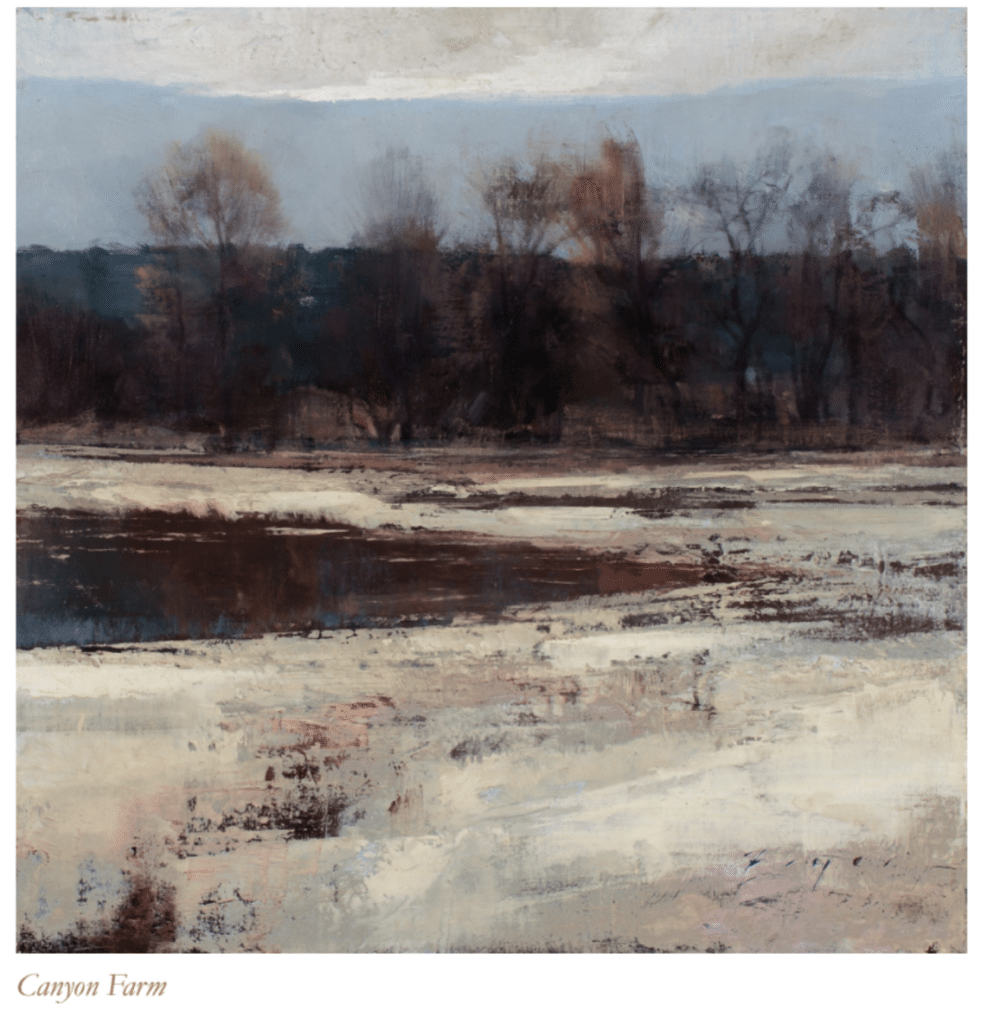
The late 18th through the mid-19th centuries marked the dominance of Romanticism in English landscape painting by artists such as Turner and Constable, and in France, the
realism of Courbet, Corot and Rousseau of the Barbizon School. In America, artists of the Hudson River School and subsequent Luminists including Cole, Durand, Church,
Moran, and Kensett, took inspiration from these European masters. French Impressionists, influenced by their unique times and philosophical motives, as well as technical innovations (particularly photography and ready-mixed paint in tubes), created works of common, ordinary subjects that captured the fleeting and transient qualities of light and movement. The landscape was also used as subject by the succeeding Post-Impressionists, Fauvists and Cubists. The last hundred years have seen a multitude of movements that incorporate landscape, ranging from regional to worldwide.
We now see the landscape in Photorealism, Neo Tonalism, and Contemporary Realism, among many others. Art is the result or the process of deliberately arranging
elements in a way that influences and affects the senses and emotions. As artists we ponder what we see, imagine and experience. We contemplate relationships of ideas, forms and materials. We become intrigued by the implications of the dialogue, drawing conclusions and gaining material for the next piece.
Most commonly, art is used as a language to communicate information about ourselves. As viewers (or listeners or readers, depending upon the art form) we assimilate the experience of others. Art encourages the viewer (and the artist himself) to consider differing points of view, to think in new ways about their relationship with others, the world, and their spiritual self. Art is rarely about the mundane, the outer shell. On the contrary, art is usually the formal expression of inner feelings or concepts. As Hamlet says:
“There is something in this more than natural, if philosophy could find it out.”
Great painting poses questions basic to our emotional and psychological state, and at the same time confirms, or at least suggests, answers or resolution to those questions. Landscape painting plays its own particular role in this process, and like other art forms, it can give understanding, inspiration, and unspoken discourse. The choices, processes and methods for creating art vary according to the motive—the intent –of the artist. Various dichotomies offer interesting choices to the painter. Consider the following examples:
Reality/Idealism
Actuality/Appearance
Seen/Unseen
Natural Form/Spiritual Form
Conscious/Unconscious (Dreams)
Verifiable/Ineffable
Accurate/Interpretive
Objectivity/Subjectivity
Copied/Invented
Knowledge/Belief
Pragmatic/Visionary
To choose absolutely one side over the other in any of these dichotomies may be futile, pointless and even crippling. It is in the integration of the opposites (and allowing others
their particular method of integration) that art becomes so wonderfully varied and complex.
Artists are naturally drawn to groups or individuals who share their opinions and sensibilities. Most often these associations are healthy, and great work is produced through a mutual striving toward common dialogue. At times, however, there are attempts to overthrow the opposing camp, create written or unwritten manifestos, and unfortunately dismiss valuable resources that may be found in the opposing view. We artists sometimes miss the mark, tending to over-intellectualize problems that are innately emotional and aesthetic—much to our disadvantage. As historian Paul Johnson wrote in Intellectuals:
“. . . Far from being highly individualistic and non- conformist people, [intellectuals] follow certain regular patterns of behavior. Taken as a group they are often ultra-conformist within the circles formed by those whose approval they seek and value. That is what makes them, en masse, so dangerous, for it enables them to create climates of opinion and prevailing orthodoxies, which themselves often generate irrational and destructive courses of action.”
Aesthetics, emotion and sentiment (as opposed to sentimentality) are central to any artistic endeavor, as is the idea of beauty—a subject that can be difficult to raise in many artistic circles. In Sculpting in Time, Russian filmmaker Andrey Tarkovsky said, “I think that one of the saddest aspects of our time is the total destruction in people’s awareness of all that goes with a conscious sense of the beautiful.” At the same time Tarkovsky argues that, “. . .hideousness and beauty paradoxically are contained within each other.”
Light and darkness, the accurate and the interpreted, the objective and the subjective, the pragmatic and the visionary are inseparably connected and mutually necessary to
give meaning to each other. Questioning, understanding, organizing and effectively communicating our perceptions and notions about the important facets of our experiences are what give art its real expressive power. Nowhere else is this more important than in landscape painting, for without this longing for truth, the landscape becomes no more than a picture postcard.
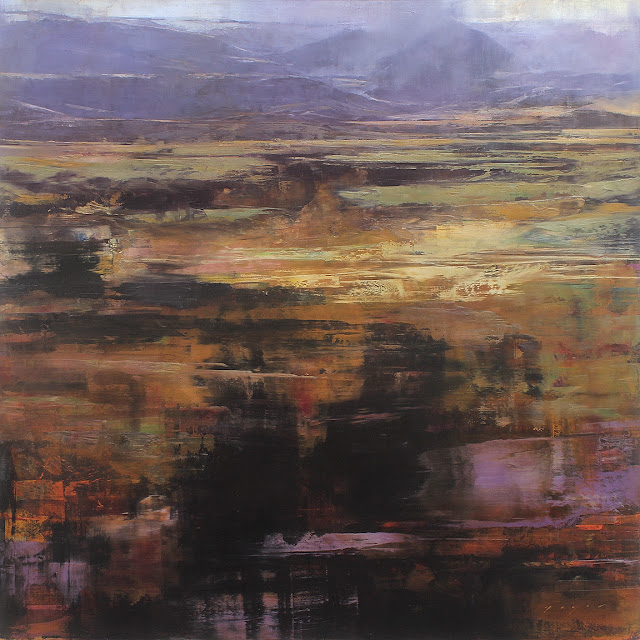
Douglas Fryer, Wasach Squall, 36 x 36
When drawing or painting a figure or a still-life, the artist views the subject from a point of reference that is separate and relatively removed. When painting the landscape the artist experiences it from inside: he moves through it; it is all around him. It
surrounds the painter with forms, certainly, but also with sounds, smells and motions—fleeting, transitory and time-dependent elements that the artist must consider. Also, real objects that the artist contemplates are only points of departure for a work of art, and there are endless inventive possibilities for aesthetic solutions.
Point-of-view, then, is something more than where you are standing; it has just as much
to do with where your mind and imagination are positioned. Marco Polo, in Italo Calvino’s Invisible Cities teaches Kublai Khan: “My gaze is that of a man meditating, lost in thought – I admit it. But yours? You cross archipelagos, tundras, mountain ranges. You would do as well never moving from here.”
What do we actually see, know, believe or imagine? What is it about the pursuit of an
image that gives us pleasure or fulfillment? What are the psychological shifts, those issues that affect us or arise in our minds and hearts that prompt our conscious and intuitive choices—that stimulate us to consider metaphysical questions as well as the pragmatic?
These are vital considerations, or at least it is vital that we attain that state of mind where the creation of art is inevitable.
Debora Stewart Teaches Abstraction for Self-Expression
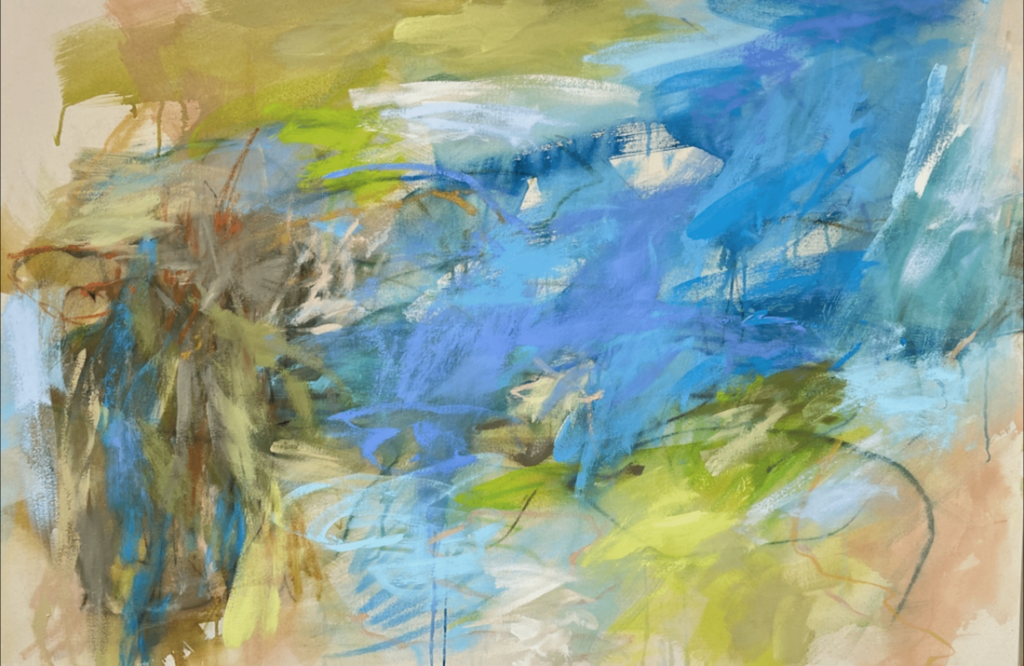
Debora Stewart, Earth Blues 1, acrylic on canvas, 40 x 60 x 1.5 inches
Loosen up and explore abstract art with Debora Stewart through her easy-to-follow teaching videos. Let Debora show you how to loosen up and express yourself through exciting techniques to make powerful paintings. Start by learning to see abstract compositions, follow lessons on color mixing, and translate intuitive sketches into exciting color combinations in energetic paintings full of color, feeling, gesture, and life. Browse her various videos for painters at every level here.