
As a French “Barbizon” painter, Camille Corot (1796-1875) helped invent what we think of as plein air painting, but it’s his lyrical later work, perfected in the studio, for which he is most widely known.
Corot’s paintings have a marvelous unity of effect – what many have called Corot’s poetry – the way, wordlessly and all at once, they convey a feeling. There is magic afoot in the mist-silvered shorelines and cottaged, dewy-gray woods. Corot paints us a timeless, lyrical world superimposed over the visible one.
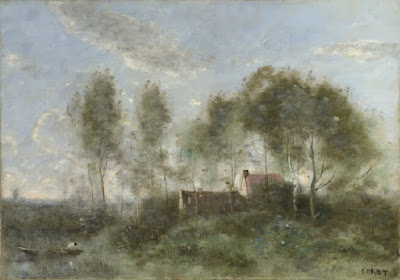
Camille Corot, Souvenir of a Visit to Coubron, 1873
An influential writer and art critic of the Victorian age, Elbert Hubbard described how Corot’s subdued colors and delicate lyricism achieve a magic all their own: “… pale lilac, silver gray, and diaphanous green. He poetizes everything he touches—quiet ponds, clumps of bushes, white-washed cottages, simple swards, yellow cows, blowsy peasants, woodland openings, stretching meadows and winding streams—they are all full of divine suggestion and joyous expectancy.”

Closeup of the foreground from Corot’s Souvenir of a Visit to Coubron, 1873 (above).
“Something is just going to happen—somebody is coming, someone we love—you can almost detect a faint perfume, long remembered, never to be forgotten. A Corot is a tryst with all that you most admire and love best—it speaks of youth, joyous, hopeful, expectant youth.” (Excerpts from “Corot” by Elbert Hubbard)

Closeup of Corot’s foliage from Souvenir of a Visit to Coubron (above). Note the soft colors, and how subtly the cloud barely emerges from the luminous sky, how the leaves seem to dissolve in warm, wispy greyed-out flecks blown across the sky.
Like Cezanne, Corot covered his whole canvas as soon as possible and worked on all parts of the painting at once, “improving it very gently until I find that the effect is complete,” he said.

Corot, Woman Reading
If there’s any other “secret” to how he worked, it’s that he saw and painted the subtle nuances and infinite gradations of mid-tone light and shadow. “That which I look for while I paint is the form, the harmony, the value of the tones,” he wrote. “Color comes afterwards for me because above all I like the harmony in the tones.”
Corot often used cobalt blue in the sky and in the greyish mauve of his middle distances. His mid-green foregrounds are created from blue and yellow, made up of a transparent yellow (possibly chrome) and a fine blue (possibly Prussian blue) mixed with white, red and black in small amounts.
Corot used his own admixture of white, red, and black to his green mixture to create the subtle, neutralized modulations of tone (value) that people love in his work. Between the complementary red and the black, that green is well on its way to a neutral hue, and the white levels the value as well.

Closeup of Corot’s foliage
Creating a similar mauve mixture for the background and limiting color to these few hues freed Corot to control the painting’s overall values. He could then revel in modulating the “tones” with just the slightest variations in the proportions of light and dark paint. The result was magic.
“The pale silvery tones of Corot, the shadowy boundaries that separate the visible from the invisible … ” Hubbard wrote. “His colors are thin and very simple—there is no challenge in his work as there is in the work of Turner. Greens and grays predominate, and the plain drab tones are blithe, airy, gracious….Before a Corot you would better give way, and let its beauty caress your soul.”

Camille Corot, Dance of the Nymphs, 1850
BONUS: Elbert Hubbard died in 1915, so who knows what he’d think of the new world of the Internet and online art. Nonetheless, I think something he said before the first World War could apply during the tumultuous onslaught of the incipient age of AI: “One machine can do the work of fifty ordinary men. No machine can do the work of one extraordinary man.”
Landscape artist John MacDonald has a video out that teaches you how to use color, value relationships, and the quality of light to create a desired mood or emotion in your paintings. Consider downloading John MacDonald: The Poetic Landscape here.
Plein Air Painters Flock to the Adirondacks

Sanford Robinson Gifford, A Twilight in the Adirondacks, 1864
The Adirondack Mountains of upstate New York began luring painters with their majestic beauty as early as the 1840s and ’50s. They’ve never been as popular a destination as they are right now for artists eager to capture images of the rugged beauty of North America’s natural landscape.
This week, dozens of artists are painting the landscape in Eric Rhoads’ annual Publishers Invitational painting event. Learn more here.