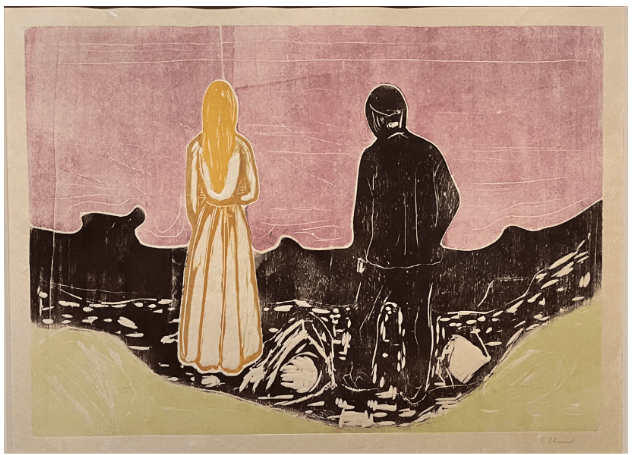
Swedish proto-modernist Edvard Munch ( ) explored many different mediums in his work, and woodblock printing remained one of his constants. The flattened picture plane and simplified forms gave the artist a very direct, uncomplicated forum for the play of expressive and symbolic forms.
One motif he repeatedly explored was a shoreline that featured a man and a woman seen from behind, looking out at an empty expanse of water. In Two Human Beings: The Lonely Ones(above), the pair do not touch or look at one another despite their proximity. Their anonymity and the title elevate the work to a statement about loneliness among humanity in general.
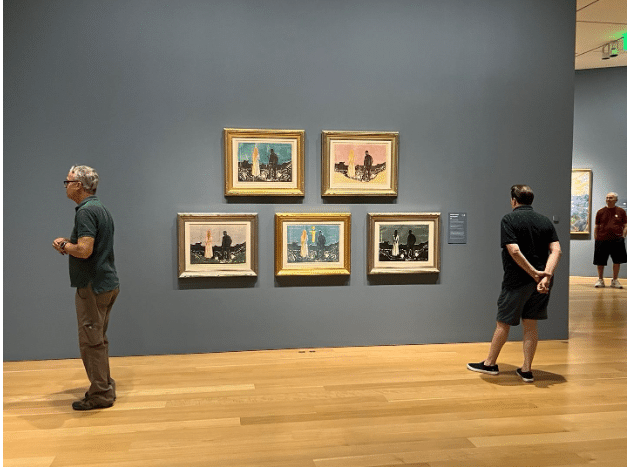
Five different versions of “The Lonely Ones” exhibited at the Clark Institute of Art in 2023.
Munch used a jigsaw method to create his woodblock prints. He started with one block of wood, carving the subject himself. Then he used a jigsaw to separate elements of the block. The man and the land were one piece of wood, the sea another, and the woman a third. After inking these parts separately, they were set together like a puzzle and painted. Munch could alter the effect of the composition by changing the palette on one or all of the carved pieces. The man, however, always remained black and woman white.
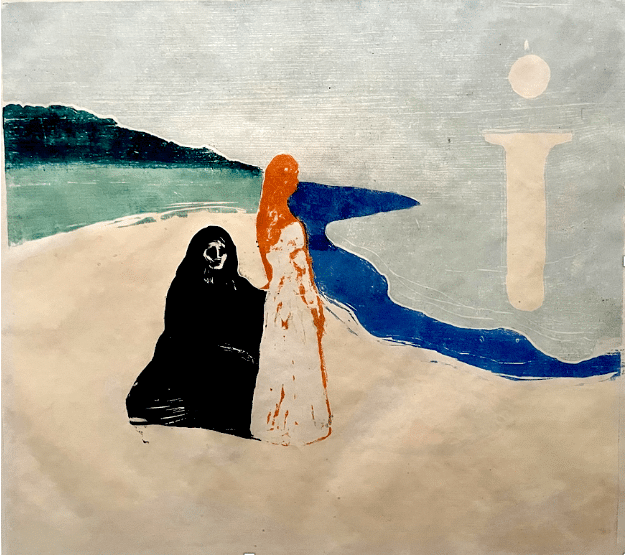
Edvard Munch, Two Women on the Shore, 1898, color woodcut and crayon on paper.
The impression of Two Women on the Shore shown here exemplifies the variety of effects Munch produced by inking his woodblocks with different colors.
In keeping with Symbolism, the late 19th, early 20th century movement his work inspired, Munch blends life and death in the two figures isolated here. He contrasts the two by color – the old woman, with her skull-like features, in black, the younger “maiden” in white. Most important though is that Munch fuses the two into a single shape; wrapping the death-like figure around the hem of the youthful figure’s dress implies that the old woman is like the shadow of the younger: Death is the shadow of Life, and the two move through this world together.
After cutting apart and reassembling the blocks for Two Women on the Shore, Munch used a stencil to paint the moon and its reflection onto the assembled block before making the print.This motif – the stylized reflection in the water with the circle of the full moon above it – appears in several of Munch’s most important prints and paintings. In itself it resembles an ancient symbol, something painted on the wall of an Egyptian tomb perhaps. But just what it symbolizes isn’t clear.