“The night is the time when all things are possible, when the world is a vast, dark canvas, ways writer Sylvain Reynard, “waiting to be painted with the colors of our dreams.”
If Pythagoras was right, and “night is the mother of thoughts,” for artists the darker hours have often been about pure feeling and a mysteriously attractive and moving motif. There are so many great nocturnes, we can only offer a scattering. Catching up with our previous post “narrated” by poetic passages from Walt Whitman, we arrive with the great American poet under the cover of darkness.
Let night come.
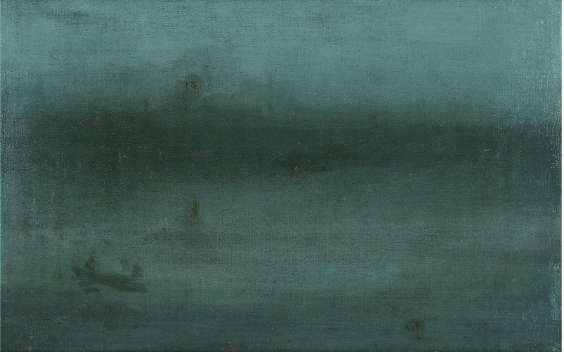
James McNeill Whistler, Nocturne, Blue and Silver: Battersea Reach, 1878, Oil on canvas, 39.4 x 62.9 cm
Whistler invented the nocturne as such, borrowing a term from musical composition that went back to Chopin. “My whole scheme was only to bring about a certain harmony of color,” the painter said.
(The rest of the words below are “from” Walt Whitman, but they are not direct quotes from Leaves of Grass. They’re quasi-stanzas, excerpts and snippets stitched together and rearranged thematically over at www.thewordsofwaltwhitman.com . )
THE NIGHTTIME SKY
The sky and stars speak no word, nothing to the intellect,
Yet in silence, of a fine night, questions are answer’d to the soul,
The best answers that can be given.
There is a region beyond—O, so infinitely beyond!—anything from art, books, sermons, or from science, old or new.
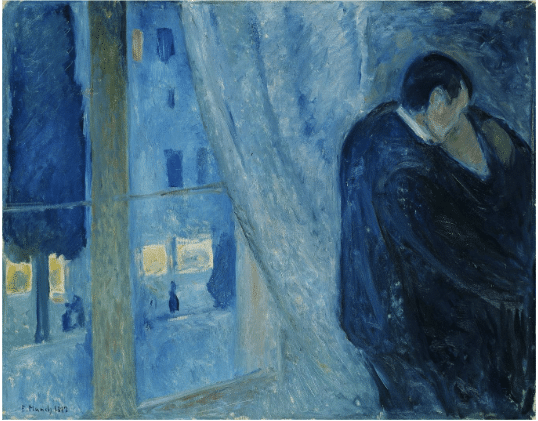
Edvard Munch, Kiss by the Window, ca. 1892, oil on canvas, National Museum of Art, Architecture and Design. Oslo, Norway. Wikimedia Commons.
After the dazzle of day is gone,
The dark, dark night shows to my eyes the stars—
Give me nights perfectly quiet, and I looking up at the stars.
I was thinking the day most splendid, till I saw what the not-day exhibited,
I was thinking this globe enough, till there sprang out so noiseless around me myriads of other globes,
Some shaped, others unshaped, with their varied degrees of perfection, climate, swiftness,
And all I see, multiplied as high as I can cipher, edge but the rim of the farther systems.
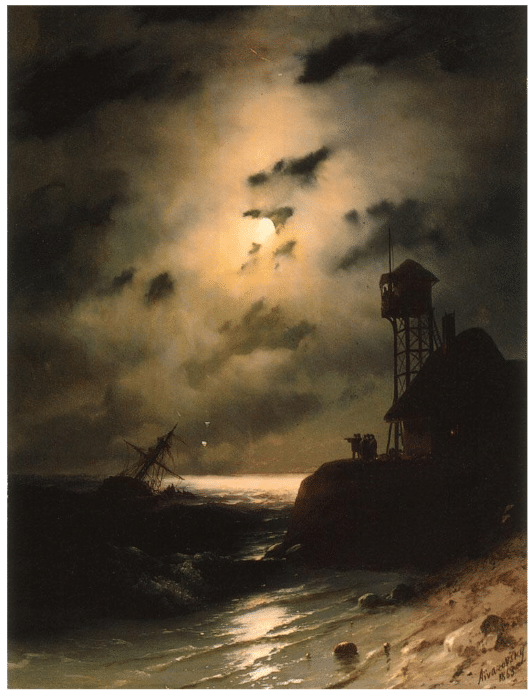
Ivan Aivazovsky, Moonlight Seascape with Shipwreck, ca. 1832, private collection. Wikimedia Commons.
Under the full of the moon, shimmering and shifting, delicate color-effects of pellucid green and tawny vapor, with tawny halos, silver edgings.
Never a more glorious moon, floundering through the drifts, great fleeces, depths of blue-black in patches, and occasionally long, low bars hanging silently a while, and then gray bulging masses rolling along stately, sometimes in long procession.
The vitreous pour of the full moon just tinged with blue,
Throwing down a broad dazzle of highway on the waters,—ghastly, phantom moon!
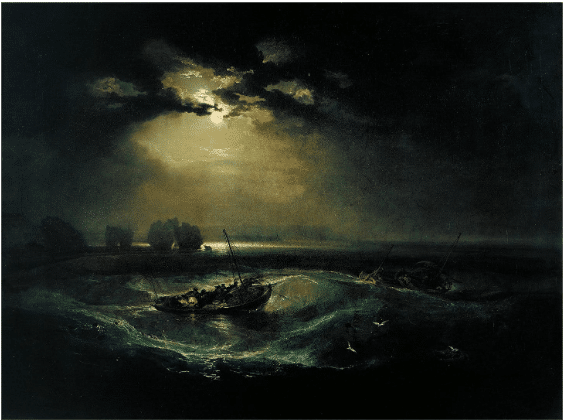
J. M. W. Turner, Fishermen at Sea, exhibited 1796, Tate, London, UK. One of the first he exhibited, this rocketed Turner to the upper echelons of the Royal Academy,
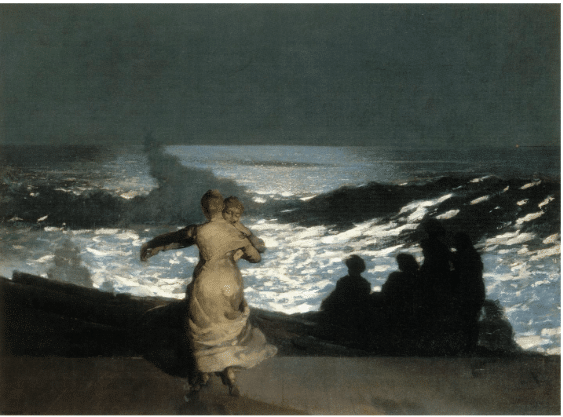
Winslow Homer, Summer Night, ca. 1890, Musée d’Orsay, Paris, France. Wikimedia Commons.
The rare nocturnal scene, how soon it sooth’d and pacified me,
As I stood on the rising ground in the breeze in the cool transparent night.
The air, the stars, the moon—what a fullness of inspiration they imparted! what exhilaration!
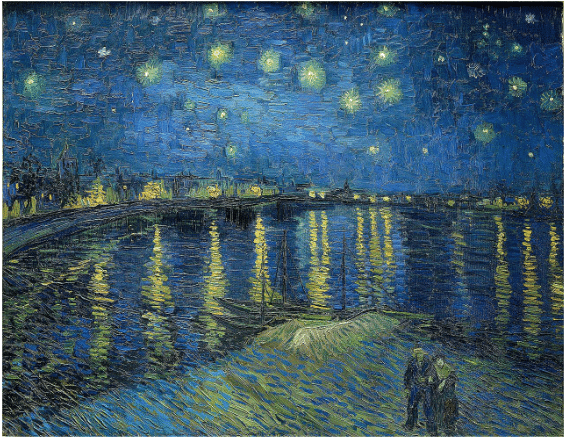
Vincent Van Gogh, Starry Night Over the Rhone, 1888, Musée d’Orsay, Paris, France.
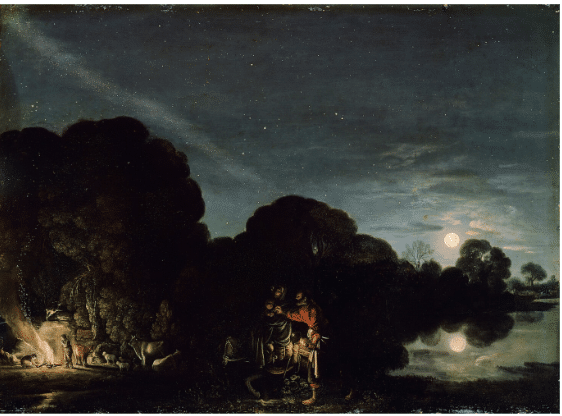
Adam Elsheimer, The Flight into Egypt, 1609, Alte Pinakothek, Munich, Germany.
It was a great, a precious, a memorable, experience.
The planets, the moderate west wind, the elastic temperature, the miracle of that great star, and the moon swimming in the west, suffused the soul—
Everything a miracle of splendor, moon splendor and star splendor—
And silently by my side my dear friend;
Something altogether to filter through one’s soul,
And nourish and feed and soothe the memory long afterwards.
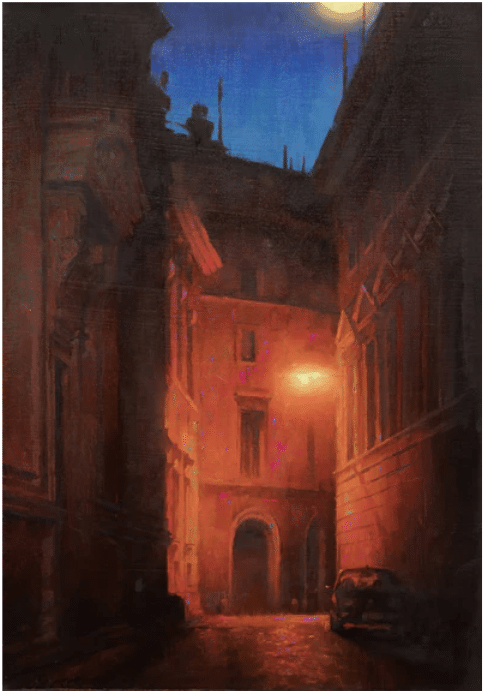
Gavin Glakas teaches a method for painting spectacular night paintings in his video, Painting the Night.
A prolific artist and ambitious world traveler, Paul Jackson is a versatile contemporary watercolorist known for striking light effects, interesting compositions, and not least of all nocturnes, especially urban ones. Learn how he does it in his video, Watercolor Workshop – Nighttime in the City.
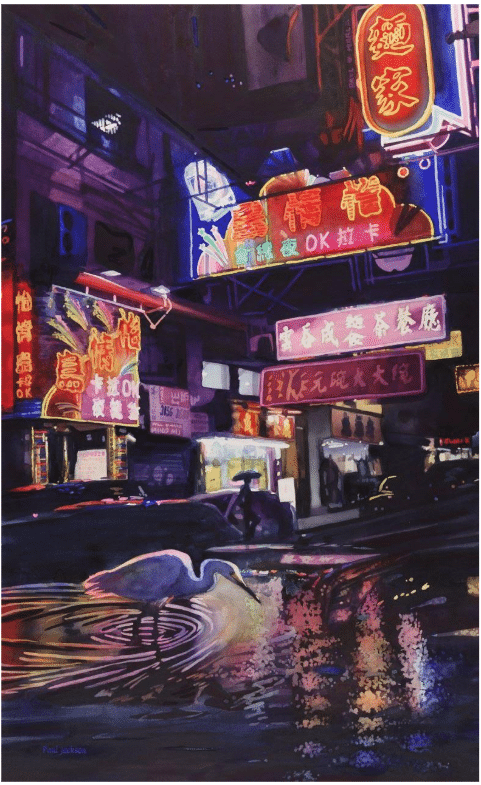
Paul Jackson, “Street Sushi,” watercolor
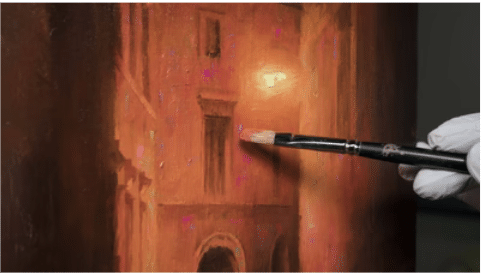
Screen capture from Gavin Glakas’ video, Painting the Night.
Note: The texts in this post, as applies to the web page on which they originate, should NOT be cited as direct quotations from Whitman. If you want to quote from this site for something you are writing or posting, please read this first (click here).
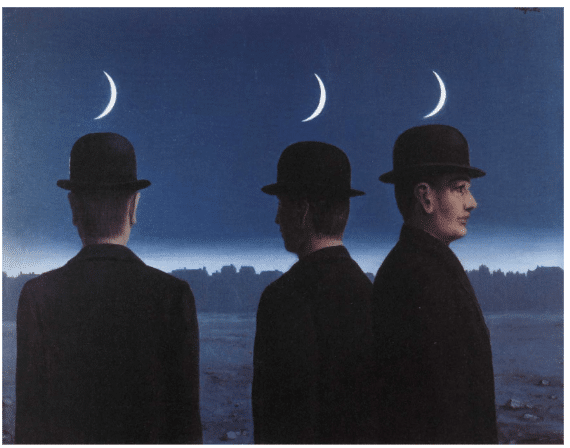
René Magritte, The Mysteries of the Horizon, 1955, private collection. WikiArt.
The ravening clouds shall not long be victorious,
They devour the stars only in apparition,
Be patient, watch again another night,
Jupiter shall emerge, the Pleiades shall emerge, Venus shall emerge—
They are immortal,
The vast immortal suns shall shine again.
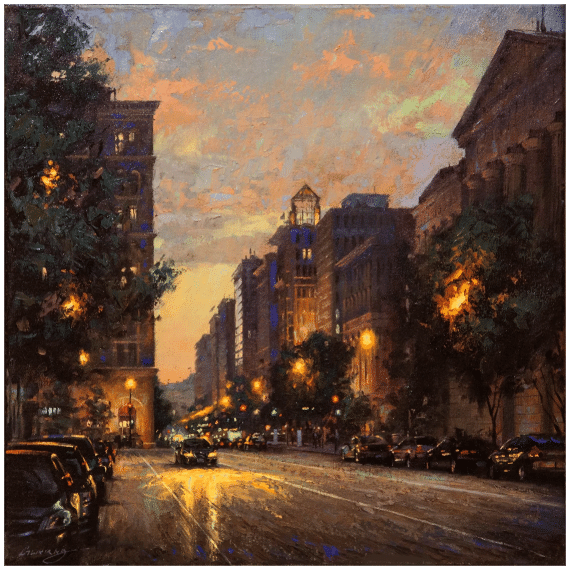
Gavin Glakas, 7th and F Streets, oil on linen, about 20×20 in.