
Landscape orientation tends to tempt one into stacking rectangles on top of each other. It can also lead us into the temptation of “stripes” – thin bands of horizontals that do nothing to keep the eye from sliding out the sides of the painting and onto the next one on the wall. In this post we’ll look at how to use diagonals, curvature, and non-parallel lines (all of which can be seen at work in the Paul Kratter painting above) to keep things from getting boring.
Diagonals
A surefire way to defeat stripeyness is to consciously pull diagonals into the composition (whether they’re obvious in the landscape you’re looking at or not).

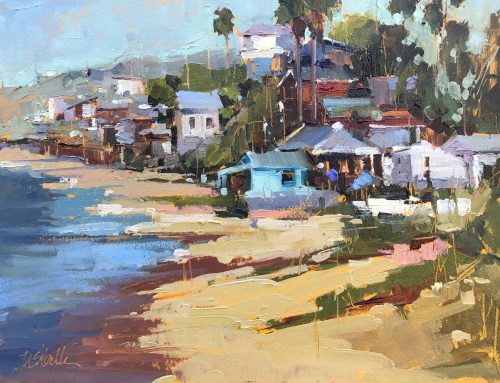
Paul Kratter, Warm Slopes of Diablo, 11” x 14,” oil
In the painting Warm Slopes of Diablo (above) Paul Kratter has pretty much eliminated ANY horizontal lines. Everything is a diagonal – foreground, milled-ground, even the background mountains. Note how he varies their balance and direction – when one goes up the one behind it goes down and vice versa. That keeps things dynamic and always moving (all lines in painting are directional lines – our eyes follow the directions that edges and shapes point us to).
Curvature

Paul Kratter, Return to Curry Canyon, 16” x 16” oil
Once again, there are relatively few horizontal lines in Paul Kratter’s painting Return to Curry Canyon, above. In this composition, the most prominent leading lines are curved. The tree’s foliage spreads above in a gentle arch, to be answered by the rounded, “u” shaped dip in the dry creek bed directly below it. The bank on the left curves downward, the one on the right curves upward (the shadows on either side emphasize these directions). The upward curvature and the downward curvature work together to form a “secret” circular composition that defeats any untoward horizontality and keeps our eyes circulating smoothly around and around within the painting.
Non-Parallel Lines
In the painting below, in contrast to the previous two, Kratter uses almost nothing but horizontal lines. However, he subtly varies the “straight” lines with curves and widths to successfully keeps things from getting too stripey.

Paul Kratter, Two Headlights, 15” x 29” oil, original above, diagrammed below
As you can see in the diagram, where the several pairs of potentially parallel lines are color-coded, when one line curves up, the one directly below it curves down.
Change Your Format
Notice how, of all the paintings we looked at, the one with the most horizontal lines (Two Headlights, 15” x 29”) was also the one in the most extended “landscape format”? The others were mostly squares, with the exception of the 11” x 14.” Coincidence? Nope. A good way to train yourself away from the flat, stacked horizontal landscape is to vary the format. You can sometimes break the horizontal habit by painting the same scene as a horizontal or a square and deliberately adding strong diagonal or circular compositional elements. Then when you return to the scene of the crime, your horizontal landscapes will stand a better chance of lively, dynamic design.
In his teaching video, Landscape Painting and Design, Paul Kratter covers a wealth of insight beyond the basics of design. Paul demonstrates things such as how to make objects such as mountains or trees seem tall and majestic – or, alternately, how to make them recede in space. He also covers brushwork, leading angles and shapes, how to make believable rocks and the virtues of the three-value preliminary sketch. Check it out here.
Pastel Takes Center Stage in Pastel Live

Vianna Szabo, Tilted, pastel, 8” x 10”
Vianna Szabo is among 25 of the world’s best pastel artists who will be featured over the course of three days of everything pastel in this year’s Pastel Live online event, running August 17-19. The event is all about materials, techniques, paint-alongs and demos in landscape, portrait, still life, and so much more.