By their very nature as horizontal beasts, landscape paintings are prone to “stripey-ness.” They can become dominated by unbroken horizontal shapes stacked neatly one on top of the other.
This can result in paintings that come across as predictable, flat, lacking in energy or interest. Such paintings have a serious underlying structural problem too: there’s nothing to stop a viewer’s eyes from gliding straight out and onto the next one on the wall (inevitably a painting by somebody else!).

The photographer of the stretch of marshland above wasn’t trying to do anything more artful than record the geography of the area and show how devoid of hills it is. The horizon line is flat and unbroken (even the clouds are relatively straight and undifferentiated), and the only strong leading line, that of the diagonal starting at the bottom righthand corner, actually encourages us to leave the composition by pointing to somewhere outside the frame. This is not a dynamic or even a particularly interesting or aesthetically pleasing image, nor was it meant to be.
Most landscape painters feel it’s their duty to do something nearly the opposite of this example. Traditionally, they aim for aesthetically pleasing compositions that move the eye around within the frame and actively keep the eye from leaving. What follows are five strategies to help counter stripeyness with dynamic design. Most strong compositions utilize more than one of these in combination. We’ll cover two in this, part one, and three more in part two next time.
1. Put in Roadblocks
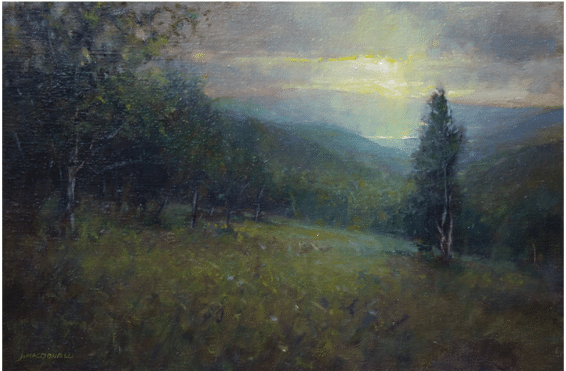
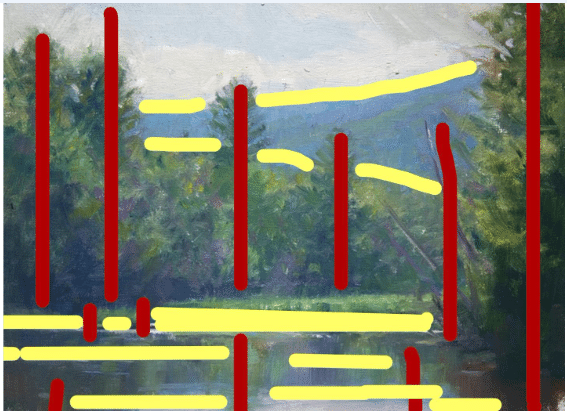
Perhaps the simplest fix is to disrupt horizontal lines and masses with vertical ones. In the paintings above and below (Moonlight from Petersburg Pass and Harmon Pond), artist John MacDonald has placed a variety of verticals (in this case, trees) strategically with this in mind. Framing the scene with trees, he also divides the horizontal space, varying the “rhythm” (the intervals between the horizontal shapes and the interposed vertical ones). In both paintings the effect is to keep the eye from being able to follow the horizon line (or even any horizontal lines) sideways out of the picture.
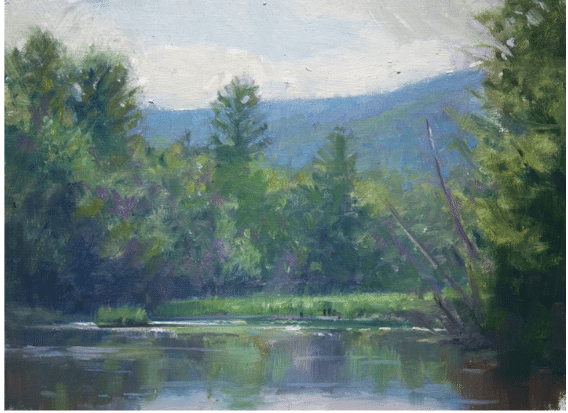
John MacDonald, Harmon Pond, 9” x 12,” oil on linen
The diagram below shows how in this painting the vertical roadblocks (red lines) break up the horizontals (yellow lines) and stop them in their tracks before they can travel out of the frame. The only horizontals allowed to leave the premises are two at the lower left corner.
The other major strategy in this regard is to group all the verticals into a large mass that takes center stage, allowing less of the horizon line to show, and then only in relatively small (note, also varied) stretches at the edges. That’s what’s at work in the next, MacDonald’s Pines at the Clark. MacDonald disrupts the horizontality not with many but with one major vertical mass (or mass of verticals, technically).
The grove of pines he plants there is so tall and wide that the equation between horizontal and vertical is completely upended by just this one dominant intervention. (But note how he also pinched off the left edge of the water to a point (over where the trail disappears) to avoid a potentially uninterrupted “stripe” caused by the water’s two banks. Sure, this may be what was actually there, but it doesn’t have to be.
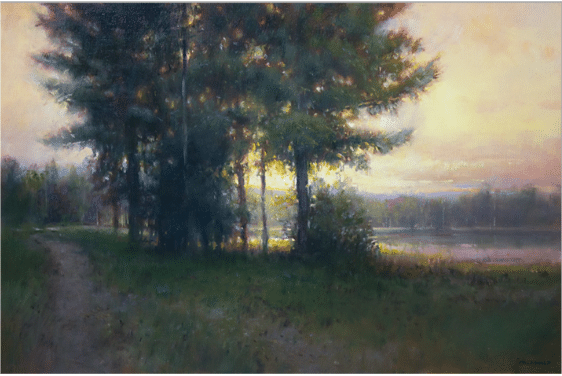
John MacDonald, Pines at the Clark, 16” x 24,” oil on linen
Even if this painting is a “faithful” rendering of reality (which only matters from a technical perspective), MacDonald still had to choose his vantage point and consciously design the composition; he had to compose it in a way that checked the “not too stripey box.”
2. Add Verticals with Strong Visual Weight
Instead of using verticals to disrupt the flat lines, another way to go is to add and accentuate vertical elements with significant “visual weight” (relative ability to draw the eye). Add counter–horizontals with vertically elongated clouds, reflections, tree trunks, buildings, or any number of other up-and-down elements.
In Mausert’s Pond, Clarkesville, below, MacDonald uses the reflections in the water as a counterweight. He designed this one with a high horizon line that gives more than half of the painting to the vertical elements.
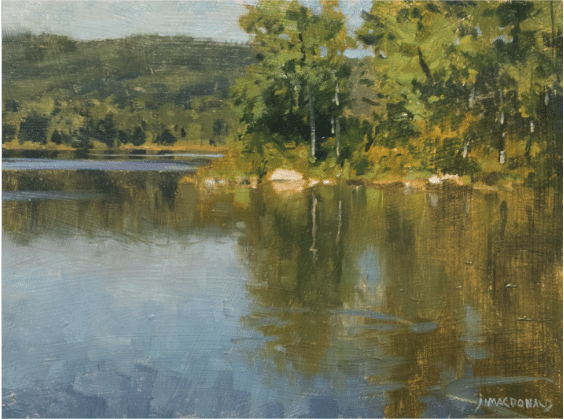
John MacDonald, Mausert’s Pond, Clarkesville, 9” s 12,” oil on linen
In Beyond the Marsh, below, MacDonald uses a foreground tree to disrupt the horizon line, but he also loads the foreground vegetation with a series of sharp, staccato vertical marks echoed by individuated tree trunks in the middle ground. The background hills curve inward and converge toward the center. It all adds up to strong vertical vs. horizontal energy – an enlivening tension, which is what we talk about when we talk about dynamic composition.
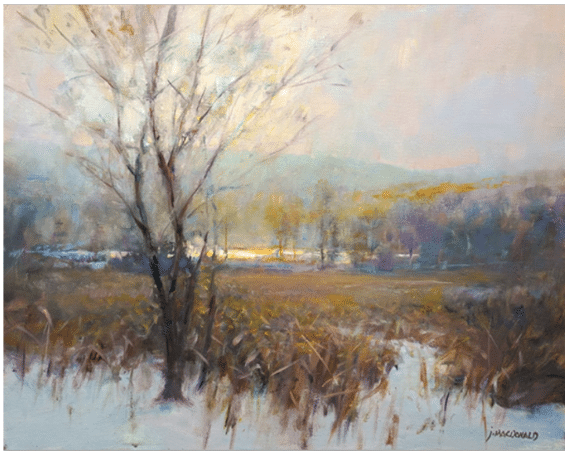
John MacDonald, Beyond the Marsh, 16” s 20,” oil on linen
We’ll cover three more important tools for avoiding flat paintings in part two, including how to use diagonals, curvature, and non-parallel lines to keep things from getting boring.
In his teaching video, Dynamic Landscapes, John MacDonald covers how to create effective composition and value structures plus a slew of other game-changers. These include finessing variety and contrast in shapes, values, colors, edges, and details, changing your view to make sure each painting is a brand-new invention and not a copy of what you are seeing, and creating a hierarchy of importance among the painting’s visual elements (where does the eye go first, but also where does it go second and third and after that?). Check it out here.