For days, rumors had been circulating about an injured wolf lingering near town. Sightings like that make people uneasy — and when a wild predator crosses into human spaces, the outcome is rarely good for the animal.
One evening, walking to my car, there he was, only a few feet away. Standing that close to a wolf reminds you exactly where you are in the order of things. Time felt suspended. He looked directly at me, studying me as carefully as I studied him, and eventually, without drama, we both turned and walked away.
Encounters like that stay with you. They reshape how you see wildlife — not as subjects apart from the landscape, but as living beings who belong fully to their environment. That understanding has shaped the way I paint, and the way I see.
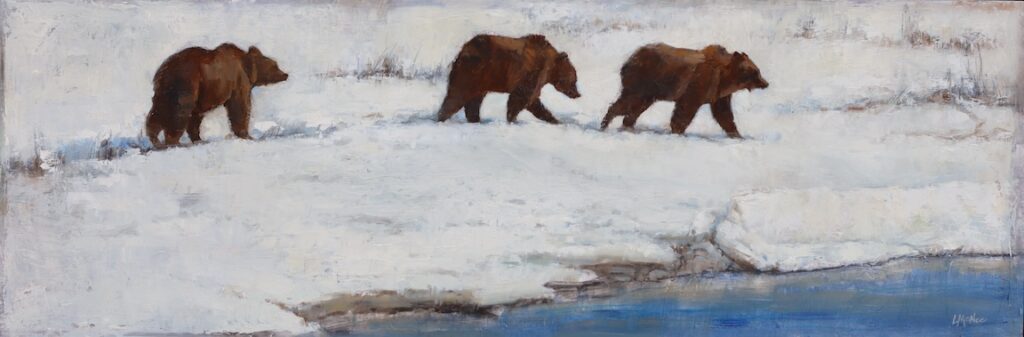
“Snow Drifters” (oil, 36 x 12 in.)
WELL DESCRIBED, BUT NOT ALIVE
Early in my career, I worked as a wildlife painter and illustrator, where accuracy and precision mattered above all — I carefully rendered fur, feathers, and texture from photographic reference. That training was valuable, but something was missing.
The animals were well described, but they didn’t always feel alive — isolated on the canvas, as if placed there rather than found there. Learning to paint the animal wasn’t enough; I needed to understand the world it lived in. That realization led me outside.
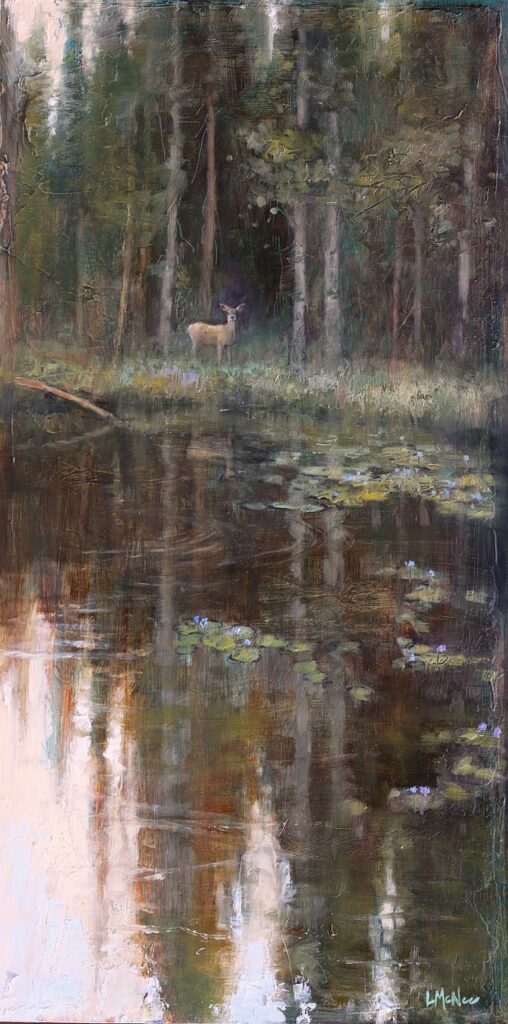
“The Listening Wood”(oil, 24 x 12 in.)
SAME LIGHT, SAME AIR
Plein air teaches us that nothing in nature stands alone — everything shares the same light and atmosphere. Spend enough time painting outdoors and something begins to shift. At first, the impulse is to chase what you see: the color of a tree, the shape of a cloud, the exact edge of a shadow. But nature doesn’t sit still long enough for that; the light shifts constantly, and what feels resolved one moment quickly changes.
Plein air isn’t about copying — it’s about feeling, observing, and interpreting. Over time, patterns emerge: distant forms cool and soften, foreground shapes hold more contrast, edges dissolve as they recede, and shadows carry reflected color and subtle temperature shifts.
I began painting plein air during the day and still life at night, often including birds or other animals in those arrangements. Still life offered control, like a small universe I could manage in the studio. Plein air offered the opposite — no chance to overwork or second-guess, just the need to simplify, respond quickly, and trust the process. Together, the two disciplines built a foundation.
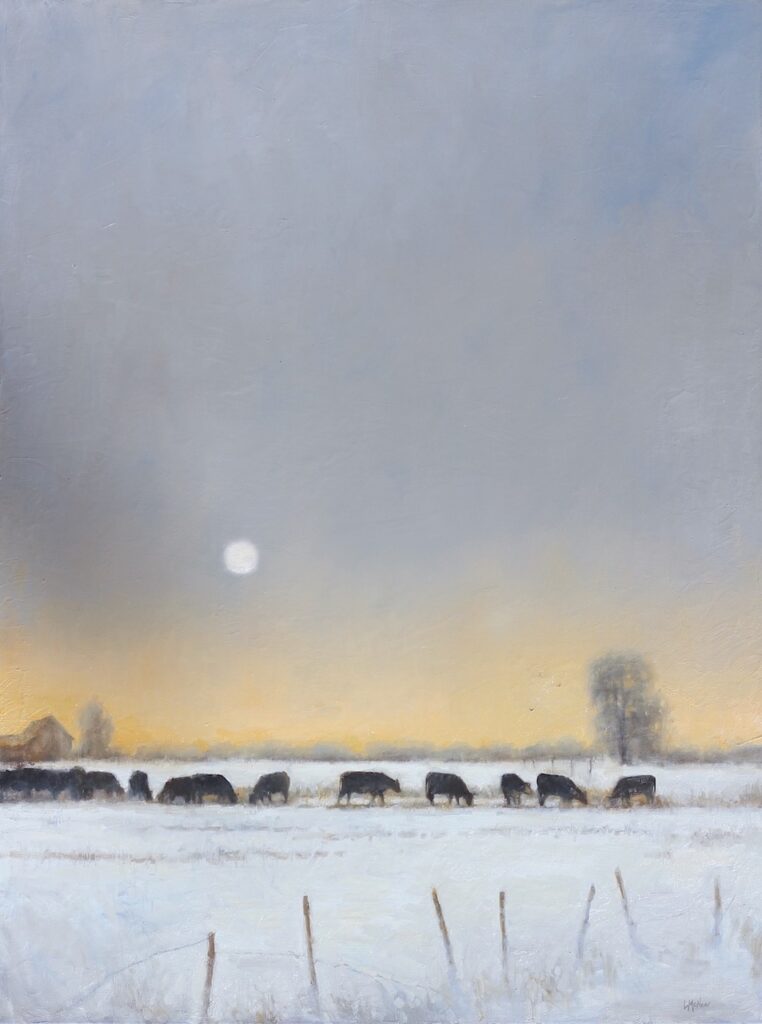
“Afternoon Moon” (oil, 48 x 24 in.)
PAINTING WILDLIFE TUTORIAL | Painting an Animal That Belongs
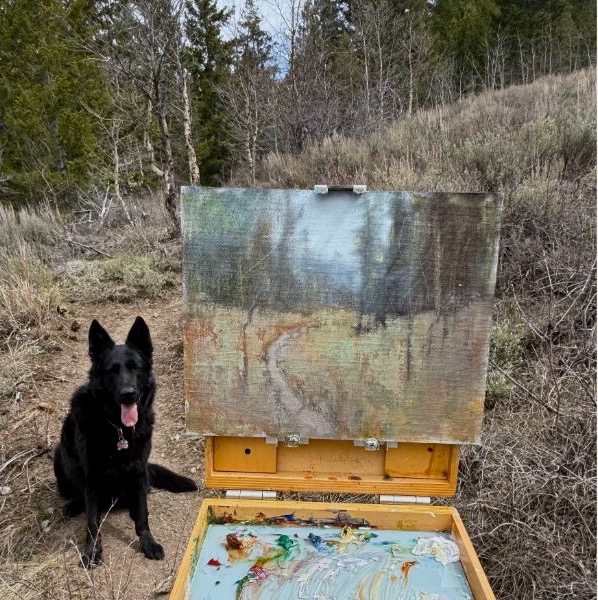
Step 1: Plein air landscape study of Proctor Trail (oil, 8 x 10 in.)
Into the Silence began outdoors, and the initial study wasn’t about the fox at all — it was about the landscape: the rhythm of the trees, the movement of a familiar hiking trail, the way the atmosphere softened the scene. The fox herself was one I’d seen many times before. Later, in the studio, the goal wasn’t to recreate the scene exactly but to recreate the feeling of it. Reference photos informed the fox’s structure, gesture, and proportions, while the plein air study served as visual memory.
STRUCTURE FIRST, THEN THE ANIMAL
I began on a gray gesso support, which helped establish a moody atmosphere from the start, and loosely blocked in large shapes to determine the design. Detail was not the priority; structure was.
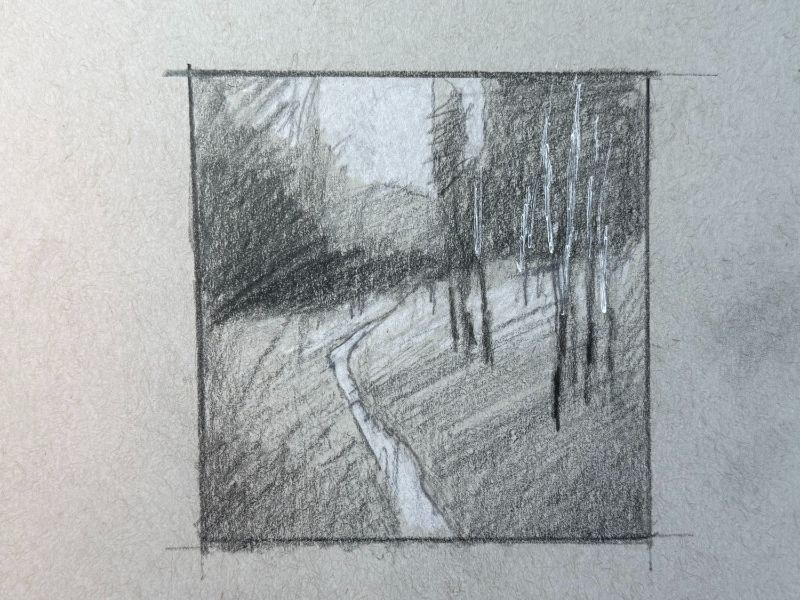
Step 2: Studio value sketch (graphite and colored pencil on gray paper)
I established the fox’s scale and position with a simple line drawing, then blocked her in with a thin wash of raw umber acrylic, ensuring from the beginning that she belonged within the composition.
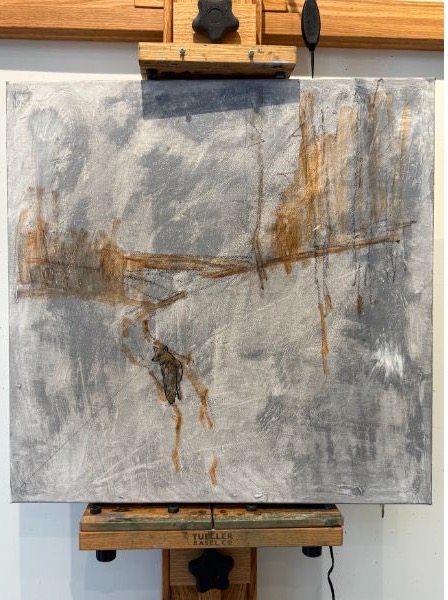
Step 3: Composition study with initial fox placement (oil and mixed media on panel)
I resisted the urge to finish the animal too soon, keeping it loose so it could evolve within the landscape. Value relationships were adjusted so the fox didn’t jump forward unnaturally, temperature shifts helped integrate her further, and edges were softened where she meets the grasses and path, with a few sharper accents reserved to guide the viewer’s eye. In the end, I wasn’t happy with her direction and repainted her so she turned into the painting rather than out of it.
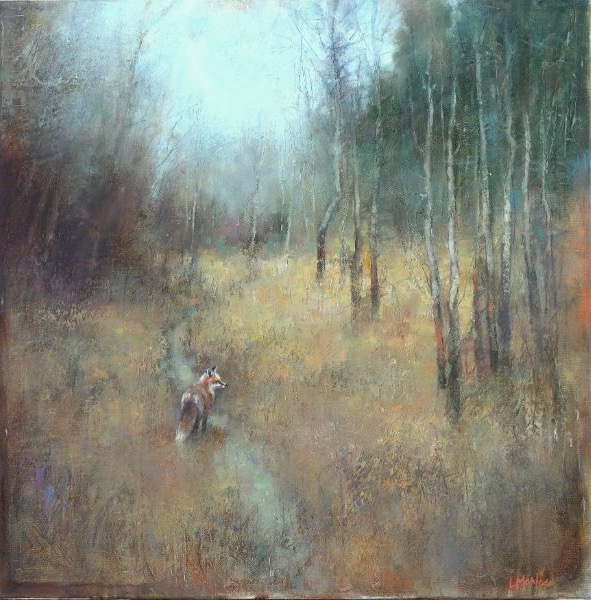
Step 4: Finished painting with fox’s head turned into the painting
Lori demonstrates how she uses water-mixable oils to paint the landscape in her video workshop: “Lori McNee: Luminous Landscape Painting.”