
Gustav Klimt is famous for his fantastical figural portraits of women adorned with dreamlike lattices, swirls, and leaves of gold.
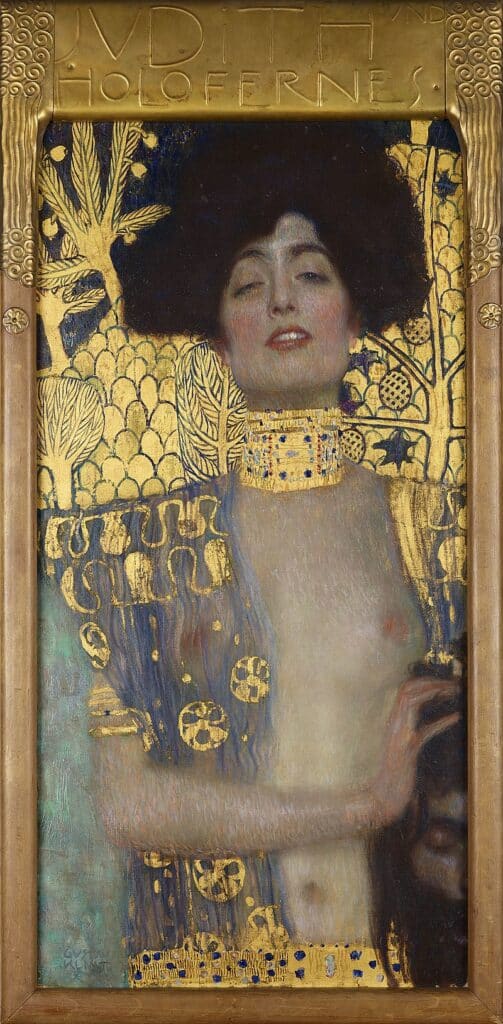
Gustav Klimt, Judith with the Head of Holofernes, 84 cm × 42 cm (33 in × 17 in)
Klimt’s work is part of a movement called Symbolism, a movement at the turn-of-the-century (19th to 20th) that blended Realist, Romantic and Impressionist techniques and principles with imagery related to fables, fantasy, and literature. Because of its sense of the otherworldly, it has a mysterious, psychological resonance beyond plain representation.

Less well known is that Klimt painted marvelous post-Impressionist landscapes. Post-Impressionist generally refers to the extension of the creative territory pioneered by Impressionism towards the new frontiers of Modernism and abstraction.

Landscape by Gustav Klimt, Bauerngarten, 1907

Gustav Klimt, Birch Grove, 1902
The Impressionistic paint handling aside, for Klimt to reduce his forms to sparse geometric shapes and give the rest over to pure color was a seemingly small but actually profound choice. It’s not what most plein air painters would naturally think to do. Taken to its logical conclusions, the choice of so much “flat” space leads to non-representational abstract paintings by household names like Pollock and Rothko.
So stylistically, Klimt’s work occupies a delightful niche between the colorful glories of Impressionism and the subsequent course of art history toward modernism and abstraction. That’s what makes him an “important” artist; he was a leading member of a group of artists whose work literally changed art history, and the rest of his oeuvre (the portraits and figural pieces) is already intriguing, unlike any other, and beloved of many.
Prices for Klimt’s works have skyrocketed in recent years. In 2016, Billionaire talk show host Oprah Winfrey sold Kilmt’s painting Portrait of Adele Bloch-Bauer II (1912) to a Chinese buyer for $150 million. The deal was one of the biggest private sales in the art world that year and represented a near-doubling of the work’s price just 10 years after Oprah bought it for $87.9 million.

Gustav Klimt, “Insel im Attersee” (1902), oil on canvas, 39 1:2 x 39 1:2 inches
The above plein-air painting of Austria’s Lake Attersee (“Insel im Attersee,” 1902), where Klimt summered with his family, could fetch up to $45M at auction when it goes under the hammer at Southeby’s next week (Tuesday, May 16). One can imagine Klimt standing lakeside at his vacation home, friends and family around and doing their own thing, pleasantly enjoying the day as his collage of little Impressionistic paint-marks seemingly assemble of their own free will on the easel before him.
Still, why so much money? For one thing, think of how many similar compositions you’ve seen – a wide-open, near-abstract foreground anchored by small forms in the back and generally toward one of the top corners – this is a common design choice today. We see this wide-open, semi-abstract foreground approach in landscapes by Douglas Fryer, for example (see below). It was definitely not a common choice in 1900. Thank the European post-Impressionists, Klimt among them, for channeling new-found influences from Asia and thereby innovating painting into the 20th century.

Douglas Fryer, Mountain Pasture 8 x 8 inches
Klimt’s a painter everyone interested in art should know. Whether your taste runs to realism, Impressionism, plein air, abstraction or all of the above, it’s in there, and the magic that happens when Klimt handles and combines them has much to do with why we look at art at all.

Gustav Klimt, Lakeside with Birch Trees, 1901
Douglas Fryer, by the way, teaches a freeing method of blending an intuitive use of materials and tools with imagination, observation, and a sense of the life of the land. For more, check out his video, Painting with Intuition.
And if plein air is your passion, check out the “Woodstock of Plein Air.” Every year, hundreds of the world’s most enthusiastic outdoor painters gather at the Plein Air Convention & Expo (PACE) to learn painting techniques from the world’s top artists. They come to see what’s new, what’s hot, and what’s working RIGHT NOW in art marketing. It is the largest gathering of plein air painters on the planet and there is no other event like it. The “Woodstock of plein air” is different every year, yet every year there are artists at PACE who are, or will become, some of the greatest artists of our time… and you get to meet and mingle with them.
Learn more about PACE.
Making a Personal Creative Statement |
| By Richard McKinley |

Richard McKinley squints as he makes final adjustments to Pacific Sentinels with a pastel pencil.
“Once we’ve mastered the ability to make a tree look like a tree and a rock look like a rock, the real work begins.”
Early in our plein air landscape painting adventures, we focus on honing the technical skills required to make a scene look like it does. If someone recognizes that it is a Lombardy poplar tree we are painting, we are thrilled. Once we’ve mastered the ability to make a tree look like a tree and a rock look like a rock, however, the real work begins. While technical aptitude is rewarding, there is something more waiting – an ability to express a personal vision rooted in how we feel about what we see.
For the majority of my artistic journey, I have focused on the beauty in the mundane, and the sublime found in places that most people wouldn’t give a second glance. Simple groupings of trees have become one of those themes. What is wonderful about commonplace scenes is that they can be found anywhere. Trees, rocks, and fields are abundant and often as close as our backyard. Manipulating textural rhythm, color nuances, and value dynamics becomes the artist’s prerogative.
Read more at Plein Air Today.