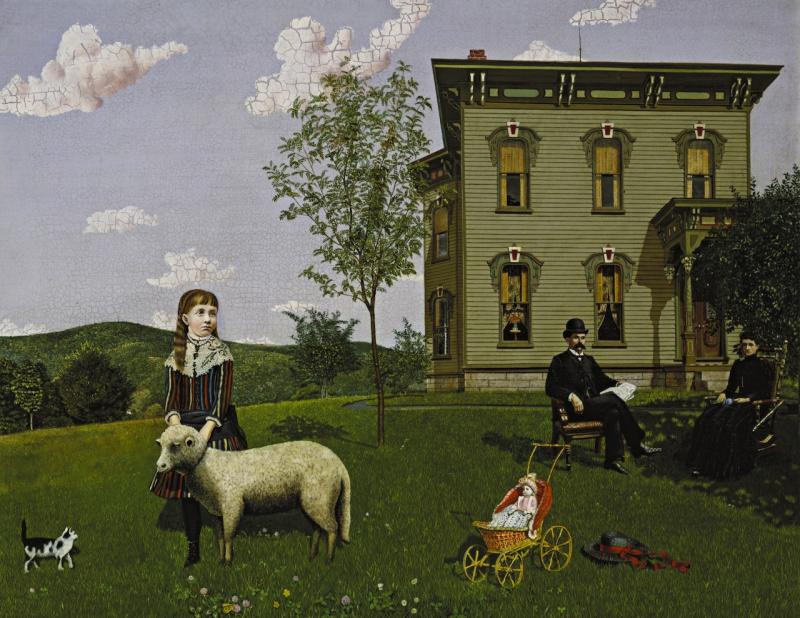
This strange painting by little-known American artist Edwin Ramanzo Elmer at first appears simply pleasant, then somewhat surreal. Only the visitors to Smith College where it’s displayed who stop and take the time to look hard perhaps realize they’re viewing a quintessential late Victorian-period grief scene.
The little girl gazing dreamily beyond the borders of the picture is the artist’s daughter Effie, who died of appendicitis when she was nine. Here she stands with her pet lamb and kitten, with the artist and his wife dressed for mourning tucked into the background; half in sun and half in shadow, the two seated figures appear rigid and diminished against the clapboard house Elmer built in Western Massachusetts. Everything looks pasted on, as if from a child’s set of cut-out paper dolls or a painting by Magritte.
Paintings such as this one may at first seem like a visual puzzle. In her poem Mourning Picture, the poet Adrienne Rich speaks for Effie, the couple’s only child, imagining herself in the dead girl’s place and giving the mute figure a voice.
Mourning Picture, Adrienne Rich (1965)
They have carried the mahogany chair and the cane rocker
out under the lilac bush,
and my father and mother darkly sit there, in black clothes.
Our clapboard house stands fast on its hill,
my doll lies in her wicker pram
gazing at western Massachusetts.
This was our world.
I could remake each shaft of grass
feeling its rasp on my fingers,
draw out the map of every lilac leaf
or the net of veins on my father’s
grief-traced hand.
Out of my head, half-bursting,
still filling, the dream condenses–
shadows, crystals, ceilings, meadows, globes of dew.
Under the dull green of the lilacs, out in the light
carving each spoke of the pram, the turned porch-pillars,
under high early-summer clouds,
I am Effie, visible and invisible,
remembering and remembered.
It’s thanks to Rich’s poem that we remember both Effie and probably as well her father, who’s only known to have painted two or three landscapes, a rather visually complex still life, and a skillful if quirky self-portrait.

One of only a handful of paintings by Edwin Romanzo Elmer known to exist, a man picking apples in a Buckland orchard (at Smith College), dated 1906.
Rich’s poem illustrates an approach to understanding art that works for any painting or sculpture. Rich channels the inner life of “Mourning Picture” (not titled by the artist by the way, and only added later) by imaginatively engaging with the painting and exploring how the details add up and relate.
With a poet’s sensitivity, Rich gazes so deeply into the work that she virtually becomes part of it, lending a voice to Effie’s inner life. Effie’s head is “half-bursting/still filling” because she is so young, but this voice is also the poet’s, whose head is full to bursting with emotion and ideas set in motion by the picture.
Effie is “visible and invisible” because she is present for us and for the people in the painting even though she was already absent from life when it was painted. Yet the poet too, not just Effie, is “remembering and remembered,” because art and writing are about bearing witness, giving voice to, and making visible.
In modeling such a vivid way of looking at a painting, the poet is two people at once, in two places in time, able to “remake each shaft of grass” of a visionary world in partnership with the painter.
It’s not a bad way to look at art (and the world itself for that matter) – with a sympathetic eye and a mind wide open to what we see.
If you’re looking to brush up on your landscape painting, check out the video resources here.
TURN IT ALL AROUND!
|

|